
Clinical Manifestations:
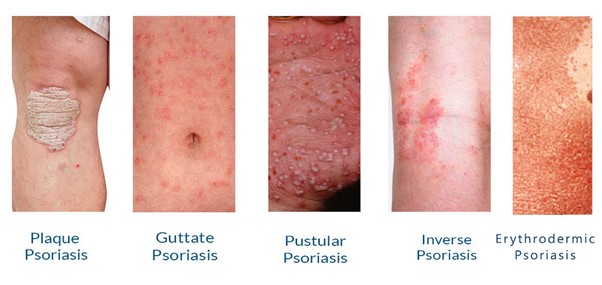
- Plaque Psoriasis: The most common type, characterized by well-defined, red, raised plaques covered with silvery scales.
- Guttate Psoriasis: Presents as small, drop-like lesions scattered over the body, often triggered by bacterial infections (e.g., streptococcal throat infection).
- Inverse Psoriasis: Affects skin folds, such as the armpits, groin, and under the breasts, and appears as smooth, red, and inflamed patches.
- Pustular Psoriasis: Presents with pustules filled with non-infectious pus, and may be localized or generalized.
- Erythrodermic Psoriasis: A severe and rare form, characterized by widespread redness and scaling of the skin, often leading to medical emergencies.
Nursing Test Bank
Test Bank #1: RN Pharmacology Exams
Test Bank #2: RN Medical-Surgical Exams
Test Bank #3: RN Fundamentals Exams
Test Bank #4: RN Maternal-Newborn Exams
Test Bank #5: RN Anatomy and Physiology Exams
Test Bank #6: RN Obstetrics and Pediatrics Exams
Test Bank #7: RN Fluid and Electrolytes Exams
Test Bank #9: RN Adult Health
Test Bank #10: RN Dosage Calculation
Test Bank #11: RN Community Health Exams
Test Bank #12: RN Psychology Exams
Test Bank #13: RN Nursing Care Of Children
Test Bank #14: RN Foundations of Nursing Exams
Naxlex Comprehensive Predictor Exams
Exam #1: RN Comprehensive predictor 2023 proctored exam
Exam #2: Ati rn vati comprehensive predictor proctored exam
Exam #3: Ati Rn Comprehensive Predictor Proctored Exam 2023
Exam #4: Rn Comprehensive Predictor 2023 Proctored Exam - St. Joseph
Exam #5: RN Comprehensive Predictor Proctored Exam (National U CA San Diego)
Exam #6: Ati rn comprehensive predictor 2023 retake proctored exam
Exam #7: RN Hesi Exit Proctored Exam
Exam #8: Hesi RN Exit proctored exam
Exam #9: Hesi rn exit proctored exam
Exam #10: Hesi Rn compass exit B proctored exam
Questions on Clinical Manifestations:
Correct Answer is C
Explanation
Psoriasis is not a type of skin cancer. It is a benign skin condition that does not involve the malignant transformation of melanocytes.
Correct Answer is C
Explanation
Translucent, fluid-filled blisters: Translucent, fluid-filled blisters are not typically associated with psoriasis. This description is more consistent with a condition called pemphigus, not psoriasis.
Correct Answer is C
Explanation
Protective factors against developing psoriasis: Environmental factors are not protective against developing psoriasis. As an autoimmune condition, psoriasis is primarily influenced by genetic predisposition and immune system dysfunction, not by protective environmental factors.
Correct Answer is B
Explanation
Thickened, hardened skin with deep cracks: This description is more typical of a condition called lichenified eczema or chronic contact dermatitis, not psoriasis.
Correct Answer is C
Explanation
Immune system functions independently of psoriasis development: This statement is incorrect. The immune system plays a central role in psoriasis etiology. The abnormal immune response is the driving force behind the development and progression of psoriasis.
Correct Answer is D
Explanation
<p>Moisturizing the skin is essential for managing psoriasis and preventing dryness and scaling. Regular use of moisturizers helps maintain skin hydration and reduce the discomfort associated with psoriasis.</p>
Correct Answer is A
Explanation
Sun exposure can affect psoriasis, but it is not the primary factor contributing to its development. In some cases, moderate sunlight exposure may even improve psoriasis symptoms.
Correct Answer is D
Explanation
Chronic psoriasis is characterized by thickened, scaly plaques with silvery-white scales. These plaques result from the excessive growth and turnover of skin cells in psoriasis.
Correct Answer is D
Explanation
Adherence to prescribed treatment plans and attending follow-up appointments with healthcare providers are crucial for effectively managing psoriasis and preventing complications.
Correct Answer is C
Explanation
Pustular psoriasis: Pustular psoriasis is a specific subtype characterized by pustules on the skin, but it is less common than plaque psoriasis.
Correct Answer is B
Explanation
<p>Purple or red lumps under the skin are more suggestive of other conditions, such as nodules or hematomas, rather than psoriasis.</p>
Correct Answer is D
Explanation
Auspitz sign is a characteristic finding in psoriasis where pinpoint bleeding occurs when scales on the skin are removed. It is caused by the rapid growth and shedding of skin cells, which leads to the formation of delicate blood vessels that bleed easily.
Correct Answer is B
Explanation
<p>Urinalysis is not used to diagnose psoriasis, as it does not provide relevant information about the skin condition.</p>
Correct Answer is A
Explanation
While warm baths can be soothing, frequent baths may actually dry out the skin and worsen psoriasis. Additionally, the water should be lukewarm rather than hot to avoid triggering flare-ups.
Correct Answer is C
Explanation
Genetic factors impair the skin's barrier function: Psoriasis is not caused by a skin barrier dysfunction. The condition is characterized by immune system dysregulation and the subsequent inflammation and rapid skin cell turnover.
Correct Answer is C
Explanation
"Expose your skin to direct sunlight for prolonged periods to improve symptoms." - While some sunlight exposure may benefit psoriasis, prolonged and direct exposure can lead to skin damage and increase the risk of skin cancer. Sun exposure should be limited and done with caution.
Correct Answer is A
Explanation
"Frequent application of alcohol-based hand sanitizers." - Alcohol-based hand sanitizers can dry out the skin and may irritate psoriasis lesions. It is better to use gentle, non-irritating handwashing techniques.More questions
Correct Answer is D
Explanation
A skin biopsy is commonly performed to confirm the diagnosis of psoriasis. It involves taking a small sample of skin tissue from a psoriatic plaque and examining it under a microscope to identify the characteristic histological changes, such as hyperkeratosis, parakeratosis, and elongation of the rete ridges.
Correct Answer is A
Explanation
Eosinophils: Eosinophils are a type of white blood cell involved in immune responses against parasitic infections and allergic reactions. While they are important in certain immune processes, they are not the main players in psoriasis etiology.
Correct Answer is B
Explanation
A viral skin condition resulting in fluid-filled blisters - Psoriasis does not result in fluid-filled blisters; it presents as red, scaly patches instead.