
Clinical presentation and symptoms
- The clinical presentation of ascites varies depending on the volume of fluid accumulation, the rate of fluid accumulation, and the underlying cause.
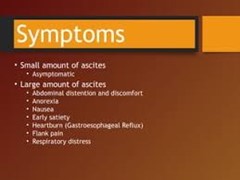
- The most common symptom of ascites is abdominal distension, which can cause discomfort, early satiety, indigestion, nausea, vomiting, dyspnea, orthopnea, reduced mobility, and impaired quality of life.
- Other symptoms may include:
- abdominal pain (due to stretching of the capsule or peritoneum)
- fever (due to infection)
- jaundice (due to liver dysfunction)
- lower extremity edema (due to hypoalbuminemia or right-sided heart failure)
- weight gain (due to fluid retention)
- encephalopathy (due to hepatic failure)
- The physical examination of ascites may reveal:
- increased abdominal girth
- shifting dullness (change in percussion note with change in position)
- fluid wave (transmission of a wave across the abdomen when one flank is tapped)
- flank dullness (dull percussion note over the dependent flank)
- umbilical or inguinal hernia (due to increased intra-abdominal pressure)
- caput medusae (dilated veins around the umbilicus due to portal-systemic shunting) spider angiomas or palmar erythema (due to hyperestrogenism or vasodilation)
- asterixis (flapping tremor of the hands due to encephalopathy)
- signs of underlying causes (e.g., hepatomegaly or splenomegaly)
Nursing Test Bank
Test Bank #1: RN Pharmacology Exams
Test Bank #2: RN Medical-Surgical Exams
Test Bank #3: RN Fundamentals Exams
Test Bank #4: RN Maternal-Newborn Exams
Test Bank #5: RN Anatomy and Physiology Exams
Test Bank #6: RN Obstetrics and Pediatrics Exams
Test Bank #7: RN Fluid and Electrolytes Exams
Test Bank #9: RN Adult Health
Test Bank #10: RN Dosage Calculation
Test Bank #11: RN Community Health Exams
Test Bank #12: RN Psychology Exams
Test Bank #13: RN Nursing Care Of Children
Test Bank #14: RN Foundations of Nursing Exams
Naxlex Comprehensive Predictor Exams
Exam #1: RN Comprehensive predictor 2023 proctored exam
Exam #2: Ati rn vati comprehensive predictor proctored exam
Exam #3: Ati Rn Comprehensive Predictor Proctored Exam 2023
Exam #4: Rn Comprehensive Predictor 2023 Proctored Exam - St. Joseph
Exam #5: RN Comprehensive Predictor Proctored Exam (National U CA San Diego)
Exam #6: Ati rn comprehensive predictor 2023 retake proctored exam
Exam #7: RN Hesi Exit Proctored Exam
Exam #8: Hesi RN Exit proctored exam
Exam #9: Hesi rn exit proctored exam
Exam #10: Hesi Rn compass exit B proctored exam
Questions on Clinical presentation and symptoms
Correct Answer is D
Explanation
This statement is correct. The kidneys' primary function related to fluid balance is filtration and excretion of waste products and excess fluid, which helps maintain proper fluid balance in the body. In chronic kidney disease (CKD), impaired kidney function can lead to fluid retention and contribute to the development of ascites.
Correct Answer is A
Explanation
Pulmonary function tests are used to assess lung function and are not directly related to determining the underlying cause of ascites.
Correct Answer is B
Explanation
A high-protein diet is not specifically indicated to promote reabsorption of fluid in the abdomen. It is essential for clients with cirrhosis and ascites to follow a balanced diet that meets their individual nutritional needs.
Correct Answer is B
Explanation
Deep breathing exercises are beneficial for promoting lung expansion, but they may not be the priority in a client experiencing severe respiratory distress.
Correct Answer is B
Explanation
Maintaining a supine position during the procedure is not required. The nurse should position the client comfortably, which may include elevating the head of the bed or placing the client in a side-lying position to facilitate fluid drainage.
QUESTION
Correct Answer is A
Explanation
Bone Density Scan (DEXA scan) is used to assess bone health and is not directly related to the evaluation of ascites in clients with cirrhosis.
Correct Answer is A
Explanation
Applying an abdominal binder may be beneficial in certain cases, but it will not directly address the underlying cause of ascites or reduce fluid accumulation in the abdomen.
Correct Answer is D
Explanation
This statement is correct. Respiratory distress and cyanosis are concerning findings in a client with ascites, as they may indicate severe pulmonary edema or other respiratory complications that require immediate intervention and medical attention.
Correct Answer is B
Explanation
Hypothermia and shivering are not typical complications of therapeutic paracentesis. The procedure is performed under controlled conditions to minimize the risk of temperature-related complications.
Correct Answer is C
Explanation
Inflammation of the pancreas (pancreatitis) is not directly related to the abdominal pain and discomfort experienced by the client with ascites.
Correct Answer is C
Explanation
Heart failure can result in fluid overload, but it is not directly related to the development of ascites in individuals with alcohol abuse.
Correct Answer is D
Explanation
This statement is correct. Spironolactone is a potassium-sparing diuretic, which means it can lead to hyperkalemia (elevated potassium levels) if not monitored carefully. Hyperkalemia can cause irregular heart rhythms and other serious complications.
Correct Answer is C
Explanation
Increasing carbohydrate consumption for sustained energy is not directly related to reducing fluid accumulation in the abdominal cavity for clients with ascites.
Correct Answer is C
Explanation
A complete blood count (CBC) is a blood test that evaluates the number and types of blood cells. While it may be useful for other diagnostic purposes, it is not used to visualize ascites.
Correct Answer is C
Explanation
Reduced ankle edema and lower extremity swelling are not early signs of ascites progression. Ascites primarily affects the abdominal cavity, not the extremities.