
Complications of dialysis
- Dialysis is a life-saving treatment for patients with end-stage renal disease, but it also carries some risks and potential complications.
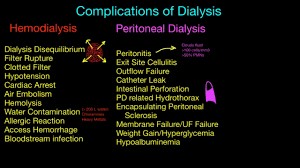
- Some of the common complications of dialysis are:
- Hypotension: This is a drop in blood pressure that can occur during or after dialysis, especially if too much fluid is removed or the patient has a low blood volume. Symptoms include dizziness, nausea, vomiting, cramps, headache, chest pain, and shortness of breath.
- To prevent or treat hypotension, the nurse should monitor the patient's vital signs, adjust the fluid removal rate, administer saline or hypertonic solutions, elevate the patient's legs, and stop or slow down the dialysis if needed.
- Muscle cramps: These are painful spasms of the muscles that can occur during or after dialysis, usually in the legs or feet. The exact cause is not clear, but it may be related to fluid shifts, electrolyte imbalances, or nerve irritation.
- To prevent or treat muscle cramps, the nurse should ensure adequate hydration, avoid excessive fluid removal, correct electrolyte abnormalities, massage the affected muscles, apply heat or cold packs, and administer antispasmodic medications if prescribed.
- Infection: This is a serious complication that can affect the access site (fistula, graft, or catheter), the bloodstream, or other organs. Infection can be caused by bacteria, fungi, or viruses that enter through the access site or during dialysis. Symptoms include fever, chills, redness, swelling, pain, pus, drainage, or foul odor at the access site, and signs of sepsis or organ dysfunction.
- To prevent or treat infection, the nurse should follow strict aseptic technique when handling the access site and dialysis equipment, inspect and clean the access site regularly, change dressings as needed, administer antibiotics or antifungal medications if prescribed, and monitor for signs of infection and report them promptly.
- Anaemia: This is a low level of red blood cells (RBCs) or haemoglobin in the blood that can result from chronic kidney disease or dialysis. Anaemia can cause fatigue, weakness, pallor, shortness of breath, chest pain, and increased risk of cardiovascular complications.
- To prevent or treat anaemia, the nurse should monitor the patient's haematocrit and haemoglobin levels regularly
- administer erythropoietin-stimulating agents (ESAs) or iron supplements if prescribed
- educate the patient on dietary sources of iron and folate.
- Bone and mineral disorders: These are abnormalities in calcium, phosphorus, parathyroid hormone (PTH), and vitamin D metabolism that can occur in patients with chronic kidney disease or dialysis. These disorders can cause bone loss, fractures, joint pain, itching, calcification of soft tissues and blood vessels (vascular calcification), and increased risk of cardiovascular complications.
- To prevent or treat bone and mineral disorders, the nurse should monitor the patient's serum calcium, phosphorus, PTH, and vitamin D levels regularly. They should also administer phosphate binders, calcium supplements, vitamin D analogues, or calcimimetics if prescribed.
- They should educate the patient on dietary restrictions of phosphorus and calcium.
- Hypotension: This is a drop in blood pressure that can occur during or after dialysis, especially if too much fluid is removed or the patient has a low blood volume. Symptoms include dizziness, nausea, vomiting, cramps, headache, chest pain, and shortness of breath.
Nursing Test Bank
Test Bank #1: RN Pharmacology Exams
Test Bank #2: RN Medical-Surgical Exams
Test Bank #3: RN Fundamentals Exams
Test Bank #4: RN Maternal-Newborn Exams
Test Bank #5: RN Anatomy and Physiology Exams
Test Bank #6: RN Obstetrics and Pediatrics Exams
Test Bank #7: RN Fluid and Electrolytes Exams
Test Bank #9: RN Adult Health
Test Bank #10: RN Dosage Calculation
Test Bank #11: RN Community Health Exams
Test Bank #12: RN Psychology Exams
Test Bank #13: RN Nursing Care Of Children
Test Bank #14: RN Foundations of Nursing Exams
Naxlex Comprehensive Predictor Exams
Exam #1: RN Comprehensive predictor 2023 proctored exam
Exam #2: Ati rn vati comprehensive predictor proctored exam
Exam #3: Ati Rn Comprehensive Predictor Proctored Exam 2023
Exam #4: Rn Comprehensive Predictor 2023 Proctored Exam - St. Joseph
Exam #5: RN Comprehensive Predictor Proctored Exam (National U CA San Diego)
Exam #6: Ati rn comprehensive predictor 2023 retake proctored exam
Exam #7: RN Hesi Exit Proctored Exam
Exam #8: Hesi RN Exit proctored exam
Exam #9: Hesi rn exit proctored exam
Exam #10: Hesi Rn compass exit B proctored exam
Questions on Complications of dialysis
Correct Answer is D
Explanation
Hypervolemia (severe fluid overload) is a critical indication for initiating dialysis in clients with end-stage renal disease. Dialysis helps remove excess fluid from the body and can relieve symptoms such as pulmonary edema and hypertension.
Correct Answer is C
Explanation
This statement is incorrect. Peritoneal dialysis does not require a catheter to be inserted into the bladder. Instead, it uses a catheter to infuse and drain dialysate into and out of the peritoneal cavity.
Correct Answer is C
Explanation
This statement is incorrect. Notifying the healthcare provider about the symptoms is important, but the nurse should first assess the catheter for possible issues to determine if immediate intervention is needed.
Correct Answer is C
Explanation
This statement is incorrect. Hypokalemia (low potassium levels) is not an indication for initiating dialysis. In fact, dialysis may lead to a reduction in potassium levels, and clients on dialysis are more likely to experience hyperkalemia.
Correct Answer is B
Explanation
Incorrect. While daily dressing changes are important, using sterile technique for catheter dressing changes may not be necessary, as the dressing does not directly contact the peritoneal cavity during CAPD exchanges.
Correct Answer is D
Explanation
This statement is accurate. Cloudy drainage from the catheter site may indicate peritonitis, which is an infection of the peritoneal cavity. Obtaining a sample of the drainage for culture and sensitivity testing can help identify the presence of infection and guide appropriate treatment.
Correct Answer is A
Explanation
Incorrect. If an AV fistula starts bleeding, the client should not apply pressure to the site. Instead, they should immediately elevate the arm and apply pressure to the bleeding site with a clean cloth or bandage while seeking medical attention.QUESTIONS
Correct Answer is C
Explanation
Correct. Notifying the healthcare provider about any redness or drainage at the catheter site is essential, as these can be signs of infection or other complications that require prompt evaluation and treatment.
Correct Answer is B
Explanation
Incorrect. Placing the client in a semi-Fowler's position may be appropriate for respiratory distress, but the nurse should first assess the client's vital signs and overall condition before implementing positioning changes.
Correct Answer is C
Explanation
Incorrect. Clients on dialysis typically need to restrict their phosphorus intake to prevent complications related to high phosphorus levels, such as bone disease and cardiovascular issues.
Correct Answer is D
Explanation
Severe metabolic acidosis, which results from the kidneys' inability to adequately excrete acids and regulate pH balance, is a critical indication for initiating dialysis in clients with CKD.
Correct Answer is A
Explanation
Incorrect. Administering prescribed intravenous medications may be necessary during dialysis, but it is not the priority action stated in this question.
Correct Answer is C
Explanation
This statement is incorrect. Cleaning the catheter site with hydrogen peroxide is not recommended, as it can be too harsh and irritating to the skin. Instead, the site should be cleaned with mild soap and water or as instructed by the healthcare provider.
Correct Answer is B
Explanation
This statement is incorrect. Monitoring blood urea nitrogen (BUN) levels is crucial for clients with ESRD, but it is not directly related to the administration of heparin during hemodialysis.QUESTIONS
Correct Answer is B
Explanation
None
Correct Answer is B
Explanation
This statement is incorrect. Encouraging the client to consume dairy products is not directly related to managing constipation. While calcium intake may be important for bone health in clients with ESRD, it is not a primary intervention for constipation.QUESTIONS
Correct Answer is B
Explanation
Incorrect. Administering intravenous hypertonic saline during dialysis is not a routine intervention to prevent hypotension. It may be used in specific cases, but fluid management is the primary approach.
Correct Answer is B
Explanation
Incorrect. Checking the client's pre-dialysis weight is not the priority when the client is experiencing severe neurological symptoms. Immediate assessment and intervention are needed.
Correct Answer is B
Explanation
This statement is incorrect. Administering an anticoagulant medication is not indicated for muscle cramps during hemodialysis. Anticoagulants are used to prevent blood clots during the procedure but would not alleviate muscle cramps.
Correct Answer is A
Explanation
This statement is incorrect. Elevating the client's legs may help improve blood flow, but it does not address the underlying cause of the reported symptoms. The nurse should first check the client's blood pressure and pulse rate to assess for hypotension before implementing further interventions.
Correct Answer is C
Explanation
This statement is incorrect. Hyponatremia (low sodium levels) is not the primary indication for initiating dialysis in this scenario. Uremia and the accumulation of waste products are the primary concerns that require dialysis to address.QUESTIONS
Correct Answer is B
Explanation
No explanation
Correct Answer is C
Explanation
Incorrect. Applying a heating pad to the affected muscles is not recommended during dialysis, as it may cause burns or worsen the cramps.