
Pathophysiology
Diabetes insipidus occurs due to disruptions in the synthesis, release, or action of ADH, which plays a crucial role in regulating water reabsorption in the kidneys.
This disruption leads to reduced water reabsorption, resulting in excessive urine production and subsequent dehydration.
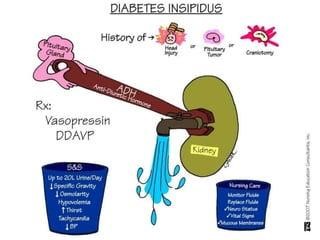
Nursing Test Bank
Test Bank #1: RN Pharmacology Exams
Test Bank #2: RN Medical-Surgical Exams
Test Bank #3: RN Fundamentals Exams
Test Bank #4: RN Maternal-Newborn Exams
Test Bank #5: RN Anatomy and Physiology Exams
Test Bank #6: RN Obstetrics and Pediatrics Exams
Test Bank #7: RN Fluid and Electrolytes Exams
Test Bank #9: RN Adult Health
Test Bank #10: RN Dosage Calculation
Test Bank #11: RN Community Health Exams
Test Bank #12: RN Psychology Exams
Test Bank #13: RN Nursing Care Of Children
Test Bank #14: RN Foundations of Nursing Exams
Naxlex Comprehensive Predictor Exams
Exam #1: RN Comprehensive predictor 2023 proctored exam
Exam #2: Ati rn vati comprehensive predictor proctored exam
Exam #3: Ati Rn Comprehensive Predictor Proctored Exam 2023
Exam #4: Rn Comprehensive Predictor 2023 Proctored Exam - St. Joseph
Exam #5: RN Comprehensive Predictor Proctored Exam (National U CA San Diego)
Exam #6: Ati rn comprehensive predictor 2023 retake proctored exam
Exam #7: RN Hesi Exit Proctored Exam
Exam #8: Hesi RN Exit proctored exam
Exam #9: Hesi rn exit proctored exam
Exam #10: Hesi Rn compass exit B proctored exam
Questions on Pathophysiology
Correct Answer is B
Explanation
<p>This choice is incorrect. High urine glucose levels are indicative of diabetes mellitus, not diabetes insipidus.</p>
Correct Answer is A
Explanation
<p>This choice is incorrect. A serum creatinine test assesses kidney function but is not specific to diabetes insipidus diagnosis.</p>
Correct Answer is B
Explanation
<p>This choice is incorrect. The desmopressin stimulation test involves administering synthetic ADH to differentiate between central and nephrogenic diabetes insipidus.</p>
Correct Answer is D
Explanation
<p>Clients with diabetes insipidus should maintain a balanced and adequate diet to ensure proper nutrition and hydration. While fluid intake may need to be monitored, severe fluid restriction is not typically necessary.</p>
Correct Answer is B
Explanation
<p>This choice is incorrect. Elevated blood glucose levels are characteristic of diabetes mellitus, not diabetes insipidus.</p>
Correct Answer is D
Explanation
<p>Excessive fluid intake to compensate for fluid loss in diabetes insipidus (DI) can lead to weight loss as the body attempts to excrete excess water.</p>
Correct Answer is D
Explanation
<p>The desmopressin stimulation test measures the response of the kidneys to synthetic ADH (desmopressin) and is used to differentiate between central and nephrogenic diabetes insipidus.</p>
Correct Answer is B
Explanation
<p>This choice is incorrect. Gestational diabetes insipidus is a rare condition that occurs during pregnancy and is not commonly acquired due to kidney disease or medications.</p>
Correct Answer is B
Explanation
<p>This choice is incorrect. Hypouricemia refers to low levels of uric acid and is not directly related to diabetes insipidus.</p>
Correct Answer is D
Explanation
<p>The water deprivation test is commonly used to diagnose diabetes insipidus and differentiate between central and nephrogenic DI. During this test, the client is deprived of fluids while their urine output and concentration are monitored.</p>
Correct Answer is B
Explanation
<p>This choice is incorrect. Hypoglycemia is not a typical symptom of diabetes insipidus.</p>
Correct Answer is C
Explanation
<p>This choice is incorrect. Antidiabetic medications are used to manage diabetes mellitus, not diabetes insipidus.</p>
Correct Answer is B
Explanation
<p>This choice is incorrect. While fluid retention is a potential effect of desmopressin therapy, it is not typically associated with adverse outcomes.</p>
Correct Answer is B
Explanation
<p>This choice is incorrect. Hypoglycemia is not a typical consequence of diabetes insipidus.</p>
Correct Answer is B
Explanation
<p>This choice is incorrect. Type 1 diabetes insipidus is not a recognized classification of diabetes insipidus.</p>