
Respiratory Hygiene/Cough Etiquette:
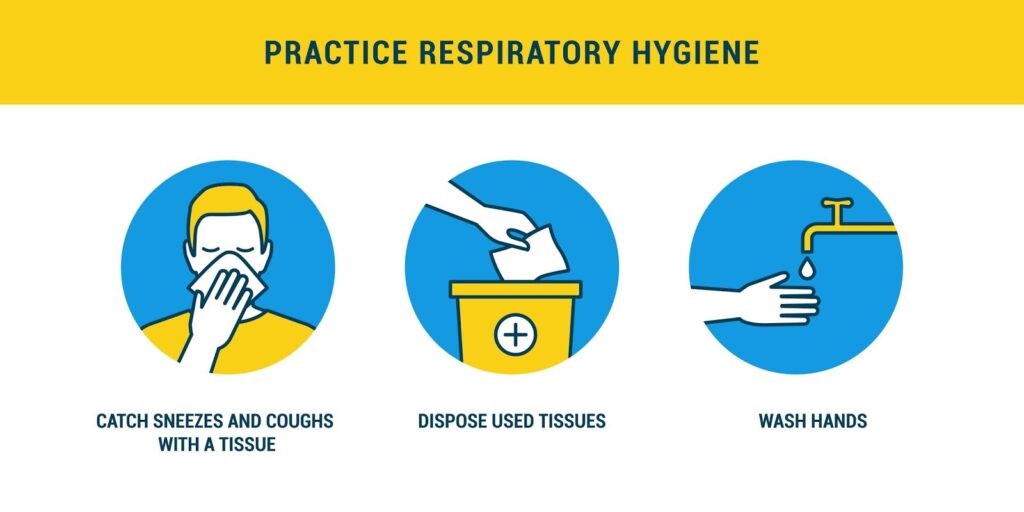
- Respiratory hygiene and cough etiquette aim to prevent the transmission of respiratory infections.
- Patients and visitors with respiratory symptoms should be provided with tissues and instructed to cover their mouth and nose when coughing or sneezing.
- They should be encouraged to perform hand hygiene after coughing, sneezing, or using tissues.
Nursing Test Bank
Test Bank #1: RN Pharmacology Exams
Test Bank #2: RN Medical-Surgical Exams
Test Bank #3: RN Fundamentals Exams
Test Bank #4: RN Maternal-Newborn Exams
Test Bank #5: RN Anatomy and Physiology Exams
Test Bank #6: RN Obstetrics and Pediatrics Exams
Test Bank #7: RN Fluid and Electrolytes Exams
Test Bank #9: RN Adult Health
Test Bank #10: RN Dosage Calculation
Test Bank #11: RN Community Health Exams
Test Bank #12: RN Psychology Exams
Test Bank #13: RN Nursing Care Of Children
Test Bank #14: RN Foundations of Nursing Exams
Naxlex Comprehensive Predictor Exams
Exam #1: RN Comprehensive predictor 2023 proctored exam
Exam #2: Ati rn vati comprehensive predictor proctored exam
Exam #3: Ati Rn Comprehensive Predictor Proctored Exam 2023
Exam #4: Rn Comprehensive Predictor 2023 Proctored Exam - St. Joseph
Exam #5: RN Comprehensive Predictor Proctored Exam (National U CA San Diego)
Exam #6: Ati rn comprehensive predictor 2023 retake proctored exam
Exam #7: RN Hesi Exit Proctored Exam
Exam #8: Hesi RN Exit proctored exam
Exam #9: Hesi rn exit proctored exam
Exam #10: Hesi Rn compass exit B proctored exam
Questions on Respiratory Hygiene/Cough Etiquette:
Correct Answer is B
Explanation
<p>The recommended duration for hand hygiene before and after administering injections is typically 15 seconds. This allows sufficient time to effectively clean the hands and reduce the risk of infection transmission.</p>
Correct Answer is B
Explanation
<p>Standard precautions should always be followed, but additional precautions specific to the mode of transmission (in this case, droplet precautions) are required for effective infection control.</p>
Correct Answer is C
Explanation
Face shield and gloves are not the recommended combination of PPE for tuberculosis precautions.
Correct Answer is C
Explanation
Leaving used needles and syringes on the patient's bedside table is unsafe and can pose a risk to the patient and healthcare providers.
Correct Answer is C
Explanation
<p>Enforcing strict dress code policies is unrelated to the primary purpose of staff health programs.</p>
Correct Answer is A
Explanation
<p>Standard precautions should always be followed, but additional precautions specific to the mode of transmission (in this case, airborne precautions) are required for effective infection control.</p>
Correct Answer is B
Explanation
Fumigation of patient rooms is a more extreme measure typically used for specific situations, such as outbreaks, and is not part of routine cleaning.
Correct Answer is B
Explanation
<p>Tuberculosis requires airborne precautions due to the risk of transmission through airborne particles.</p>
Correct Answer is B
Explanation
<p>Gloves should be removed and hand hygiene performed before touching clean surfaces.</p>
Correct Answer is C
Explanation
Delaying vaccination until the contraindication resolves may not be appropriate, as some contraindications may be permanent.
Correct Answer is A
Explanation
No explanation
Correct Answer is A
Explanation
No explanation
Correct Answer is C
Explanation
Assigning blame for the occurrence of infections is not the primary purpose of analyzing surveillance data.
Correct Answer is C
Explanation
Attending team-building activities is beneficial for team dynamics but not directly related to staff health and immunization.
Correct Answer is A
Explanation
<p>Standard precautions should always be followed, but additional precautions specific to the mode of transmission (in this case, contact precautions) are necessary when dealing with infectious wounds.</p>
Correct Answer is B
Explanation
<p>Reducing healthcare costs associated with infections is a potential benefit of effective infection prevention and control, but it is not the primary purpose of isolation precautions.</p>
Correct Answer is B
Explanation
Using dedicated equipment for each patient is an example of transmission-based precautions, not standard precautions.
Correct Answer is A
Explanation
<p>Standard precautions should always be followed, but additional precautions specific to the mode of transmission (in this case, airborne precautions) are required for effective infection control.</p>
Correct Answer is C
Explanation
Air filtration systems are designed to control airborne contaminants but do not act as physical barriers themselves.
Correct Answer is C
Explanation
<p>Hand hygiene should be performed regardless of visible dirt or contamination, as microorganisms may be present even if not visible.</p>
Correct Answer is C
Explanation
<p><strong>Leave them on a clean surface for someone else to handle</strong>: This is highly inappropriate as it exposes others to potential infection and does not follow proper hygiene and infection control practices.</p>
Correct Answer is D
Explanation
Healthcare staff receiving immunizations helps prevent the transmission of infectious diseases to vulnerable patients and also protects themselves from contracting vaccine-preventable infections.
Correct Answer is A
Explanation
<p>Using a shared hand towel with other healthcare providers can promote the spread of microorganisms and is not recommended.</p>
Correct Answer is B
Explanation
<p>60 seconds are longer than necessary for using an alcohol-based hand rub and can lead to wastage of the product.</p>
Correct Answer is C
Explanation
<p>N95 respirators should be fit-tested to ensure a proper seal and provide adequate respiratory protection.</p>
Correct Answer is B
Explanation
<p>Wearing a gown when administering oral medication to a non-isolated patient is not typically required unless there is a risk of splashing or exposure to bodily fluids.</p>
Correct Answer is D
Explanation
Using single-use syringes and needles for each injection is an essential component of safe injection practices. It helps prevent the transmission of infectious agents between patients.
Correct Answer is A
Explanation
No explanation
Correct Answer is D
Explanation
Effective infection surveillance requires the collection and analysis of accurate and timely data to identify trends, patterns, and potential areas for improvement.