
naxlex image logo

Naxlex

  • Nursing School Content
  • TEAS Content
  • HESI Content
  • Register
  • Sign Up
How it Works
Naxlex
  • Medical Surgical
  • Communicable Diseases
  • Signs and symptoms
Try Naxlex NCLEX-RN (14-day Free-Trial)

Signs and symptoms


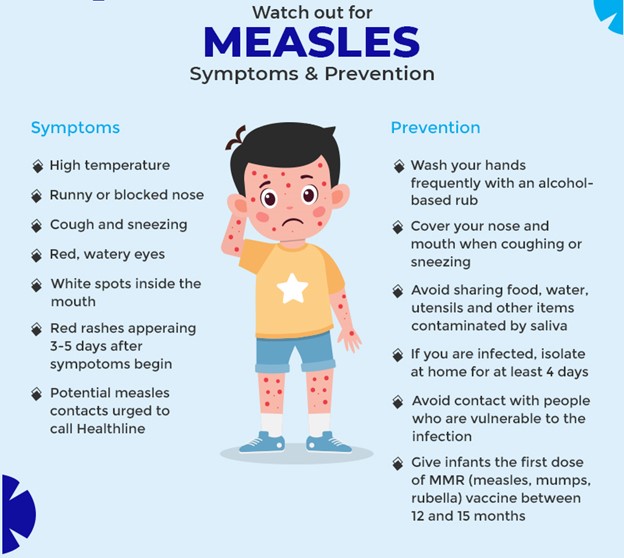
- Measles infection can be divided into four clinical stages: incubation, prodrome, exanthem, and recovery.

- The incubation period of measles is 6 to 21 days (median 13 days), during which the infected person is asymptomatic or may experience transient respiratory symptoms, fever, or rash.

- The prodrome stage of measles lasts 2 to 4 days and is characterized by high fever (>38.5°C), malaise, anorexia, cough, coryza, conjunctivitis, photophobia, and Koplik spots.

  • Koplik spots are small white lesions on the buccal mucosa surrounded by a red halo that appears 1 to 2 days before the rash. They are pathognomonic for measles.
  • Cough, coryza, conjunctivitis, and cephalocaudal spread are known as the “4 C’s” of measles

- The exanthem stage of measles lasts 4 to 7 days and is marked by the appearance of a maculopapular rash that begins on the face and spreads to the trunk and extremities. The rash usually fades in the same order as it appeared

  • The rash may be accompanied by itching, peeling, desquamation, or hyperpigmentation
  • The fever usually peaks on the first or second day of rash onset and then declines gradually

- The recovery stage of measles lasts 1 to 2 weeks and is characterized by the resolution of symptoms and the restoration of immunity

  • However, measles virus can persist in some tissues and organs for months or years after infection, causing chronic inflammation and immunosuppression

Nursing Test Bank

Test Bank #1: RN Pharmacology Exams Test Bank #2: RN Medical-Surgical Exams Test Bank #3: RN Fundamentals Exams Test Bank #4: RN Maternal-Newborn Exams Test Bank #5: RN Anatomy and Physiology Exams Test Bank #6: RN Obstetrics and Pediatrics Exams Test Bank #7: RN Fluid and Electrolytes Exams Test Bank #9: RN Adult Health Test Bank #10: RN Dosage Calculation Test Bank #11: RN Community Health Exams Test Bank #12: RN Psychology Exams Test Bank #13: RN Nursing Care Of Children Test Bank #14: RN Foundations of Nursing Exams

Naxlex Comprehensive Predictor Exams

Exam #1: RN Comprehensive predictor 2023 proctored exam Exam #2: Ati rn vati comprehensive predictor proctored exam Exam #3: Ati Rn Comprehensive Predictor Proctored Exam 2023 Exam #4: Rn Comprehensive Predictor 2023 Proctored Exam - St. Joseph Exam #5: RN Comprehensive Predictor Proctored Exam (National U CA San Diego) Exam #6: Ati rn comprehensive predictor 2023 retake proctored exam Exam #7: RN Hesi Exit Proctored Exam Exam #8: Hesi RN Exit proctored exam Exam #9: Hesi rn exit proctored exam Exam #10: Hesi Rn compass exit B proctored exam

Questions on Signs and symptoms

Correct Answer is A

Explanation

Elimination is not a characteristic clinical stage of measles infection. It does not describe any specific phase of the disease progression.

Correct Answer is ["C","D","E"]

Explanation

Providing oral care to the client with Koplik spots or oral ulcers is essential for maintaining oral hygiene and preventing secondary infections.

Correct Answer is C

Explanation

Nucleoprotein (N) and matrix protein (M) are not directly involved in viral entry and fusion. Nucleoprotein plays a role in protecting the viral RNA, and the matrix protein is involved in viral assembly and budding.

Correct Answer is D

Explanation

The client's statement about using topical anesthetics on their eyes to reduce discomfort requires immediate nursing intervention. Topical anesthetics should be avoided in cases of viral conjunctivitis, as they can delay healing and potentially worsen the condition. The nurse should intervene to educate the client about the potential harm of using topical anesthetics and ensure they follow the prescribed treatment plan for conjunctivitis.

Correct Answer is C

Explanation

Measles is not transmitted through exposure to contaminated food. The virus is not foodborne, and the main mode of transmission is person-to-person through respiratory droplets.

Correct Answer is C

Explanation

Recommending taking antibiotics prophylactically is not appropriate for measles prevention. Measles is a viral infection, and antibiotics are only effective against bacterial infections, not viral ones. Prophylactic use of antibiotics can lead to antibiotic resistance and is not indicated for preventing measles.

Correct Answer is D

Explanation

<p>Airborne precautions are required for diseases that are transmitted by smaller droplets, which remain in the air for long periods of time and can be spread over long distances when the infected person breathes, coughs, or sneezes. Measles is known to be highly contagious and can remain airborne for up to two hours in an airspace after the infected person leaves an area. Therefore, airborne precautions, which include the use of a high-efficiency particulate air (HEPA) filter and special respiratory protection, are necessary to prevent the spread of measles.</p> <p><img src="https://naxlex.com/nursing/assets/images/study_guides/image_1719013596.png" style="height:691px; width:1173px" /></p>

Correct Answer is C

Explanation

<p>Applying topical corticosteroid ointment to the spots is not appropriate for a client with measles and Koplik spots. Corticosteroids can suppress the immune response, which may interfere with the body&#39;s ability to fight off the measles virus.</p>

The parent's statement about SSPE (Subacute Sclerosing Panencephalitis) being a rare but fatal complication of measles that occurs years after infection and can be effectively treated with antiviral medications is incorrect. SSPE is indeed a rare but fatal complication of measles that occurs several

Measles-specific IgM antibodies test is the definitive diagnostic test for measles. It detects the presence of specific antibodies produced by the immune system in response to the measles virus.

This statement is incorrect. The fever subsides during the prodrome stage, but the client remains contagious during the early part of the exanthematous stage when the rash is present.

Hyperpigmentation of the skin is not a symptom typically associated with the prodrome stage of measles.

<p>Administering Vitamin A is the correct supplement for a child with measles. Vitamin A deficiency is associated with more severe cases of measles, and supplementation can help reduce the severity and complications of the disease.</p>

This statement is incorrect. The rash of measles is not limited to the face and trunk; it affects the entire body.

Hyperpigmentation of the skin is not a characteristic of the prodrome or any stage of measles. Hyperpigmentation refers to the darkening of the skin, which is not associated with measles infection.
Try Naxlex NCLEX-RN
(14 Day Free-Trial)

Search Here

More on Nursing

  • Medico-Surgical Procedures
  • Immunological System
  • Blood and Cardiovascular Disorders
  • Genito-Urinary System Disorders
  • Digestive System Disorders
  • Perioperative Nursing
  • Endocrine Systems
  • Introduction
  • Musculoskeletal System

Free Nursing Study Materials

Access to all study guides and practice questions for nursing for free.

  • Free Nursing Study Trials
  • Free Nursing Video tutorials
  • Free Nursing Practice Tests
  • Free Exam and Study Modes
  • Free Nursing Revision Quizlets
Join Us Today
naxlex-logo-footer

Designed to assess a student's preparedness for entering the health science fields.

Email Address: [email protected]

Phone No: +18175082244

Company

  • Contact us
  • How it Works
  • Blog

Resources

  • Privacy Policy
  • Terms of use
  • Help Center

© 2026 Naxlex.com