
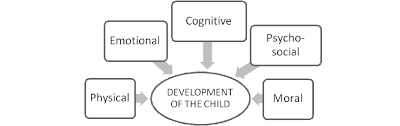
Stages of physical, cognitive, social and emotional development from infancy to adolescence
-
Physical development refers to the changes in height, weight, and appearance of the body. Cognitive development refers to the changes in thinking, memory, language, and problem-solving skills.
-
Social development refers to the changes in relationships, interactions, and communication with others.
-
Emotional development refers to the changes in feelings, self-esteem, and coping skills.
-
According to Gesell's theory of biophysical development, physical growth occurs in a cephalocaudal (head to toe) and proximodistal (center to periphery) manner.
-
According to Erikson's theory of psychosocial development, there are eight stages of psychosocial development from infancy to adulthood, each with a specific conflict that needs to be resolved.
-
According to Piaget's theory of cognitive development, there are four stages of cognitive development from birth to adolescence, each with a different way of thinking and learning. According to Kohlberg's theory of moral development, there are six stages of moral development from childhood to adulthood, each with a different level of reasoning and judgment.
-
According to Freud's theory of psychoanalytic development, there are five stages of psychosexual development from birth to adolescence, each with a different focus on sexual energy and pleasure.
-
Below is a summary of the the main characteristics of each stage of development according to these theories based on the:
-
Physical Development
-
Psychosocial Development
-
Cognitive Development
-
Moral Development
-
Psychosexual Development
-
-
Physical Development: Rapid growth in height and weight; development of reflexes and motor skills; sensory and perceptual abilities improve.
-
Psychosocial Development: Trust vs mistrust: infants need physical comfort and reliable care from caregivers to develop trust in themselves and others.
-
Cognitive Development: Sensorimotor stage: infants use their senses and motor actions to explore the world; they develop object permanence (understanding that objects still exist even when out of sight) and stranger anxiety (fear of unfamiliar people).
-
Moral Development: Preconventional level: infants have no moral sense; they act based on their needs and desires.
-
Psychosexual Development: Oral stage: infants derive pleasure from sucking, biting, and chewing; they may develop oral fixation (excessive dependence or aggression) if their oral needs are not met or overindulged.
-
Physical Development: Growth slows down; fine and gross motor skills improve; bladder and bowel control develops.
-
Psychosocial Development: Autonomy vs shame and doubt: toddlers need opportunities to make choices and learn self-care skills to develop autonomy and independence; they may develop shame and doubt if they are restricted or criticized.
-
Cognitive Development: Preoperational stage: toddlers use symbols (words, images, gestures) to represent objects and events; they are egocentric (unable to see other perspectives) and animistic (attributing life to inanimate objects).
-
Moral Development: Preconventional level: toddlers follow rules based on rewards and punishments; they are self-centered and obey authority out of fear.
-
Psychosexual Development: Anal stage: toddlers derive pleasure from controlling their bladder and bowel movements; they may develop anal fixation (excessive orderliness or messiness) if their toilet training is too harsh or lenient.
Birth-1 year
1-3 years
3-6 years
Physical Development: Growth is steady; physical abilities improve; brain development is rapid; handedness emerges.
Psychosocial Development: Initiative vs guilt: preschoolers need opportunities to initiate activities and express their creativity to develop initiative and confidence; they may develop guilt if they are discouraged or scolded.
Cognitive Development: Preoperational stage: preschoolers use intuitive thinking (based on appearances rather than logic); they have difficulty with conservation (understanding that physical properties remain the same despite changes in shape or arrangement) and reversibility (understanding that actions can be undone).
Moral Development: Preconventional level: preschoolers follow rules based on personal interest; they are pragmatic and judge actions by their consequences.
Psychosexual Development: Phallic stage: preschoolers derive pleasure from their genitals; they develop Oedipus complex (boys) or Electra complex (girls), which involve sexual attraction to the opposite-sex parent and rivalry with the same-sex parent; they resolve these conflicts by identifying with the same-sex parent.
6-12 years
Physical Development: Growth is slow but steady; puberty begins for some children; physical health and fitness are important.
Psychosocial Development: Industry vs inferiority: school-age children need opportunities to learn new skills and achieve goals to develop industry and competence; they may develop inferiority if they feel inadequate or unsuccessful.
Cognitive Development: Concrete operational stage: school-age children use logical thinking (based on rules and principles); they can perform operations (mental actions) on concrete objects (things that can be seen or touched); they can classify, seriate (arrange in order), and use transitivity (understand relationships between objects).
Moral Development: Conventional level: school-age children follow rules based on social norms and expectations; they are conformist and judge actions by their intentions.
Psychosexual Development: Latency stage: school-age children repress their sexual impulses and focus on social and intellectual activities; they develop friendships and hobbies; they may develop neurosis (emotional distress) if their previous conflicts are unresolved. |
12-18 years
Physical Development: Growth spurt occurs; sexual maturation occurs; secondary sex characteristics develop; body image and self-esteem are affected by physical changes.
Psychosocial Development: Identity vs role confusion: adolescents need opportunities to explore their identity and values to develop a sense of self; they may develop role confusion if they are uncertain or dissatisfied with themselves.
Cognitive Development: Formal operational stage: adolescents use abstract thinking (based on concepts and ideas); they can perform operations on hypothetical situations (things that are not real or observable); they can reason deductively (from general to specific) and inductively (from specific to general).
Moral Development: Postconventional level: adolescents follow rules based on universal ethical principles; they are autonomous and judge actions by their moral values.
Psychosexual Development: Genital stage: adolescents derive pleasure from sexual intercourse; they develop mature sexual relationships; they may develop fixation (unresolved issues) if their previous conflicts are unresolved.
Nursing Test Bank
Naxlex Comprehensive Predictor Exams
Questions on Stages of physical, cognitive, social and emotional development from infancy to adolescence