
Types and Components of Chest Tube Drainage Systems
- There are four main types of chest tube drainage systems:
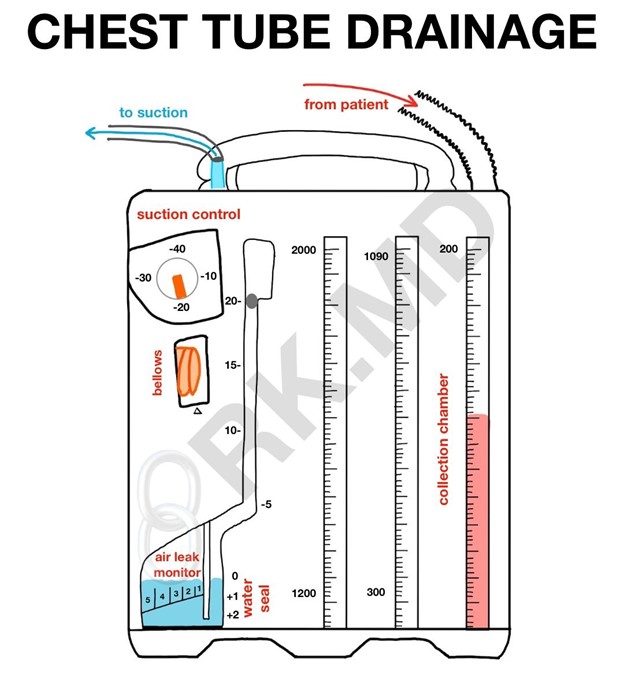
- Wet suction: a system that uses water to create suction and a water seal
- Dry suction: a system that uses a mechanical regulator to create suction and a water seal
- Dry-Wet suction: a system that uses a mechanical regulator to create suction and water to create a water seal
- Mediastinal: a system that drains air or fluid from the mediastinum without suction or water seal
- The common components of chest tube drainage systems are:
- Collection chamber: a chamber that collects the drainage from the chest tube and has a calibrated scale to measure the amount and rate of drainage
- Water-seal chamber: a chamber that contains water (usually 2 cm) and acts as a one-way valve to prevent air or fluid from returning to the chest cavity. It also allows for monitoring of intrapleural pressure changes by observing fluctuations (tidaling) or bubbling in the water column.
- Suction-control chamber: a chamber that regulates the amount of suction applied to the chest cavity by using either water (usually 20 cm) or a mechanical regulator. It also indicates the presence and level of suction by observing gentle bubbling in the water column or an orange bellows in the regulator.
- Tubing: a set of tubing that connects the chest tube to the drainage system and has clamps, stopcocks, or caps to control or occlude the flow of air or fluid. The tubing should be patent, secured, and free of kinks, loops, or dependent areas.
Nursing Test Bank
Test Bank #1: RN Pharmacology Exams
Test Bank #2: RN Medical-Surgical Exams
Test Bank #3: RN Fundamentals Exams
Test Bank #4: RN Maternal-Newborn Exams
Test Bank #5: RN Anatomy and Physiology Exams
Test Bank #6: RN Obstetrics and Pediatrics Exams
Test Bank #7: RN Fluid and Electrolytes Exams
Test Bank #9: RN Adult Health
Test Bank #10: RN Dosage Calculation
Test Bank #11: RN Community Health Exams
Test Bank #12: RN Psychology Exams
Test Bank #13: RN Nursing Care Of Children
Test Bank #14: RN Foundations of Nursing Exams
Naxlex Comprehensive Predictor Exams
Exam #1: RN Comprehensive predictor 2023 proctored exam
Exam #2: Ati rn vati comprehensive predictor proctored exam
Exam #3: Ati Rn Comprehensive Predictor Proctored Exam 2023
Exam #4: Rn Comprehensive Predictor 2023 Proctored Exam - St. Joseph
Exam #5: RN Comprehensive Predictor Proctored Exam (National U CA San Diego)
Exam #6: Ati rn comprehensive predictor 2023 retake proctored exam
Exam #7: RN Hesi Exit Proctored Exam
Exam #8: Hesi RN Exit proctored exam
Exam #9: Hesi rn exit proctored exam
Exam #10: Hesi Rn compass exit B proctored exam
Questions on Types and Components of Chest Tube Drainage Systems
Correct Answer is ["B","D"]
Explanation
Lean protein is a good choice for individuals with diabetes as it can help stabilize blood sugar levels and promote satiety without contributing to significant fluctuations in glucose.
Correct Answer is ["A","C","D"]
Explanation
<p>Applying an occlusive dressing with petroleum gauze seals the wound, preventing air entry into the pleural space and reducing risk of recurrent pneumothorax after chest tube removal.</p>
Correct Answer is A
Explanation
"My heart has been racing throughout the day”. is also not indicative of hypoglycemia. Rapid heart rate (tachycardia) can have multiple underlying causes, and it is not a primary symptom of low blood sugar.
Correct Answer is D
Explanation
Instructing the patient to take deep breaths during the insertion is not appropriate because chest tube insertion is a sterile procedure, and patients are usually not conscious during the process. The insertion site is anesthetized, and deep breaths could compromise sterile technique and increase the risk of infection.
Correct Answer is C
Explanation
Overproduction of glucagon by the pancreas is not the primary cause of elevated blood sugar levels and excessive thirst. Glucagon, a hormone produced by the pancreas, raises blood sugar levels when necessary, but it is not the main culprit in diabetes.
Correct Answer is A
Explanation
The nurse should inform the patient that the drainage color may change from serosanguineous (pale, pink, or slightly bloody) to bright red during the recovery process. Initially, the drainage may be bloody, but as healing progresses, it should become clearer. However, if the drainage suddenly becomes bright red, it could indicate active bleeding, and the healthcare provider should be notified immediately.
Correct Answer is ["C","E"]
Explanation
Keeping the tubing free of kinks, loops, or dependent areas is correct. Any kinks, loops, or dependent areas can obstruct the flow of fluids and air within the chest tube system, impairing its functionality.
Correct Answer is D
Explanation
While an intravenous infusion pump can be used for insulin administration in some situations, it is not the best choice for rapidly correcting hyperglycemia. Intravenous bolus injection provides a more immediate and precise response. Infusion pumps are more commonly used for continuous insulin infusions, such as in critical care settings.