
Types and Components of Tracheostomy Tubes
- Tracheostomy tubes come in various sizes and angles to fit different patients’ anatomy and needs. They are made of metal, plastic, or silicone. Some common types of tracheostomy tubes are:
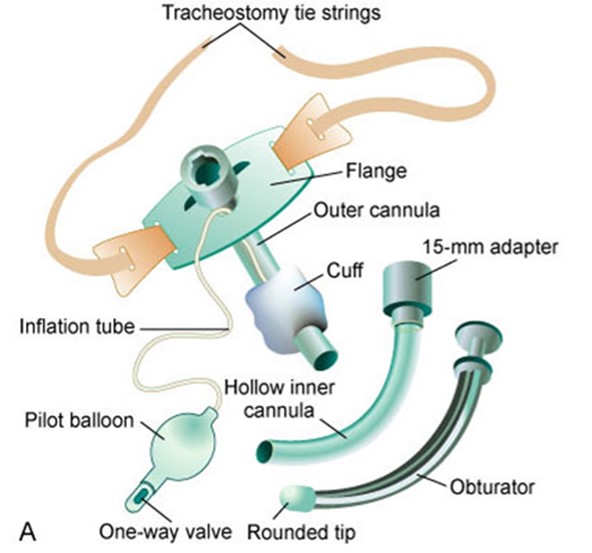
- Cuffed: A cuff is a balloon-like device that inflates around the tube to seal the trachea and prevent air leakage or aspiration. It is used for patients who need mechanical ventilation or have a high risk of aspiration. The cuff pressure should be monitored regularly and kept between 20 to 25 cm H2O to prevent tracheal damage.
- Uncuffed: An uncuffed tube has no cuff and allows air to flow around the tube. It is used for patients who can breathe spontaneously and have a low risk of aspiration. It also allows the patient to speak and cough more easily.
- Fenestrated: A fenestrated tube has one or more holes on the outer cannula that allow air to pass through the vocal cords when the inner cannula is removed. It is used for patients who are ready to wean from mechanical ventilation or need speech therapy. The fenestration should be covered by a cap or plug when suctioning or ventilating.
- Double-lumen: A double-lumen tube has two cannulas: an outer cannula that stays in place and an inner cannula that can be removed for cleaning or changing. The inner cannula provides a clear passage for air and secretions and reduces the risk of tube occlusion.
The components of a tracheostomy tube are:
- Flange: A flat plate that rests on the neck and holds the tube in place. It has holes for securing the tube with ties or straps.
- Obturator: A cone-shaped device that is inserted into the tube to guide its insertion and prevent injury to the tracheal wall. It is removed after the tube is in place.
- Pilot balloon: A small balloon that indicates the status of the cuff. It is connected to a valve that allows inflation or deflation of the cuff.
- Suction port: An opening on the tube that allows connection to a suction catheter for removing secretions.
Nursing Test Bank
Test Bank #1: RN Pharmacology Exams
Test Bank #2: RN Medical-Surgical Exams
Test Bank #3: RN Fundamentals Exams
Test Bank #4: RN Maternal-Newborn Exams
Test Bank #5: RN Anatomy and Physiology Exams
Test Bank #6: RN Obstetrics and Pediatrics Exams
Test Bank #7: RN Fluid and Electrolytes Exams
Test Bank #9: RN Adult Health
Test Bank #10: RN Dosage Calculation
Test Bank #11: RN Community Health Exams
Test Bank #12: RN Psychology Exams
Test Bank #13: RN Nursing Care Of Children
Test Bank #14: RN Foundations of Nursing Exams
Naxlex Comprehensive Predictor Exams
Exam #1: RN Comprehensive predictor 2023 proctored exam
Exam #2: Ati rn vati comprehensive predictor proctored exam
Exam #3: Ati Rn Comprehensive Predictor Proctored Exam 2023
Exam #4: Rn Comprehensive Predictor 2023 Proctored Exam - St. Joseph
Exam #5: RN Comprehensive Predictor Proctored Exam (National U CA San Diego)
Exam #6: Ati rn comprehensive predictor 2023 retake proctored exam
Exam #7: RN Hesi Exit Proctored Exam
Exam #8: Hesi RN Exit proctored exam
Exam #9: Hesi rn exit proctored exam
Exam #10: Hesi Rn compass exit B proctored exam
Questions on Types and Components of Tracheostomy Tubes
Correct Answer is C
Explanation
Using a larger tracheostomy tube may not be the most appropriate action in this situation. Enlarging the tube may not be necessary and could potentially cause other complications. It's better to ensure proper positioning and consider other interventions before resorting to a larger tube.
Correct Answer is B
Explanation
Waiting to perform tracheostomy care every 12 to 24 hours is too infrequent for most patients and may not be sufficient to maintain a patent airway and prevent complications.
Correct Answer is ["B","E"]
Explanation
<p>A sphygmomanometer is used to measure blood pressure and is unrelated to tracheostomy suctioning. It is not required for this procedure.</p>
Correct Answer is ["A","B","D"]
Explanation
Administering oxygen by mask may be necessary for oxygenation, but it is not specifically related to preventing tracheoesophageal fistula formation.
Correct Answer is C
Explanation
Plastic tracheostomy tubes are commonly used in clinical practice and may be suitable for a patient ready to wean from mechanical ventilation and requiring speech therapy. However, the fenestrated tube is a more specific choice for this scenario.
Correct Answer is B
Explanation
Waiting for at least 3 minutes between suctioning attempts is too long and not clinically appropriate. This extended time may lead to increased secretion buildup and potential airway obstruction, especially in patients with excessive secretions or those who are critically ill.
Correct Answer is C
Explanation
<p>Trendelenburg position (Choice D) is not appropriate for tracheostomy suctioning. Trendelenburg position is typically used for certain cardiovascular conditions and not for tracheostomy care.</p>
Correct Answer is B
Explanation
Ensuring proper positioning and alignment of the tracheostomy tube is important, but it is not the priority in this critical situation.
Correct Answer is C
Explanation
Recommending a fenestrated tracheostomy tube would not directly address the issue of dry and crusted secretions. Fenestrated tubes are more relevant for patients who need speech assistance, which is not the primary concern in this case.
Correct Answer is ["B","C","D","E"]
Explanation
<p>Withdrawing the catheter gently while applying suction prevents damage to the tracheal walls and minimizes the risk of bleeding.</p>
Correct Answer is D
Explanation
Metal tracheostomy tubes are not commonly used for long-term ventilation. They are mostly used in specific situations where a plastic tube may not be suitable, such as when there is a risk of tube distortion or damage. Plastic tubes are more commonly used for long-term ventilation due to their availability, flexibility, and ease of use.