
Types of IV Access
- There are two main types of IV access: peripheral and central.
Peripheral IV Access
- Peripheral IV access involves inserting a catheter into a vein in the hand or arm.
- Peripheral IV access is suitable for short-term therapy (less than a week) and low-risk fluids or medications.
- Peripheral IV access may also be used for specialized placement in the external jugular vein or the dorsal foot vein.
- Peripheral IV access requires a tourniquet to constrict the vein and make it more visible and palpable.
- Peripheral IV access uses angiocatheters that range from 14 to 24 gauge in size. The gauge refers to the diameter of the catheter; the larger the gauge, the smaller the diameter. The choice of gauge depends on the type and viscosity of the fluid or medication, the size and condition of the vein, and the duration of therapy.
- Peripheral IV access may cause complications such as infiltration, phlebitis, infection, hematoma, nerve damage, or extravasation.
Central IV Access
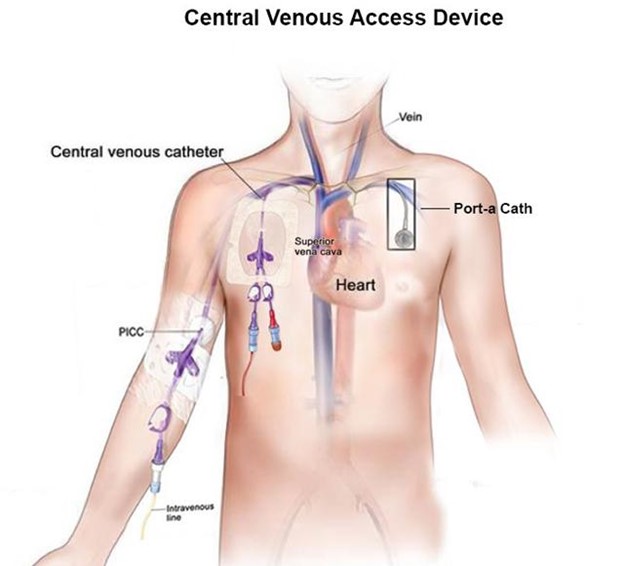
- Central IV access involves inserting a catheter into a large vein that leads directly to the heart.
- Central IV access is suitable for long-term therapy (more than a week) and high-risk fluids or medications that require rapid dilution or precise infusion rates.
- Central IV access may be achieved through percutaneous central lines, peripherally inserted central catheters (PICCs), tunneled catheters, or implanted ports.
- Central IV access does not require a tourniquet but may require ultrasound guidance or fluoroscopy to locate the vein and confirm placement.
- Central IV access uses catheters that range from 16 to 24 gauge in size. The choice of gauge depends on the type and volume of fluid or medication, the number of lumens (channels) needed, and the patient’s condition.
- Central IV access may cause complications such as pneumothorax, hemothorax, air embolism, infection, thrombosis, or catheter malposition.
Nursing Test Bank
Test Bank #1: RN Pharmacology Exams
Test Bank #2: RN Medical-Surgical Exams
Test Bank #3: RN Fundamentals Exams
Test Bank #4: RN Maternal-Newborn Exams
Test Bank #5: RN Anatomy and Physiology Exams
Test Bank #6: RN Obstetrics and Pediatrics Exams
Test Bank #7: RN Fluid and Electrolytes Exams
Test Bank #9: RN Adult Health
Test Bank #10: RN Dosage Calculation
Test Bank #11: RN Community Health Exams
Test Bank #12: RN Psychology Exams
Test Bank #13: RN Nursing Care Of Children
Test Bank #14: RN Foundations of Nursing Exams
Naxlex Comprehensive Predictor Exams
Exam #1: RN Comprehensive predictor 2023 proctored exam
Exam #2: Ati rn vati comprehensive predictor proctored exam
Exam #3: Ati Rn Comprehensive Predictor Proctored Exam 2023
Exam #4: Rn Comprehensive Predictor 2023 Proctored Exam - St. Joseph
Exam #5: RN Comprehensive Predictor Proctored Exam (National U CA San Diego)
Exam #6: Ati rn comprehensive predictor 2023 retake proctored exam
Exam #7: RN Hesi Exit Proctored Exam
Exam #8: Hesi RN Exit proctored exam
Exam #9: Hesi rn exit proctored exam
Exam #10: Hesi Rn compass exit B proctored exam
Questions on Types of IV Access