
A child has collected 50 pennies, 45 nickels, 25 dimes, and 5 quarters. Which of the following charts accurately organizes the number of coins?
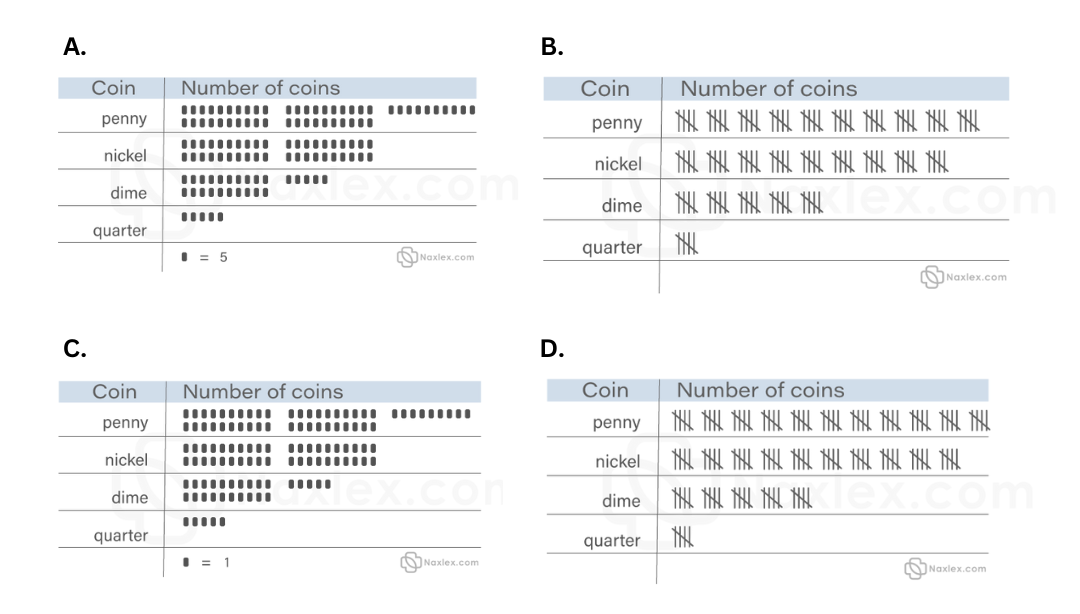
A
B
C
D
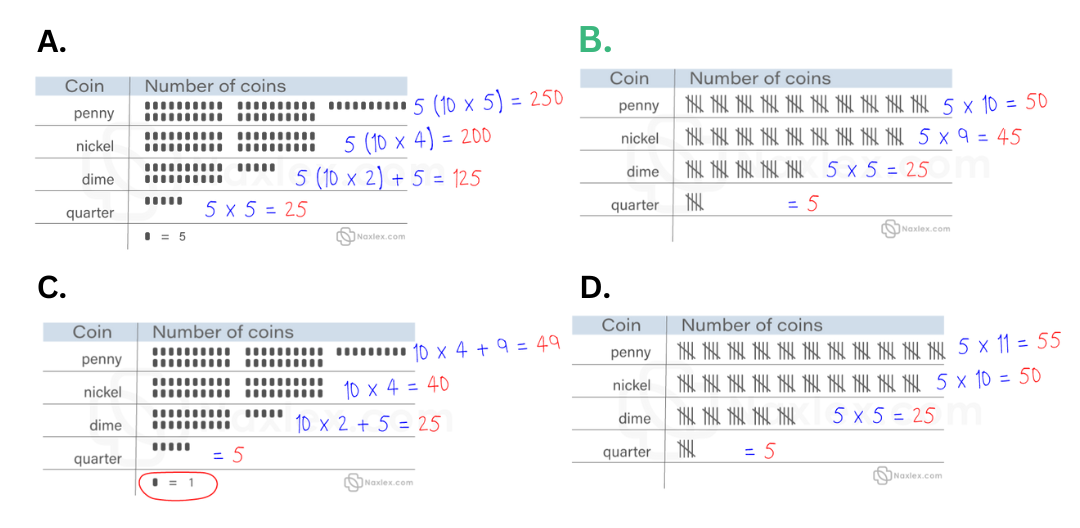
Correct Answer : B
In this scenario, we use the given scale in the charts to find the number of each coin and selected the right number of coins the student collected. The second options shows that the child collected 50 pennies, 45 nickels, 25 dimes, and 5 quarters.
TEAS 7 Exam Quiz Bank
HESI A2 Exam Quiz Bank
Find More Questions 📚
Teas 7 Questions: We got the latest updated TEAS 7 questions
100% Money Refund: 100% money back guarantee if you take our full
assessment pass with 80% and fail the actual exam.
Live Tutoring: Fully customized live tutoring lessons.
Guaranteed A Grade: All students who use our services pass with 90%
guarantee.
Related Questions
Correct Answer is D
Explanation
Correlation of two variables falls into:
Positive correlation: an increase in one variable causes another variable to increase
Negative correlation: an increase in one variable causes another one to decrease
No correlation: a change in one variable does not cause any response in another variable.
From the given choices
Option a is no correlation
Option b is a negative correlation
Option c is a negative correlation
Option d is a positive correlation
Correct Answer is B
Explanation
in the given problem, we use the calculator to find 1.3*0.47=0.611
Correct Answer is A
Explanation
Based on the above data, the horizontal axis will be tree type and vertical axis will represent the number of trees.
Based on these, a bar graph is appropriate to represent the number trees.
Correct Answer is A
Explanation
we are needed to find the portion of pizza shared by 3 three friends. We treat the whole pizza as 1. Now, 1 friend eats half of the whole pizza. Thus,
One friend=1/2 of 1=1/2*1=1/2
Remaining amount=1-1/2=2/2-1/2=1/2
Thus, ½ of pizza is left for three friends to share among themselves. Then, each friend will get
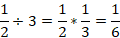
So, the other three friends will each get 1/6 of the pizza.
Correct Answer is D
Explanation
In order to solve for the value of x, we use the order of operations as follows:
The first step is to divide both sides by 4


Since 5 is subtracted, we add 5 to both sides to eliminate it from the left-hand side of the equation


Thus, the value of x is 7.
Correct Answer is B
Explanation
Since the distribution is symmetric, the mean, mode, and median will all be equal. The shape of the distribution will be bell-shaped.
Correct Answer is C
Explanation
to find the average time the athlete runs in 1 mile, find total time divided by total distance covered.
Total distance=4+4=8 miles
Total time=28+32 =60 minutes
From the above, the athlete runs 8 miles in 60 minutes, so the athlete will take how minutes to cover 1 mile.

So, the athlete covers 1 mile in 7.5 minutes.
Correct Answer is B
Explanation
we are asked to find the largest value from the options given. To solve this problem, we need to convert all the given values into fraction. Then find the least common denominator for all fractions, which we will use to multiply each fraction and make a comparison.
34÷96=
3/8=3/8
0.372=372/1000
37%=37/100
Now, we need to find the least common denominator of 48, 8, 1000, and 100, which is 6000. We multiply each fraction by 6000 as follows:
17/48*6000=2125
3/8*6000=2250
372/1000*6000=2232
37/100*6000=2220
From the above calculations, arranging the fraction from the largest to the smallest in order is: 3/8, 372/1000,37/100, and 17/48. Thus, the greatest value is 3/8.
Correct Answer is A
Explanation
We asked to convert kg to pounds. There are two ways of converting between kg and pounds

And

Since we are asked to find pounds, we use the second option for kg to cancel during conversion as follows:
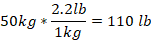
Thus, 50 kg is equal to 110 lb.
Correct Answer is A
Explanation
To find the least common denominator (LCD) of the fractions 1/2, 2/3, and 4/5, follow these steps:
Step 1: Identify the denominators
The denominators are 2, 3, and 5.
Step 2: Find the least common multiple (LCM)
The LCM of 2, 3, and 5 is the smallest number that all three denominators divide into evenly.
- Prime factorization:
- 2=2
- 3=3
- 5=5
Since 2, 3, and 5 are all prime numbers, their LCM is:
2×3×5=30
This question was extracted from the actual TEAS Exam. Ace your TEAS exam with the actual TEAS 7 questions, Start your journey with us today
Visit Naxlex, the Most Trusted TEAS TEST Platform With Guaranteed Pass of 90%.
Money back guarantee if you use our service and fail the actual exam. Option of personalised live tutor on your area of weakness.