
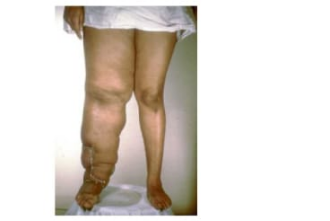
A 26-year-old woman who recently emigrated from Africa presents with swelling of her right leg (patient with elephantiasis shown). What is the name for fluid accumulation in the soft tissue of this patient's night leg?
Ascites
Effusion
Fibrinous exudate
Lymphedema
Purulent exudate
The Correct Answer is D
A. Ascites: Ascites refers to the accumulation of fluid in the peritoneal cavity, typically due to liver disease, heart failure, or malignancy. It does not describe localized swelling of the leg as seen in elephantiasis.
B. Effusion: Effusion is the collection of fluid within a body cavity, such as the pleural, pericardial, or joint spaces. While it involves fluid accumulation, it does not specifically apply to interstitial swelling of the extremities caused by lymphatic obstruction.
C. Fibrinous exudate: Fibrinous exudate contains fibrinogen and forms in severe inflammation, often coating serous surfaces. It is typically associated with pleuritis or pericarditis rather than chronic soft tissue swelling of the leg.
D. Lymphedema: Lymphedema is the accumulation of protein-rich fluid in the interstitial spaces due to impaired lymphatic drainage. In this patient, chronic lymphatic obstruction, often from filarial infection, leads to elephantiasis, causing massive swelling of the leg and thickened skin.
E. Purulent exudate: Purulent exudate is composed of neutrophils, dead cells, and infectious debris, seen in bacterial infections and abscess formation. Elephantiasis involves sterile lymphatic fluid accumulation rather than pus.
Nursing Test Bank
Naxlex Comprehensive Predictor Exams
Related Questions
Correct Answer is B
Explanation
A. Diffuse alveolar damage:Diffuse alveolar damage (DAD) presents with widespread interstitial involvement, alveolar edema, and hyaline membrane formation, typically causing diffuse infiltrates rather than discrete “coin lesions.” It does not manifest as multiple nodules on imaging.
B. Metastatic cancer:Multiple “coin lesions” on chest x-ray are characteristic of hematogenous spread of metastatic tumors to the lungs. CT-guided biopsy would likely reveal malignant cells consistent with secondary pulmonary involvement, making metastatic cancer the most probable diagnosis in a patient with multiple discrete nodules.
C. Nodular silicosis:Nodular silicosis presents with upper lobe nodules and may calcify, but it usually occurs in individuals with long-term occupational silica exposure and produces a more diffuse nodular pattern rather than well-circumscribed coin lesions.
D. Primary lung cancer:Primary lung cancer usually presents as a single mass or nodule rather than multiple discrete coin-shaped lesions. While it can metastasize, the primary presentation of multiple coin lesions is more consistent with secondary metastases.
E. Pulmonary abscess:Pulmonary abscesses are localized collections of pus that usually appear as cavitary lesions, often with air-fluid levels, rather than multiple well-circumscribed coin lesions. They are typically unilateral and associated with infection, fever, and purulent sputum.
Correct Answer is B
Explanation
A. Albumin:Albumin is the most abundant plasma protein and primarily maintains oncotic pressure and transports molecules. It is not a structural component of the fibrinous exudate seen in pericarditis.
B. Fibrin:Fibrin is a key plasma-derived protein formed from fibrinogen during the coagulation cascade. In fibrinous pericarditis, increased vascular permeability allows plasma proteins, particularly fibrinogen, to leak into the pericardial space, where it polymerizes into fibrin. This forms the characteristic “shaggy” or “bread-and-butter” appearance on the heart surface.
C. Fibronectin:Fibronectin is an extracellular matrix glycoprotein involved in tissue repair and cell adhesion. While it may play a minor role in wound healing, it is not the primary protein responsible for the gross fibrinous exudate in pericarditis.
D. Plasmin:Plasmin is a fibrinolytic enzyme that breaks down fibrin clots. It regulates clot dissolution but is not the structural protein forming the fibrinous exudate.
E. Thrombin:Thrombin is a protease that converts fibrinogen to fibrin during coagulation. While it initiates fibrin formation, the exudate itself is composed of fibrin polymers rather than thrombin.
Whether you are a student looking to ace your exams or a practicing nurse seeking to enhance your expertise , our nursing education contents will empower you with the confidence and competence to make a difference in the lives of patients and become a respected leader in the healthcare field.
Visit Naxlex, invest in your future and unlock endless possibilities with our unparalleled nursing education contents today