
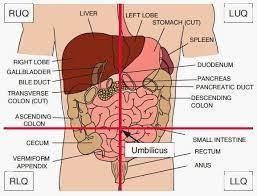
A client is admitted to the hospital with a diagnosis of R/O appendicitis. Which abbreviation would describe the location of a client's appendix?
RLQ
RUQ
LUQ
LLQ
The Correct Answer is A
Choice A rationale: RLQ (Right Lower Quadrant) is the correct abbreviation for the location of the appendix, which is typically found in the right lower quadrant of the abdomen.
Choice B rationale: RUQ (Right Upper Quadrant) is not the location of the appendix.
Choice C rationale: LUQ (Left Upper Quadrant) is not the location of the appendix.
Choice D rationale: LLQ (Left Lower Quadrant) is not the location of the appendix.
Nursing Test Bank
Naxlex Comprehensive Predictor Exams
Related Questions
Correct Answer is A
Explanation
Choice A rationale: Intravenous administration results in the most predictable onset and complete bioavailability to the client, as the medication goes directly into the bloodstream.
Choice B rationale: Oral administration is subject to factors such as absorption in the gastrointestinal tract, which can affect predictability and bioavailability.
Choice C rationale: Subcutaneous administration can be affected by factors like absorption rates and tissue characteristics, leading to variations in onset and bioavailability.
Choice D rationale: Transdermal administration has a slower onset and may be influenced by factors such as skin integrity and blood flow.
Correct Answer is ["A","D","E"]
Explanation
Choice A rationale: Compensating for an ongoing problem affecting other fluid or electrolytes is a common rationale for IV therapy.
Choice B rationale: Increasing urine specific gravity to 1.045 is not a typical goal for IV therapy. IV therapy would decrease the urine specific gravity by diluting the urine with fluids.
Choice C rationale: Moving fluid into an area that is physiologically unavailable is not a primary goal of IV therapy. Physiologically unavailable areas are those that are separated from the rest of the body by a membrane or barrier, such as the cerebrospinal fluid, the intraocular fluid, or the pleural fluid. IV therapy does not cross these barriers and only affects the intravascular and interstitial spaces.
Choice D rationale: Correcting imbalance in fluid and electrolytes is a primary goal of IV therapy.
Choice E rationale: Expanding intravascular volume is a common goal of IV therapy, especially in cases of dehydration or hypovolemia.
Whether you are a student looking to ace your exams or a practicing nurse seeking to enhance your expertise , our nursing education contents will empower you with the confidence and competence to make a difference in the lives of patients and become a respected leader in the healthcare field.
Visit Naxlex, invest in your future and unlock endless possibilities with our unparalleled nursing education contents today