
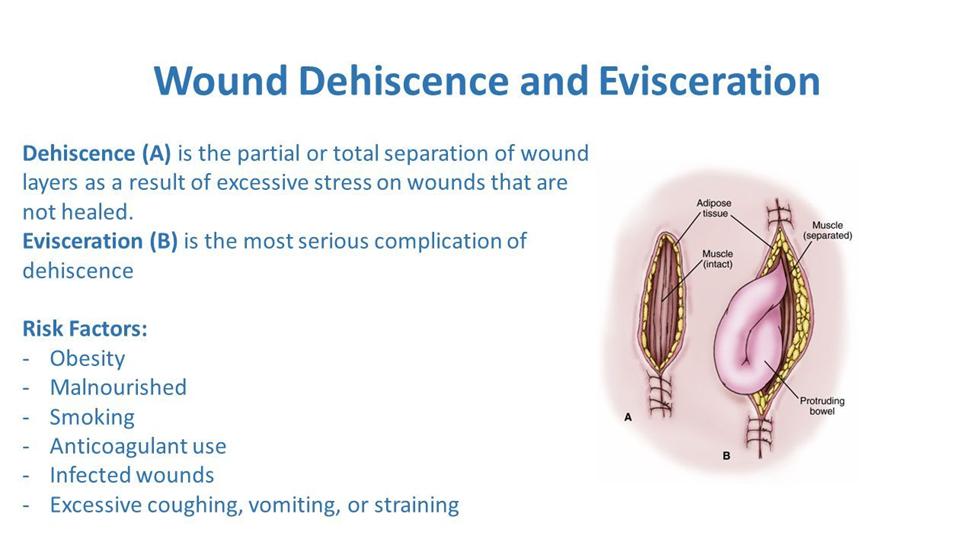
A client who had colon surgery 3 days ago is anxious and requesting assistance to reposition. While the nurse is turning the client, the wound dehiscences and eviscerates. The nurse moistens an available sterile dressing and places it over the wound. Which intervention should the nurse implement next?
Prepare the client to return to the operating room.
Obtain a sample of the drainage to send to the lab.
Bring additional sterile dressing supplies to the room.
Auscultate the abdomen for bowel sound activity.
The Correct Answer is A
A. Prepare the client to return to the operating room:
This is the correct and immediate priority. Evisceration, where internal organs protrude through the surgical incision, is a surgical emergency. Returning the client to the operating room is necessary to assess the extent of the complication, address the wound dehiscence, and protect the exposed organs. This intervention aims to prevent further complications and provide necessary surgical interventions.
B. Obtain a sample of the drainage to send to the lab:
While obtaining samples for laboratory analysis can be important for infection control, in the context of a client with evisceration, the primary concern is the surgical emergency. The priority is to address the wound complication by returning to the operating room rather than focusing on laboratory analysis at this immediate moment.
C. Bring additional sterile dressing supplies to the room:
While bringing additional supplies may be necessary, the priority in this situation is to prepare for the client's return to the operating room. Once the client is in a controlled surgical environment, additional dressing changes and wound care can be performed as needed.
D. Auscultate the abdomen for bowel sound activity:
While monitoring bowel sounds is a routine nursing assessment, in the context of evisceration, the immediate concern is the exposure of internal organs and the risk of infection. Preparing for the operating room takes precedence over routine assessments.
Nursing Test Bank
Naxlex Comprehensive Predictor Exams
Related Questions
Correct Answer is ["0.4"]
Explanation
Step 1: Use the Formula
mL = units prescribed ÷ units per mL
Step 2: Plug in the Given Values
mL = 200,000 ÷ 500,000
Step 3: Simplify the Fraction
mL = 2 ÷ 5
Step 4: Convert the Fraction to a Decimal
mL = 0.4 mL
The nurse should administer 0.4 mL of penicillin to this client.
Correct Answer is A
Explanation
A. Family members can help with regular foot exams:
This is the correct answer. Regular foot exams are essential for individuals with diabetes, especially those with peripheral neuropathy. Family members can assist in identifying any changes, cuts, or wounds on the feet that the client might not be able to perceive due to neuropathy.
B. Heating pads are useful if on the lowest setting:
The use of heating pads is generally not recommended for individuals with peripheral neuropathy. They may have reduced sensation, making it difficult to detect if the pad is too hot, leading to the risk of burns.
C. Aching feet may be soaked in lukewarm water for one hour or more:
Prolonged soaking of feet is not advisable, as it can lead to maceration of the skin and increase the risk of infection. A short, lukewarm foot soak is generally acceptable, but the duration should be limited.
D. Shoes should be worn outside the house, but it is fine to be barefoot inside:
Individuals with diabetes and peripheral neuropathy should wear protective footwear both inside and outside the house to prevent injuries and reduce the risk of complications.
Whether you are a student looking to ace your exams or a practicing nurse seeking to enhance your expertise , our nursing education contents will empower you with the confidence and competence to make a difference in the lives of patients and become a respected leader in the healthcare field.
Visit Naxlex, invest in your future and unlock endless possibilities with our unparalleled nursing education contents today