
A nurse is assessing a fetal heart rate (FHR) tracing for a client who is in active labor.
The nurse notes that the baseline FHR is 150 bpm with absent variability and recurrent variable decelerations with slow return to baseline.
What category of FHR tracing does this represent?
Category I.
Category II.
Category III.
Category IV.
The Correct Answer is C
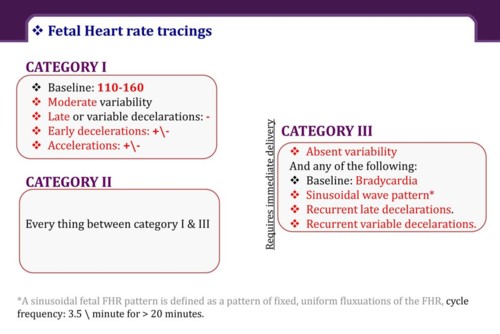
Category III. This category of FHR tracing represents an abnormal pattern that is predictive of fetal acidemia and requires prompt evaluation and intervention. A category III pattern is defined by any of the following criteria:
• Absent baseline FHR variability and any of the following:
➤ Recurrent late decelerations
➤ Recurrent variable decelerations
➤ Bradycardia
• Sinusoidal pattern
Choice A is wrong because category I is a normal pattern that is predictive of normal fetal acid-base balance at the time of observation. A category I pattern is defined by all of the following criteria:
• Baseline rate of 110 to 160 bpm
• Moderate baseline FHR variability
• No late or variable decelerations
• Early decelerations may be present or absent
• Accelerations may be present or absent
Choice B is wrong because category II is an indeterminate pattern that is not predictive of abnormal fetal acid-base balance but requires continued surveillance and reevaluation. A category II pattern includes all FHR tracings that are not category I or III.
Choice D is wrong because there is no category IV in the NICHD classification system for FHR tracings.
Nursing Test Bank
Naxlex Comprehensive Predictor Exams
Related Questions
Correct Answer is A
Explanation
Prepare the client for an amnioinfusion.An amnioinfusion is a procedure that adds fluid to the uterus during labor to relieve cord compression and improve fetal condition.Variable decelerations on the fetal monitor tracing are a sign of cord compression and fetal distress.If repositioning and oxygen administration do not resolve the decelerations, an amnioinfusion may be indicated.
Choice B is wrong because applying an internal fetal scalp electrode does not address the cause of variable decelerations, which is cord compression.
An internal fetal scalp electrode is used to monitor the fetal heart rate more accurately, but it does not improve fetal oxygenation or prevent cord compression.
Choice C is wrong because administering IV fluid bolus to the client may help increase maternal blood volume and placental perfusion, but it does not directly increase amniotic fluid volume or relieve cord compression.
Choice D is wrong because discontinuing oxytocin infusion if present may reduce uterine contractions and decrease cord compression, but it may also prolong labor and increase the risk of infection or fetal compromise.Oxytocin infusion should only be discontinued if there are signs of uterine hyperstimulation or fetal intolerance.
Correct Answer is A
Explanation
Place the device over the fetal back for 3 seconds.This is because vibroacoustic stimulation (VAS) is the application of a vibratory sound stimulus to the abdomen of a pregnant woman to induce fetal heart rate (FHR) accelerations.The presence of FHR accelerations reliably predicts the absence of fetal metabolic acidemia.VAS is typically used during a nonstress test (NST) to assess fetal well-being.The device should be placed over the fetal back for 3 seconds, as this is the optimal duration and location to elicit a fetal response.
Choice B is wrong because holding the device firmly against the maternal abdomen for 10 seconds may be too long and too strong for the fetus, and may cause discomfort or distress.
Choice C is wrong because moving the device around the maternal abdomen until fetal movement is detected may not be effective or efficient, as the device may not reach the optimal location or duration to stimulate the fetus.
Choice D is wrong because applying the device intermittently over the fundus for 15 seconds may not target the fetal auditory system, which is located near the fetal back, and may also be too long and too strong for the fetus.
Normal ranges for FHR are between 110 and 160 beats per minute, and FHR accelerations are defined as an increase of at least 15 beats per minute above baseline for at least 15 seconds.
Whether you are a student looking to ace your exams or a practicing nurse seeking to enhance your expertise , our nursing education contents will empower you with the confidence and competence to make a difference in the lives of patients and become a respected leader in the healthcare field.
Visit Naxlex, invest in your future and unlock endless possibilities with our unparalleled nursing education contents today