
A nurse is reinforcing teaching about delegation to assistive personnel (AP) with a newly licensed nurse. Which of the following statements should the nurse include in the teaching?
"After a task is delegated, the accountability for the task belongs to the AP."
"Delegation permits a designated individual to meet a goal on your behalf."
"Discharge teaching activities for clients can be delegated to an AP."
"If the AP has completed the task before, there is no need to follow up."
The Correct Answer is B
The nurse should include the statement "Delegation permits a designated individual to meet a goal on your behalf" in the teaching. This is because delegation allows the nurse to assign tasks to an AP who has the appropriate skills and knowledge to complete them, while still maintaining accountability for the outcome of the task.
Option A is incorrect because accountability for a delegated task remains with the delegator, not the AP.
Option C is incorrect because discharge teaching activities for clients cannot be delegated to an AP as they require nursing judgment and assessment.
Option D is incorrect because it is important for the nurse to follow up on delegated tasks even if the AP has completed them before to ensure that they have been completed correctly and that the client's needs have been met.
Nursing Test Bank
Naxlex Comprehensive Predictor Exams
Related Questions
Correct Answer is D
Explanation
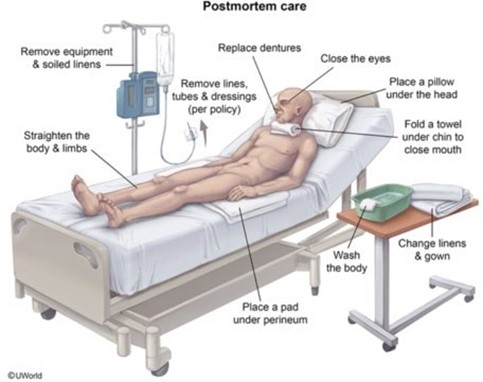
Assistive personnel (AP), also known as unlicensed assistive personnel (UAP), can perform tasks such as assisting with activities of daily living, hygiene, and nutrition, as well as those tasks that support professional nursing assessments ². Providing postmortem care for a client who has died [d] is a task that can be delegated to an AP.
The other options are not tasks that should be delegated to an AP. Educating a client on the use of a blood glucose monitor [a] involves patient education, which is typically the responsibility of a licensed nurse.
Interpreting a client's vital signs [b] involves assessing the client's health status, which is also typically the responsibility of a licensed nurse. Performing a central line dressing change for a client [c] is a complex task that requires specialized knowledge and skills.
Correct Answer is C
Explanation
The correct answer is Choice C.
Choice A rationale: A client who had a blood transfusion and has a blood pressure of 138/76 mm Hg. This client is stable. The blood pressure is within normal range, indicating that the client is not experiencing a transfusion reaction, which could cause hypotension. Therefore, this client is not the highest priority.
Choice B rationale: A client who has skeletal traction for a femur fracture and reports incisional discomfort of 4 on a scale of 0 to 10. While pain management is an important aspect of client care, a pain level of 4 indicates that the client’s pain is manageable. Therefore, this client is not the highest priority.
Choice C rationale: A client who is 4 hours postoperative following a total hip arthroplasty and has a urinary output of 15 mL/hr. This client is showing signs of oliguria, which could indicate a serious complication such as hypovolemia or acute kidney injury. This client is the highest priority because these complications can lead to further serious issues such as shock or end-organ damage if not addressed promptly.
Whether you are a student looking to ace your exams or a practicing nurse seeking to enhance your expertise , our nursing education contents will empower you with the confidence and competence to make a difference in the lives of patients and become a respected leader in the healthcare field.
Visit Naxlex, invest in your future and unlock endless possibilities with our unparalleled nursing education contents today