
A nurse manager is reviewing clients' rights with the nurses on the unit. The nurse manager should tell the nurses that informed consent promotes which of the following ethical principles?
Autonomy
Nonmaleficence
Justice
Fidelity
The Correct Answer is A
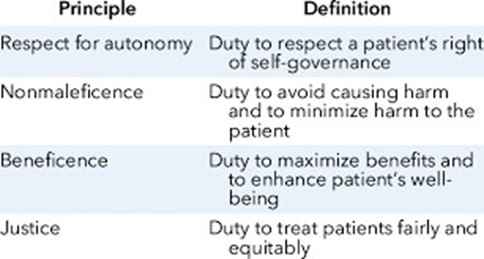
- A. Autonomy is the ethical principle that respects the right of clients to make their own decisions and choices regarding their health care. Informed consent is a process that ensures that clients are fully informed of the benefits, risks, alternatives, and consequences of a proposed treatment or procedure, and that they voluntarily agree to it.
- B. Nonmaleficence is the ethical principle that obliges health care providers to do no harm to clients, either intentionally or unintentionally. Informed consent does not directly promote this principle, although it may help to prevent harm by disclosing potential risks and complications.
- C. Justice is the ethical principle that requires fair and equal treatment of all clients, regardless of their personal characteristics, preferences, or values. Informed consent does not directly promote this principle, although it may help to ensure that clients are not coerced or manipulated into accepting a treatment or procedure that they do not want or need.
- D. Fidelity is the ethical principle that requires health care providers to be faithful and loyal to their clients, and to honor their commitments and promises. Informed consent does not directly promote this principle, although it may help to establish trust and rapport between clients and providers.
Nursing Test Bank
Naxlex Comprehensive Predictor Exams
Related Questions
Correct Answer is A
Explanation
The adolescent has not voided in 4 hr.
Rationale:
- A. The nurse should not address the parents' concerns and provide education and support, but refer the concerns to the provider to address the concerns about the surgical procedure.
- B. The adolescent's blood pressure is 131/89 mm Hg. This is not a correct answer because this blood pressure is within the normal range for an adolescent and does not indicate any complications or adverse effects from the injury or medication.
- C. The adolescent reports severe pain. This is not a correct answer because the nurse should administer morphine as prescribed for pain relief, but this is not a priority finding that requires immediate intervention or reporting to the provider. The nurse should also monitor the adolescent's pain level and response to medication, and use nonpharmacological methods to reduce pain and anxiety.
- D.Although this may raise concerns about renal injury, it is no a contraindication or cause for delay for the emergency surgical procedure.
Correct Answer is A
Explanation
- A. The nurse should discourage raw fruits due to risk of infection.
- B. There is no standard recommendation against exposure to young children.
- C. Incorrect. The nurse should measure the client's temperature at least every 4 hr, or more frequently if indicated because fever is a sign of infection in a client who has neutropenia and requires prompt intervention.
- D. Incorrect. The nurse should use disposable gloves from a box inside the client's room, not outside, to prevent cross-contamination and protect the client from exposure to pathogens.
Whether you are a student looking to ace your exams or a practicing nurse seeking to enhance your expertise , our nursing education contents will empower you with the confidence and competence to make a difference in the lives of patients and become a respected leader in the healthcare field.
Visit Naxlex, invest in your future and unlock endless possibilities with our unparalleled nursing education contents today