
A patient had a urinalysis completed and pH was checked. Is the pH as indicated by the strip of paper to the right of the chart indicative of a normal pH?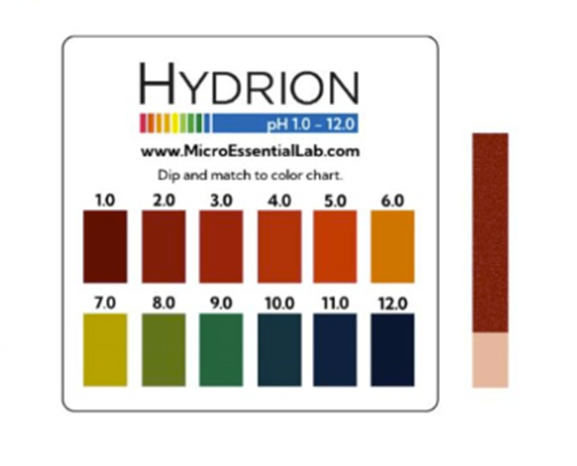
Yes, a urine pH of 5 is normal because it is within the range of 4.6-8.0.
No, a urine pH of 9 is abnormal because it exceeds the normal range of 4.6-8.0.
A urine pH of 6 is within the normal range because the normal pH range is 4.6-8.0.
Yes, a urine pH of 7.4 is normal because it falls within the normal range of 7.35-7.45.
No, a urine pH of 3 is abnormal because it is below the normal pH range of 4.6-8.0.
The Correct Answer is A
A. Yes, a urine pH of 5 is normal because it is within the range of 4.6-8.0: The test strip color matches the 5.0 reference block on the provided Hydrion chart. Human urine is typically acidic due to metabolic acid production but can vary widely between 4.6 and 8.0. A value of 5.0 is clinically expected and healthy.
B. No, a urine pH of 9 is abnormal because it exceeds the normal range of 4.6-8.0: While the statement regarding the range is correct, the visual evidence from the strip does not match the dark green or blue colors of pH 9. The strip shows a deep orange-red hue. This color corresponds to a much lower, more acidic value.
C. A urine pH of 6 is within the normal range because the normal pH range is 4.6-8.0: Although a pH of 6 is physiological, the color on the test strip is significantly more red than the 6.0 orange-yellow reference. The strip indicates a more concentrated hydrogen ion content. Therefore, 6.0 is an inaccurate reading of the provided sample.
D. Yes, a urine pH of 7.4 is normal because it falls within the normal range of 7.35-7.45: This choice confuses the tightly regulated pH of systemic arterial blood with the highly variable pH of urine. Urine pH 7.4 is possible but does not match the red-orange strip. Furthermore, the urine range is broader than the blood range.
E. No, a urine pH of 3 is abnormal because it is below the normal pH range of 4.6-8.0: The strip matches the reddish hue of the lower end of the scale, but specifically aligns with the 5.0 block. A pH of 3 is extremely acidic and generally outside human physiological limits. The provided chart indicates 5.0 is the best visual match.
Nursing Test Bank
Naxlex Comprehensive Predictor Exams
Related Questions
Correct Answer is B
Explanation
A. It indicates increased tubular secretion and higher GFR: Cystatin C is freely filtered and not secreted by the renal tubules, making it an accurate marker for filtration. An increase in its blood concentration reflects a decrease in filtration, not an increase. Elevated levels always correlate with reduced clearance.
B. It suggests early decline in GFR despite normal BUN: Cystatin C is a more sensitive marker for GFR than BUN or creatinine, especially in elderly patients with reduced muscle mass. It remains stable regardless of diet or age. An isolated rise often identifies stage 2 or 3 chronic kidney disease.
C. It reflects dehydration with preserved GFR: Dehydration typically causes a disproportionate rise in BUN (prerenal azotemia) due to increased urea reabsorption. Cystatin C is not significantly affected by hydration status or tubular flow rates. Its elevation specifically points toward a functional reduction in glomerular filtration.
D. It shows liver dysfunction unrelated to GFR: Blood urea nitrogen (BUN) levels can be affected by liver function since the liver produces urea. Cystatin C, however, is produced by all nucleated cells at a constant rate and is not influenced by hepatic health. Its primary clinical utility is renal assessment.
Correct Answer is E
Explanation
A. Diabetic ketoacidosis: This metabolic state involves high concentrations of glucose and ketone bodies within the renal filtrate. These solutes increase the osmotic pressure and density of urine, leading to an elevated specific gravity. It reflects a state of solute excess rather than dilution.
B. Urinary tract infection (UTI): Bacterial colonization and the presence of white blood cells or nitrites typically increase urine turbidity and density. While infections alter chemical composition, they do not physiologically cause the profound dilution seen in low specific gravity. It usually results in normal or high density.
C. Dehydration: In response to fluid deficit, the kidneys maximize water reabsorption under the influence of antidiuretic hormone. This produces highly concentrated urine with a significantly elevated specific gravity. Low specific gravity is physiologically incompatible with a state of systemic fluid volume depletion.
D. Presence of protein: Proteinuria increases the mass of dissolved solids per unit volume of urine. Large molecules like albumin raise the density of the fluid as it passes through the collecting ducts. This finding is associated with higher, not lower, specific gravity measurements.
E. Overhydration: Excessive fluid intake suppresses antidiuretic hormone, leading to the excretion of a large volume of dilute urine. The renal tubules minimize water reabsorption, resulting in a urine density approaching that of pure water (1.000). This physiological state directly results in low specific gravity.
Whether you are a student looking to ace your exams or a practicing nurse seeking to enhance your expertise , our nursing education contents will empower you with the confidence and competence to make a difference in the lives of patients and become a respected leader in the healthcare field.
Visit Naxlex, invest in your future and unlock endless possibilities with our unparalleled nursing education contents today