
Why can small changes in blood osmolarity significantly affect kidney filtration?
Because the filtration membrane is impermeable to water
Because osmolarity affects smooth muscle contraction
Because of the low net filtration pressure across the filtration membrane
Because osmolarity regulates aldosterone secretion
The Correct Answer is C
A. Because the filtration membrane is impermeable to water: The glomerular filtration membrane is highly permeable to water to allow for the production of 180 L of filtrate daily. Impermeability would prevent renal function entirely. Its high hydraulic conductivity is essential for the rapid movement of fluid and solutes.
B. Because osmolarity affects smooth muscle contraction: While ions affect excitability, the sensitivity of filtration to osmolarity is primarily a function of Starling forces. Direct smooth muscle effects do not explain the precise sensitivity of the filtration rate. The primary mechanism involves the balance of pressures in the capillaries.
C. Because of the low net filtration pressure across the filtration membrane: Net filtration pressure (NFP) is approximately 10 mmHg, representing the slim margin between hydrostatic and oncotic forces. Small changes in blood osmolarity alter the colloid osmotic pressure. Because the NFP is so low, these shifts significantly impact the total GFR.
D. Because osmolarity regulates aldosterone secretion: Aldosterone is primarily regulated by the renin-angiotensin system and serum potassium levels, not small fluctuations in blood osmolarity. Osmolarity primarily triggers ADH release. Furthermore, aldosterone affects tubular reabsorption, not the initial filtration rate at the glomerular tuft.
Nursing Test Bank
Naxlex Comprehensive Predictor Exams
Related Questions
Correct Answer is D
Explanation
A. Acetylcholine: This neurotransmitter is primarily associated with the parasympathetic nervous system and cholinergic transmission. In the vasculature, it often promotes vasodilation through nitric oxide release rather than vasoconstriction. It does not mediate the renal sympathetic stress response.
B. Insulin: This anabolic hormone regulates glucose uptake and lipid metabolism in peripheral tissues. While it has some minor hemodynamic effects, it is not a mediator of the acute sympathetic fight-or-flight response. It does not cause significant afferent arteriolar constriction.
C. Cortisol: As a glucocorticoid, cortisol assists in long-term stress adaptation and blood pressure maintenance by upregulating adrenergic receptors. However, it is not the primary catecholamine responsible for immediate, acute vasoconstriction during sympathetic activation. Its effects are primarily genomic and slower.
D. Epinephrine: Secreted by the adrenal medulla during sympathetic stimulation, this catecholamine binds to alpha-1 adrenergic receptors on vascular smooth muscle. This induces profound vasoconstriction of the afferent arterioles to divert blood toward vital organs. This reduces GFR during systemic stress.
Correct Answer is {"dropdown-group-1":"D","dropdown-group-2":"E","dropdown-group-3":"E"}
Explanation
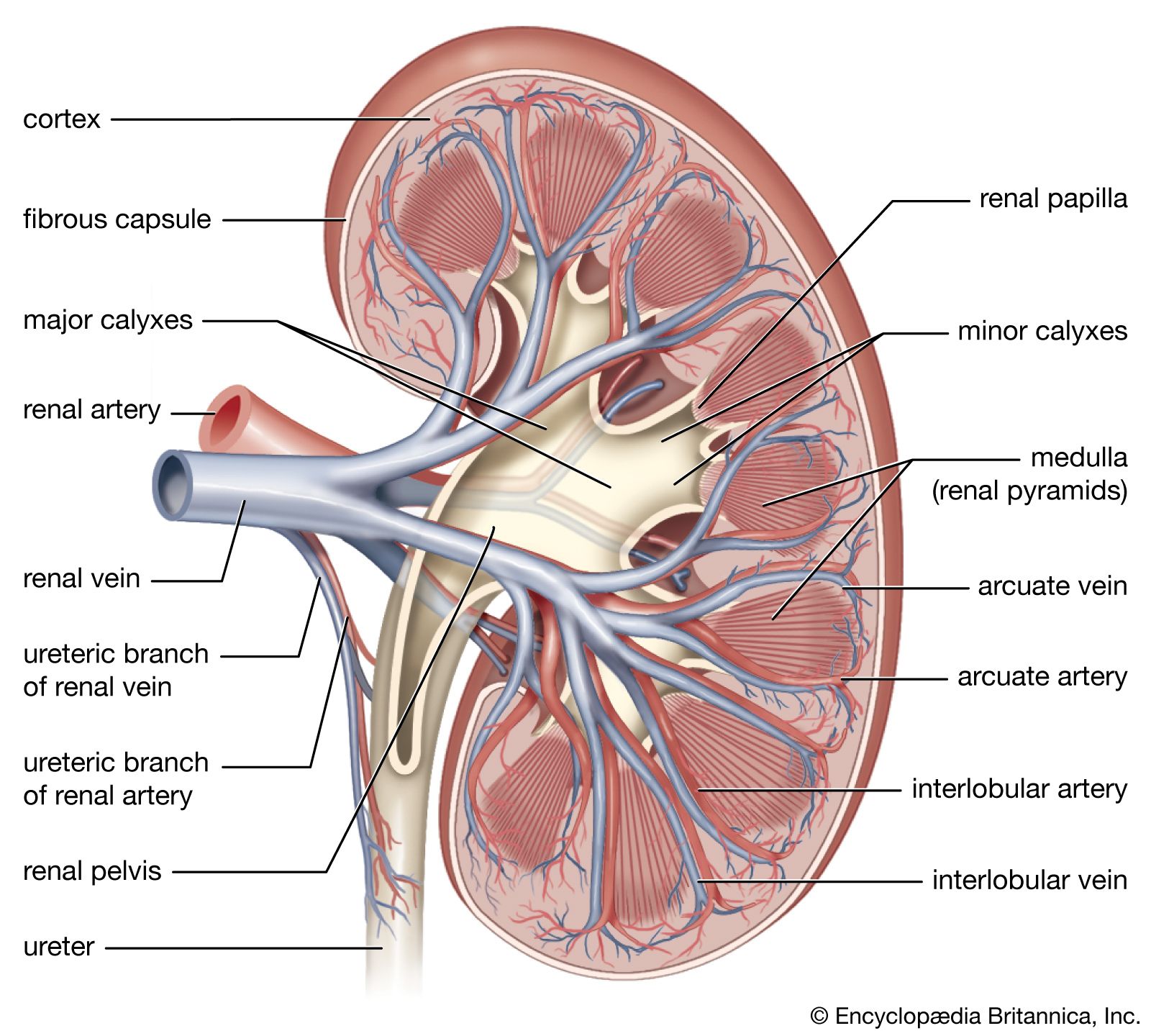
Minor calyx (I): The minor calyx is a small, cup-shaped structure that collects urine from the renal papilla at the tip of each pyramid. It is part of the drainage system, channeling urine into the major calyces and then into the renal pelvis. Look for the small funnel-like extensions directly attached to the renal papillae. These are distinctly smaller than the major calyces.
Renal medulla(H): The renal medulla is the inner region of the kidney, composed of renal pyramids. It plays a crucial role in concentrating urine through the countercurrent mechanism in the loops of Henle and collecting ducts. Appears as darker, triangular or striated regions deeper inside the kidney, between the cortex and the renal pelvis.
Renal cortex (F): The renal cortex is the outer functional tissue of the kidney, lying just beneath the fibrous capsule. It contains glomeruli and convoluted tubules, making it the primary site of blood filtration. Appears as the lighter-colored outer rim of the kidney, surrounding the medulla.
Whether you are a student looking to ace your exams or a practicing nurse seeking to enhance your expertise , our nursing education contents will empower you with the confidence and competence to make a difference in the lives of patients and become a respected leader in the healthcare field.
Visit Naxlex, invest in your future and unlock endless possibilities with our unparalleled nursing education contents today