
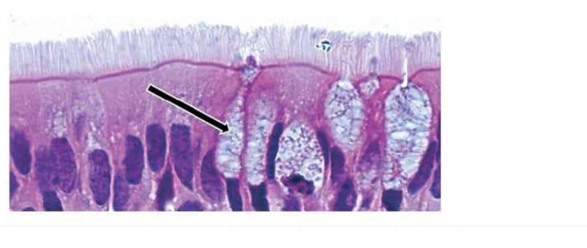
Identify the marked structure
Basal cell
Ciliated epithelial cell
Goblet cell
Squamous epithelial cell
The Correct Answer is C
The marked structure is the goblet cell, a specialized unicellular gland found within epithelial linings, particularly in the respiratory and gastrointestinal tracts. It is characterized by its distinctive “goblet” or flask shape, with a narrow base and a widened apical portion filled with mucin granules. Goblet cells secrete mucous, which forms a protective and lubricating layer over epithelial surfaces. This mucus traps pathogens and particulate matter in the airways and facilitates smooth passage of material in the intestines.
A. Basal cell: Basal cells are stem-like epithelial cells located in the deepest layer of stratified epithelia. They are responsible for regeneration and replacement of epithelial cells. Unlike goblet cells, they are not secretory cells and do not contain mucin-filled cytoplasm. Their main function is proliferation rather than secretion.
B. Ciliated epithelial cell: Ciliated epithelial cells possess hair-like projections called cilia on their apical surface. These cilia beat in coordinated waves to move mucus or fluid across epithelial surfaces, such as in the respiratory tract or fallopian tubes. Unlike goblet cells, they are specialized for movement rather than mucus production.
C. Goblet cell: Goblet cells are unicellular exocrine glands embedded within columnar epithelium. They produce and secrete mucin, which hydrates to form mucus that protects epithelial surfaces from mechanical damage, pathogens, and dehydration. Their characteristic shape, narrow base with a swollen mucus-filled apex, makes them easily identifiable and functionally specialized for secretion.
D. Squamous epithelial cell: Squamous epithelial cells are flat, thin cells that form the outermost layer of many epithelia. They are primarily adapted for diffusion and protective lining rather than secretion. Unlike goblet cells, they lack mucin granules and are not specialized for mucus production.
Nursing Test Bank
Naxlex Comprehensive Predictor Exams
Related Questions
Correct Answer is B
Explanation
The marked structure is the temporal bone, a paired irregular cranial bone forming part of the lateral skull and cranial base. It consists of squamous, petrous, mastoid, and tympanic portions, each with distinct anatomical roles. The temporal bone is clinically significant because it houses the auditory and vestibular apparatus and contributes to the temporomandibular joint (TMJ). It also provides multiple foramina for cranial nerves and vascular structures.
A. Sphenoid bone: The sphenoid bone is a centrally located cranial bone forming part of the middle cranial fossa and posterior orbital wall. It has a complex butterfly shape with greater and lesser wings and contains the sella turcica for the pituitary gland. It contributes to multiple foramina including the optic canal and superior orbital fissure for neurovascular transmission. Unlike the temporal bone, it is midline and not associated with hearing structures or the TMJ.
B. Temporal bone: The temporal bone is a lateral skull bone composed of squamous, petrous, mastoid, and tympanic parts, each serving distinct functions. The petrous portion houses the inner ear structures responsible for hearing and balance. The mastoid air cells assist in pressure regulation, while the tympanic part surrounds the external auditory canal. It articulates with the mandible at the TMJ and transmits cranial nerves VII and VIII, making it the correct answer.
C. Parietal bone: The parietal bone is a flat bone forming the superior and lateral aspects of the cranial vault. It articulates with adjacent bones via sutures including the coronal, sagittal, and lambdoid sutures. Its primary role is protection of the cerebral hemispheres beneath it. It lacks involvement in auditory structures, neurovascular canals, or mandibular articulation.
D. Occipital bone: The occipital bone forms the posterior skull and surrounds the foramen magnum, allowing passage of the spinal cord. It articulates with the atlas vertebra to enable nodding movements of the head. It also provides attachment for nuchal muscles that support head posture. Unlike the temporal bone, it is not involved in hearing or jaw articulation.
Correct Answer is A
Explanation
The respiratory tract is lined by a specialized epithelium designed to protect the airway and maintain efficient gas exchange. This lining must trap inhaled particles, prevent infection, and move debris out of the respiratory system. The epithelium of most of the conducting airways, such as the trachea and bronchi, is adapted for this protective function. It contains goblet cells and ciliated cells working together in a coordinated system known as the mucociliary escalator.
A. Mucus-secreting, ciliated, and pseudostratified: the respiratory passages are primarily lined by pseudostratified ciliated columnar epithelium. This tissue contains goblet cells that secrete mucus, which traps dust, pathogens, and debris inhaled into the airway. The cilia then beat in a coordinated motion to move this mucus upward toward the pharynx for removal. The pseudostratified arrangement allows multiple cell types at different heights while still forming a single epithelial layer essential for airway protection.
B. Mucus-secreting and transitional: transitional epithelium is found in the urinary system, particularly in the bladder and ureters. Its primary function is to allow stretching and recoil as urine volume changes, not airway protection. Although mucus secretion is present in respiratory tissues, transitional epithelium does not contain ciliated cells or form the mucociliary escalator.
C. Stratified, sputum-secreting, and non-ciliated: stratified epithelium is generally found in areas subject to high abrasion, such as the skin, esophagus, and oral cavity. The respiratory tract requires ciliated cells to move mucus, which this option lacks. Additionally, sputum production is a pathological term rather than a normal epithelial function. The absence of cilia makes this option inconsistent with respiratory physiology.
D. Simple squamous, keratinized, and dry: simple squamous epithelium is found in structures requiring rapid diffusion, such as alveoli, not the conducting airways. Keratinization and dryness are characteristics of the skin, not internal respiratory passages. The respiratory tract must remain moist to facilitate mucus movement and gas exchange.
Whether you are a student looking to ace your exams or a practicing nurse seeking to enhance your expertise , our nursing education contents will empower you with the confidence and competence to make a difference in the lives of patients and become a respected leader in the healthcare field.
Visit Naxlex, invest in your future and unlock endless possibilities with our unparalleled nursing education contents today