
Identify the part of the organ that corresponds with the statement.
The innermost part of the kidney, containing the renal pyramids and involved in concentrating urine.
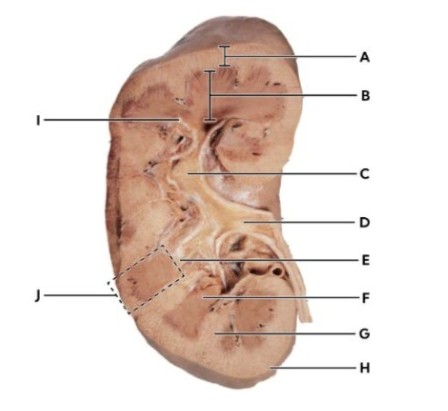
The Correct Answer is {"dropdown-group-1":"B"}
Correct answer: B
Renal medulla: The renal medulla is the deepest (innermost) region of the kidney. It is composed of renal pyramids, which are cone-shaped structures containing loops of Henle and collecting ducts. These structures are essential for the countercurrent mechanism, which allows the kidney to concentrate urine by reabsorbing water and solutes. The medulla lies beneath the renal cortex and surrounds the renal pelvis, making it central to urine formation and concentration.
Nursing Test Bank
Naxlex Comprehensive Predictor Exams
Related Questions
Correct Answer is A
Explanation
A. True: The afferent arteriole has a significantly larger diameter than the efferent arteriole, creating a unique "bottleneck" effect. This anatomical arrangement generates the high hydrostatic pressure (approximately 55 mmHg) necessary to drive ultrafiltration. It is a fundamental principle of renal hemodynamics.
Correct Answer is {"dropdown-group-1":"A"}
Explanation
A. Na+: Bicarbonate ions exit the proximal tubule cells via a Na+/HCO3- cotransporter located on the basolateral membrane. This secondary active transport mechanism ensures that for every bicarbonate ion recovered, a sodium ion is also returned to the blood. This maintains electrical neutrality and osmotic balance.
B. -H: Hydrogen ions are primarily secreted into the tubular lumen via the Na+/H+ exchanger on the apical membrane. They are not cotransported with bicarbonate across the basal membrane. Their secretion is necessary to initiate the breakdown of luminal bicarbonate into CO2 and water.
C. CI-: Chloride ions are mostly reabsorbed through paracellular pathways or specific chloride-base exchangers later in the tubule. They are not the primary partner for bicarbonate cotransport in the proximal segment. Bicarbonate reabsorption relies more heavily on the sodium electrochemical gradient.
D. K+: Potassium ions are actively pumped into the cell by the Na+/K+ ATPase on the basal membrane. They generally move in the opposite direction of sodium and do not serve as the cotransport partner for bicarbonate exit. Their intracellular concentration is kept high for resting membrane potential.
Whether you are a student looking to ace your exams or a practicing nurse seeking to enhance your expertise , our nursing education contents will empower you with the confidence and competence to make a difference in the lives of patients and become a respected leader in the healthcare field.
Visit Naxlex, invest in your future and unlock endless possibilities with our unparalleled nursing education contents today