
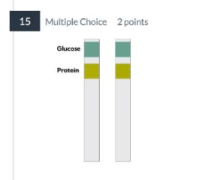
Above is the result of a patient's urinalysis that looks for protein and glucose in the urine. The dip stick on the left is a control to show what a normal sample looks like. The dip stick on the right is the patient's result. How can this test be interpreted?
The patient's test is normal for glucose, but positive for protein indicating diabetes.
The patient's test is normal for protein, but positive for glucose indicating diabetes.
The patient's test is positive for both glucose and protein in the urine
The patient's test is normal for glucose, but positive for protein indicating kidney disease.
The patient's test is normal for protein, but positive for glucose indicating kidney disease.
The patient's test is the same as the control, so the patient does not have protein or glucose in their urine.
The Correct Answer is F
A. The patient's test is normal for glucose, but positive for protein indicating diabetes: Visual inspection of the patient dipstick on the right shows the protein pad remains the same yellow-olive shade as the control. Proteinuria is a marker of glomerular damage rather than the primary diagnostic indicator for diabetes mellitus. The test does not show a change in the protein field.
B. The patient's test is normal for protein, but positive for glucose indicating diabetes: The glucose pad on the patient's strip retains the identical green-teal color seen on the normal control strip on the left. Glycosuria would manifest as a distinct color shift indicating the presence of sugar in the filtrate. No such deviation from the control is present in the patient's result.
C. The patient's test is positive for both glucose and protein in the urine: A positive result for both analytes would require both the upper and lower reagent pads to change color relative to the control. Both pads on the right-hand strip are chromatographically identical to those on the left-hand control strip. This indicates that neither substance is present in detectable concentrations.
D. The patient's test is normal for glucose, but positive for protein indicating kidney disease: While persistent proteinuria is a hallmark of chronic kidney disease and basement membrane dysfunction, this patient's reagent pad shows no color change. The yellow-olive protein pad on the right matches the "normal" control perfectly. There is no evidence of protein leakage in this sample.
E. The patient's test is normal for protein, but positive for glucose indicating kidney disease: Glycosuria typically results from blood glucose levels exceeding the renal threshold or a defect in tubular reabsorption. However, the patient's glucose reagent pad shows a normal green-teal color, identical to the negative control. This indicates a normal physiological state for both protein and glucose.
F. The patient's test is the same as the control, so the patient does not have protein or glucose in their urine: Side-by-side comparison of the control and patient dipsticks reveals no change in the color of the glucose or protein reagent pads. This identical appearance signifies that the patient's urine components fall within normal physiological limits. The urinalysis indicates a negative result for both glycosuria and proteinuria.
Nursing Test Bank
Naxlex Comprehensive Predictor Exams
Related Questions
Correct Answer is A
Explanation
A. ADH: Arginine vasopressin is released from the posterior pituitary when baroreceptors detect a significant decrease in mean arterial pressure or blood volume. It increases the water permeability of the collecting ducts. This facilitates rapid water recovery to restore systemic hemodynamics.
B. Renin: This enzyme is secreted by the juxtaglomerular cells to initiate the angiotensin cascade. While it eventually leads to water retention via aldosterone, renin itself is a proteolytic enzyme, not a hormone that directly recovers water. It is a catalyst for the system.
C. Aldosterone: This hormone promotes water recovery indirectly by increasing the active reabsorption of sodium. While it is vital for volume expansion, its primary direct target is the sodium ion. ADH remains the primary hormone for direct, regulated water recovery via aquaporins.
D. ANP: Atrial natriuretic peptide is released in response to atrial stretch caused by high blood volume. It functions to increase the excretion of sodium and water to reduce blood pressure. It is an antagonist to the volume-conserving effects of ADH.
Correct Answer is B
Explanation
A. Cortisol: High levels of glucocorticoids generally antagonize calcium absorption and can lead to hypercalciuria. They do not promote the active recovery of calcium in the distal segments of the nephron. Cortisol primarily influences glucose and protein metabolism.
B. Parathyroid hormone: This hormone responds to low serum calcium by stimulating the insertion of TRPV5 channels into the apical membrane of DCT cells. It enhances transcellular calcium reabsorption while simultaneously promoting phosphate excretion. This is a critical homeostatic regulator.
C. Aldosterone: The primary role of this mineralocorticoid is the regulation of sodium reabsorption and potassium secretion in the principal cells. While it influences fluid volume, it does not directly modulate the expression of apical calcium channels. It lacks specific calciotropic activity.
D. Antidiuretic hormone: This peptide hormone focuses exclusively on water homeostasis by inserting aquaporin-2 channels into the collecting ducts. It does not play a functional role in the molecular transport or recovery of calcium ions. Its primary stimulus is serum hyperosmolality.
Whether you are a student looking to ace your exams or a practicing nurse seeking to enhance your expertise , our nursing education contents will empower you with the confidence and competence to make a difference in the lives of patients and become a respected leader in the healthcare field.
Visit Naxlex, invest in your future and unlock endless possibilities with our unparalleled nursing education contents today