
Identify the structures denoted by the following letters:
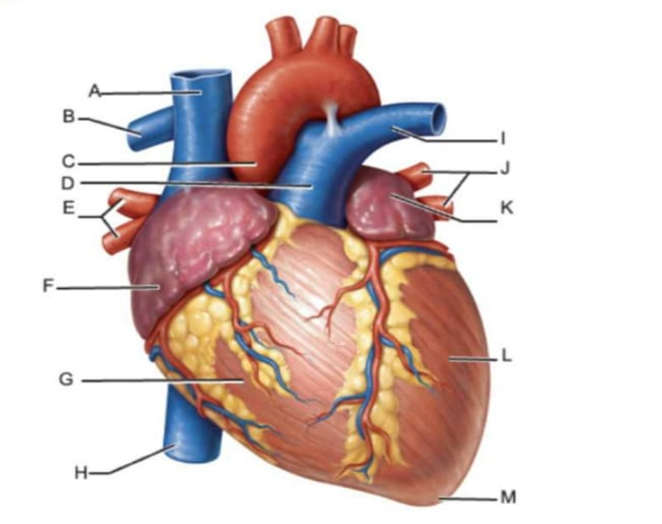
| J | dropdown |
| G | dropdown |
| D | dropdown |
The Correct Answer is {"dropdown-group-1":"A","dropdown-group-2":"B","dropdown-group-3":"C"}
Correct answer:
- J: Pulmonary veins
- G: Right ventricle
- D: Pulmonary trunk
J: Pulmonary veins- Pulmonary veins are blood vessels that carry oxygenated blood from the lungs to the left atrium of the heart. Normally, there are four pulmonary veins—two from each lung. They enter the posterior aspect of the left atrium and play a vital role in systemic circulation by delivering oxygenated blood for distribution throughout the body.
G: Right ventricle- The right ventricle is the lower right chamber of the heart responsible for pumping deoxygenated blood to the lungs for oxygenation. It receives blood from the right atrium through the tricuspid valve and ejects it into the pulmonary artery via the pulmonary valve. It generates enough pressure to move blood through the pulmonary arteries to the lungs, where carbon dioxide is exchanged for oxygen.
D: Pulmonary trunk- The pulmonary trunk is a large artery that carries deoxygenated blood from the right ventricle to the lungs. It begins at the pulmonary valve and extends upward before dividing into the right and left pulmonary arteries. It is located anterior to the ascending aorta and it transports blood to the lungs for gas exchange.
Nursing Test Bank
Naxlex Comprehensive Predictor Exams
Related Questions
Correct Answer is C
Explanation
A. Contractile force increases to compensate for the reduced cardiac output: In early compensatory phases, the heart may attempt to increase contractility via sympathetic stimulation, but in true heart failure, the myocardium is unable to generate sufficient force due to structural or functional impairment.
B. Contractile force increases, leading to an increased end systolic volume: Increased contractility would reduce, not increase, end-systolic volume because more blood is ejected per beat. In heart failure, contractile weakness leads to higher end-systolic volumes, reflecting incomplete emptying of the ventricles.
C. Contractile force is diminished due to damaged cardiomyocytes or cardiomyopathies: Heart failure results from conditions such as myocardial infarction, chronic hypertension, or dilated cardiomyopathy that impair cardiomyocyte function. This reduces the strength of ventricular contraction, decreasing stroke volume and overall cardiac output.
D. Contractile force is not affected in heart failure: Contractile force is significantly affected in heart failure. The weakened myocardium cannot generate sufficient pressure to maintain normal stroke volume, making this statement inaccurate.
E. Contractile force remains the same, but the heart becomes larger: While ventricular dilation can occur in chronic heart failure as a compensatory mechanism (eccentric hypertrophy), the contractile force per myocyte is reduced. Increased chamber size alone does not preserve effective contraction.
Correct Answer is C
Explanation
A. The time during which the heart is at rest: This describes diastole, a single phase of the cardiac cycle when the heart muscles relax and chambers fill with blood. While diastole is part of the cardiac cycle, it does not encompass the entire sequence of events from one heartbeat to the next.
B. The flow of blood through the body: This refers to systemic and pulmonary circulation, which are physiological processes involving blood movement but do not specifically define the cardiac cycle. The cardiac cycle is the sequence of mechanical and pressure events that drives this flow rather than the flow itself.
C. The series of pressure changes that occur within the heart from the beginning of one heartbeat to the beginning of the next: The cardiac cycle includes atrial and ventricular systole and diastole, with corresponding pressure and volume changes in all four chambers. These events coordinate valve opening and closing, blood ejection, and filling, ensuring efficient cardiac output with each heartbeat.
D. The electrical impulses of the heart: Electrical impulses, generated by the sinoatrial node and conducted through the conduction system, trigger the mechanical events of the cardiac cycle. While essential for initiating contraction, they represent only the electrical component and do not define the full sequence of pressure and volume changes that constitute the cardiac cycle.
Whether you are a student looking to ace your exams or a practicing nurse seeking to enhance your expertise , our nursing education contents will empower you with the confidence and competence to make a difference in the lives of patients and become a respected leader in the healthcare field.
Visit Naxlex, invest in your future and unlock endless possibilities with our unparalleled nursing education contents today