
In a certain plant, red flowers are dominant over white flowers. A plant heterozygous for red flowers and a plant with white flowers are crossed.
Which of the following is the expected proportion of phenotypes in the next generation?
3 red, 1 white.
2 red, 2 white.
4 red, 4 white.
1 red, 3 white.
The Correct Answer is B
In this cross, the plant heterozygous for red flowers has the genotype Rr (where R represents the dominant red allele and r represents the recessive white allele), while the plant with white flowers has the genotype rr.
The possible offspring from this cross would have the genotypes Rr (red), Rr (red), rr (white), and rr (white), resulting in a 1:1 ratio of red to white flowers.
Nursing Test Bank
Naxlex Comprehensive Predictor Exams
Related Questions
Correct Answer is C
Explanation
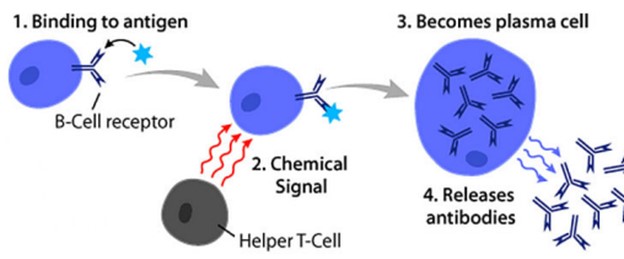
Antibodies are produced by specialized white blood cells called B lymphocytes (or B cells).
When an antigen binds to the B-cell surface, it stimulates the B cell to divide and mature into a group of identical cells called a clone.
The mature B cells, called plasma cells, secrete millions of antibodies into the bloodstream and lymphatic system.
Choice A, Natural killer cells, is not the correct answer because natural killer cells are a type of white blood cell that play a major role in the host-rejection of both tumours and virally infected cells.
Choice B, Cytotoxic T-cells, is not the correct answer because cytotoxic T-cells are a type of white blood cell that kills cancer cells, cells that are infected (particularly with viruses), or cells that are damaged in other ways.
Choice D, Helper T-cells, is not the correct answer because helper T-cells are a type of white blood cell that plays an important role in the immune system by helping other white blood cells fight infections.
Correct Answer is D
Explanation
The cytoskeleton of a cell is comprised of protein fibres that provide structural support and help maintain the shape of the cell.
These protein fibres include microfilaments, intermediate filaments, and microtubules.
Choice A. Carbohydrates is not the correct answer because carbohydrates are a type of macromolecule that provides energy to cells and are not a component of the cytoskeleton.
Choice B. Nucleic acids is not the correct answer because nucleic acids are macromolecules that store and transmit genetic information and are not a component of the cytoskeleton.
Choice C. Lipids is not the correct answer because lipids are a type of macromolecule that makes up cell membranes and are not a component of the cytoskeleton.
Whether you are a student looking to ace your exams or a practicing nurse seeking to enhance your expertise , our nursing education contents will empower you with the confidence and competence to make a difference in the lives of patients and become a respected leader in the healthcare field.
Visit Naxlex, invest in your future and unlock endless possibilities with our unparalleled nursing education contents today