
Match the letter to its blood vessel:
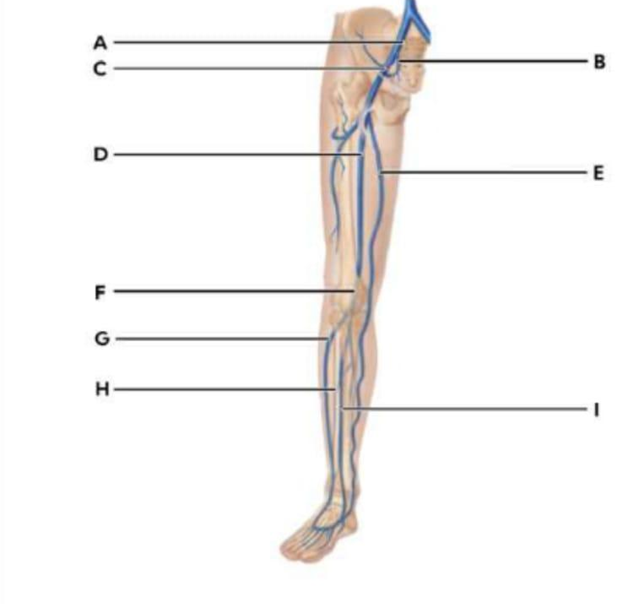
- H dropdown
- C dropdown
- F dropdown
- E dropdown
The Correct Answer is {"dropdown-group-1":"A","dropdown-group-2":"B","dropdown-group-3":"C","dropdown-group-4":"D"}
H: Anterior tibial vein
C: Femoral vein
F: Popliteal vein
E: Great saphenous vein
A. H (Anterior tibial vein): The anterior tibial vein is a deep vein of the lower leg that accompanies the anterior tibial artery. It originates from the dorsal venous arch of the foot and ascends through the anterior compartment of the leg between the tibia and fibula. It drains blood from the dorsum of the foot and anterior leg musculature, and it joins the posterior tibial vein to form the popliteal vein.
B. C (Femoral vein): The femoral vein is a major deep vein of the thigh and is the continuation of the popliteal vein after passing through the adductor hiatus. It travels superiorly within the femoral triangle medial to the femoral artery and receives tributaries such as the great saphenous vein and deep femoral vein. It becomes the external iliac vein as it passes beneath the inguinal ligament.
C. F (Popliteal vein): The popliteal vein is located in the popliteal fossa posterior to the knee joint. It is formed by the union of the anterior and posterior tibial veins. It ascends through the posterior knee region, receives the small saphenous vein, and continues proximally to become the femoral vein after passing through the adductor hiatus.
D. E (Great saphenous vein): The great saphenous vein is the longest superficial vein in the body. It begins on the medial side of the dorsal venous arch of the foot, ascends anterior to the medial malleolus, and travels along the medial aspect of the leg and thigh. It drains into the femoral vein at the saphenofemoral junction.
Nursing Test Bank
Naxlex Comprehensive Predictor Exams
Related Questions
Correct Answer is C
Explanation
A. Warm and flushed skin: Warm, flushed skin typically indicates vasodilation and increased blood flow rather than impaired perfusion. It is often seen in fever, inflammation, or early sepsis and generally reflects adequate tissue oxygenation, not compromise.
B. Elevated oxygen saturation levels: High oxygen saturation (SpO₂) usually indicates sufficient oxygen delivery to the tissues. While oxygen saturation measures arterial oxygenation, it does not reflect impaired microcirculatory perfusion; tissues can still be hypoperfused despite normal SpO₂ in certain shock states.
C. Bluish discoloration of the skin (cyanosis): Cyanosis occurs when there is an increased amount of deoxygenated hemoglobin in the blood or inadequate oxygen delivery to tissues. It is a direct clinical sign of compromised tissue perfusion and impaired oxygenation, often first visible in lips, nail beds, or earlobes, signaling urgent need for assessment.
D. Increased capillary refill speed: Normally, capillary refill is under 2 seconds. A faster-than-normal refill usually indicates vasodilation or hyperdynamic circulation rather than compromised perfusion. Sluggish or delayed capillary refill is a more reliable indicator of reduced peripheral perfusion.
Correct Answer is C
Explanation
A. To supply blood to the kidneys: The kidneys are primarily supplied by the renal arteries, which branch directly from the abdominal aorta inferior to the origin of the celiac trunk. The celiac trunk does not provide arterial blood flow to renal structures.
B. To carry deoxygenated blood to the inferior vena cava: The celiac trunk is an arterial vessel arising from the abdominal aorta. It carries oxygenated blood away from the heart, not deoxygenated blood toward the inferior vena cava, which is a venous structure.
C. To supply blood to the liver, stomach, and spleen: The celiac trunk is a major unpaired branch of the abdominal aorta that trifurcates into the left gastric, splenic, and common hepatic arteries. These branches supply oxygenated blood to foregut structures including the liver, stomach, spleen, and portions of the pancreas and duodenum.
D. To transport blood to the lower limbs: Blood supply to the lower limbs is provided by the common iliac arteries, which arise from the distal abdominal aorta. The celiac trunk functions much higher in the abdominal cavity and does not contribute to lower extremity circulation.
E. To drain blood from the digestive organs: Venous drainage from the digestive organs occurs through the hepatic portal vein and associated venous system, not the celiac trunk. The celiac trunk is part of the arterial supply, not venous return.
Whether you are a student looking to ace your exams or a practicing nurse seeking to enhance your expertise , our nursing education contents will empower you with the confidence and competence to make a difference in the lives of patients and become a respected leader in the healthcare field.
Visit Naxlex, invest in your future and unlock endless possibilities with our unparalleled nursing education contents today