
Provided is an ECG image of ventricular fibrillation.
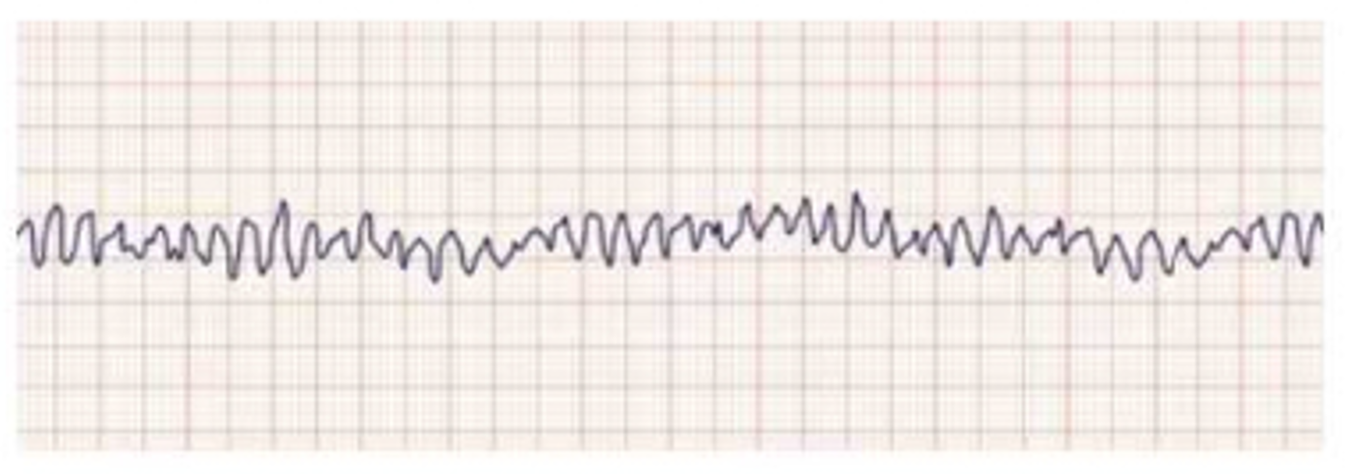
Identify the wave pattern and describe its characteristics.
The wave pattern shows rapid, chaotic, and irregular electrical activity with no identifiable P waves or QRS complexes.
The wave pattern shows a regular rhythm with a heart rate exceeding 150 beats per minute and widened QRS complexes.
The wave pattern shows a saw-tooth appearance with a consistent atrial rate and regular ventricular response.
The wave pattern shows a normal sinus rhythm with occasional premature ventricular contractions.
The Correct Answer is A
Choice A rationale
Ventricular fibrillation represents the most disorganized and lethal cardiac rhythm because it involves multiple re-entrant circuits in the ventricles. There is no coordinated depolarization of myocardial tissue, which results in the absence of mechanical contraction and cardiac output. Since there is no organized atrial or ventricular depolarization, the ECG lacks P waves, QRS complexes, and T waves. The tracing appears as a wavy, undulating line with varying amplitude and frequency known as coarse or fine fibrillation.
Choice B rationale
A regular rhythm with a rate exceeding 150 beats per minute and widened QRS complexes greater than 0.12 seconds typically describes ventricular tachycardia. This rhythm originates from an ectopic focus in the ventricles and can lead to hemodynamic instability, but it maintains a degree of organization that ventricular fibrillation lacks. While it is serious, the electrical signals are still forming distinct complexes, unlike the chaotic oscillations seen in fibrillation where the muscle fibers simply quiver without pumping blood.
Choice C rationale
A saw-tooth appearance on an ECG is the hallmark of atrial flutter. This pattern is caused by a macro-re-entrant circuit in the atria, usually around the tricuspid valve, occurring at a rate of 250 to 350 beats per minute. This results in regular "F" waves. The ventricular response depends on the conduction ratio through the atrioventricular node. This is a supraventricular tachycardia and is distinct from the chaotic ventricular activity that defines the life-threatening state of ventricular fibrillation.
Choice D rationale
Normal sinus rhythm with occasional premature ventricular contractions describes a baseline rhythm originating from the sinoatrial node with a rate of 60 to 100 beats per minute. The occasional premature ventricular contractions are early QRS complexes that are wide and bizarre in shape because they originate from the ventricles rather than the normal conduction system. This is a common finding and does not represent the total loss of organized electrical activity and cardiac output seen in fibrillation.
Nursing Test Bank
Naxlex Comprehensive Predictor Exams
Related Questions
Correct Answer is D
Explanation
Choice A rationale
Activity intolerance is a common nursing diagnosis for patients with dysrhythmias because the heart cannot effectively increase the heart rate or stroke volume to meet the oxygen demands of the body during physical exertion. While this affects the patient's quality of life and ability to perform daily tasks, it is not an immediate threat to life. It is a secondary consequence of the primary physiological failure occurring within the cardiac conduction system and pump mechanism.
Choice B rationale
Impaired gas exchange can occur if a dysrhythmia leads to acute heart failure and pulmonary congestion, which interferes with the diffusion of oxygen and carbon dioxide at the alveolar-capillary membrane. However, the gas exchange problem is usually a result of the heart's inability to move blood forward. Addressing the underlying cardiac output is the more direct way to solve the resulting respiratory issues in a patient whose primary diagnosis is a heart rhythm disturbance.
Choice C rationale
Alteration in comfort, often manifesting as palpitations, chest pressure, or anxiety, is frequently reported by patients experiencing dysrhythmias. While managing pain and distress is a core tenet of nursing care, it does not address the hemodynamic stability of the patient. In the hierarchy of needs, physiological stability and vital organ perfusion take precedence over comfort measures, especially when a dysrhythmia has the potential to become lethal or cause systemic collapse.
Choice D rationale
Decreased cardiac output is the priority because dysrhythmias directly impair the heart's ability to pump an adequate volume of blood to meet metabolic demands. Whether the heart is beating too fast to allow for adequate ventricular filling or too slow to maintain systemic pressure, the end result is reduced perfusion to vital organs like the brain and kidneys. Ensuring sufficient cardiac output is essential to prevent cardiogenic shock, organ failure, and death in the cardiac patient.
Correct Answer is A
Explanation
Choice A rationale
Transcutaneous pacing is the immediate treatment of choice for symptomatic sinus bradycardia that does not respond to atropine. This non-invasive method delivers electrical impulses through large electrode pads placed on the chest and back to stimulate ventricular contraction. It serves as a crucial bridge until more definitive treatments, like a transvenous or permanent pacemaker, can be established. It is rapid to initiate and effective in maintaining an adequate heart rate and cardiac output.
Choice B rationale
An implanted or permanent pacemaker is a long-term solution for chronic or irreversible bradycardia, but it is not the immediate treatment for an acute, sudden-onset event in an unstable patient. The placement of a permanent device requires a surgical procedure and time for preparation. In an emergency where a patient is not responding to atropine, a faster, temporary method like transcutaneous pacing must be used first to stabilize the patient before considering a permanent implant.
Choice C rationale
An asynchronous defibrillator is used to deliver high-energy shocks to treat pulseless rhythms like ventricular fibrillation or pulseless ventricular tachycardia. It is not used for bradycardia, as the heart still has organized, albeit slow, electrical activity. Applying an unsynchronized shock to a patient with a pulse could induce a more dangerous rhythm, such as ventricular fibrillation, by hitting the T wave. Defibrillation is entirely inappropriate for a slow heart rate with a pulse.
Choice D rationale
Synchronized cardioversion is used to treat unstable tachydysrhythmias, such as supraventricular tachycardia or atrial fibrillation with a rapid ventricular response. The goal is to slow down or reset a fast heart rate. Using cardioversion on a patient with sinus bradycardia would be counterproductive and dangerous, as the patient's heart rate is already too slow. This intervention is designed to interrupt fast circuits, not to provide the regular stimulus needed to increase a slow rate.
Whether you are a student looking to ace your exams or a practicing nurse seeking to enhance your expertise , our nursing education contents will empower you with the confidence and competence to make a difference in the lives of patients and become a respected leader in the healthcare field.
Visit Naxlex, invest in your future and unlock endless possibilities with our unparalleled nursing education contents today