
The nurse is most likely to assess for which of the following during assessment of the client with urinary incontinence? Select all that apply
Perineal skin irritation
Fluid intake of less than 1,500 mL/day
History of antihistamine intake
History of frequent urinary tract infections
A fecal impaction
Correct Answer : A,B,D,E
Urinary incontinence is the involuntary leakage of urine, a common condition especially among women and older adults, caused by factors such as weakened pelvic muscles, overactive bladder, or obstruction, and it can present as stress, urge, mixed, overflow, or continuous incontinence; though not life-threatening, it significantly impacts quality of life and is managed through lifestyle changes, pelvic floor exercises, medications, or surgical interventions depending on severity and type.
Rationale for correct answers:
1. Perineal skin irritation: Chronic exposure to urine changes the skin's pH and creates a moist environment. This leads to incontinence-associated dermatitis, characterized by redness, itching, and skin breakdown. Assessing the skin is a priority to prevent secondary fungal infections or pressure ulcers.
2. Fluid Intake of Less than 1,500 mL/day: While it seems counterintuitive, patients with incontinence often restrict fluids to avoid “accidents.” However, low fluid intake leads to concentrated urine, which acts as a bladder irritant, increasing urgency and frequency. A healthy intake is typically 1,500–2,000 mL/day unless contraindicated.
4. History of frequent urinary tract infections (UTIs): A UTI is a leading cause of “transient” or acute incontinence. Inflammation of the bladder wall (cystitis) causes the bladder to become hyperactive, leading to a sudden, uncontrollable urge to void. Conversely, chronic incontinence can increase the risk of UTIs due to the use of pads or catheters.
5. A fecal impaction: The rectum and the bladder share the same pelvic floor space. An impacted mass of stool in the rectum can physically press against the bladder neck, obstructing flow (leading to overflow incontinence) or irritating the bladder (leading to urge incontinence). Relieving constipation often resolves the urinary issue.
Rationale for incorrect answers:
3. History of antihistamine intake: Many over-the-counter antihistamines have anticholinergic effects. These drugs can cause the bladder muscle (detrusor) to relax too much or the urethral sphincter to contract, leading to urinary retention.
Test taking strategy:
When faced with a “Select all that apply” (SATA) question regarding a symptom like incontinence, treat each option as a True/False statement and categorize them into two groups:
- Complications: Ask, “Is this a physical result of being incontinent?” (Choice 1 fits here).
- Etiologies (Causes): Ask, “Could this factor actually trigger or worsen bladder leakage?” (Choices 2, 4, and 5 fit here).
Take home points:
- Urinary incontinence assessment includes skin integrity, hydration, medications, infections, and bowel function.
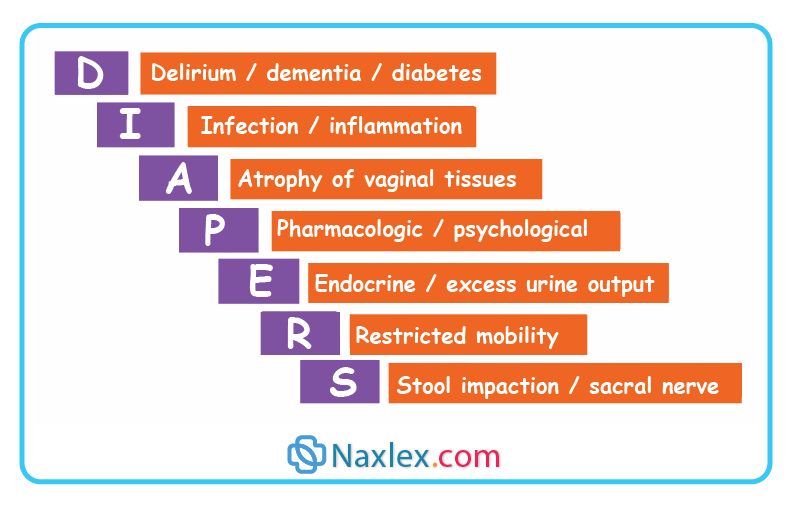
- Many causes of incontinence are reversible, making thorough nursing assessment essential. Always look for the DIAPPERS acronym to find treatable causes.
Nursing Test Bank
Naxlex Comprehensive Predictor Exams
Related Questions
Correct Answer is B
Explanation
Clean intermittent self-catheterization (CISC) is a technique where individuals insert a catheter into the bladder at regular intervals to drain urine, then remove it immediately afterward, rather than leaving it in place; it is commonly used for patients with neurogenic bladder, chronic urinary retention, or incomplete bladder emptying, and is preferred over long-term indwelling catheters because it reduces the risk of infection, preserves bladder function, and promotes independence.
Rationale for correct answer:
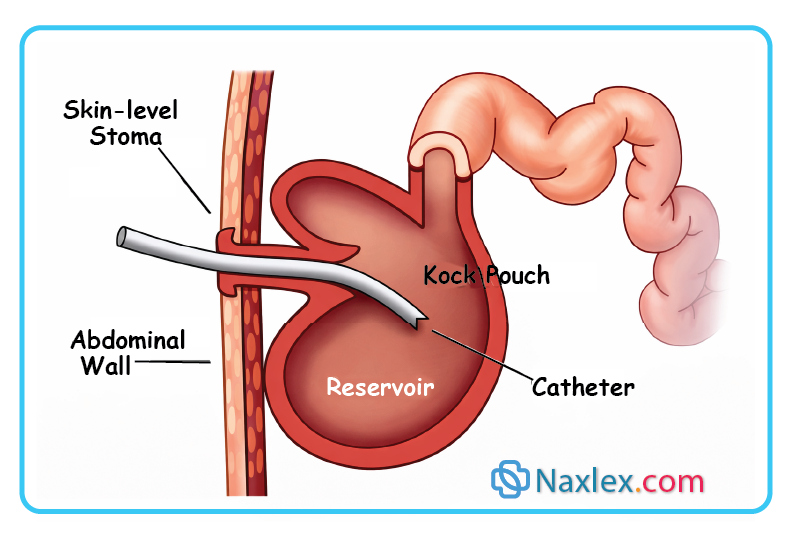
2. Kock pouch: This is a continent cutaneous urinary diversion. The surgeon creates an internal reservoir from the small intestine. A “nipple” valve is created so urine does not leak out. Because there is no external bag, the client must perform CISC every 4–6 hours to empty the internal pouch through the stoma.
Rationale for incorrect answers:
1. Ileal conduit: This is an incontinent urinary diversion. The ureters are connected to a piece of the ileum, which opens onto the abdominal wall as a stoma. Urine drains continuously into an external collection bag. No catheterization is required.
3. Neobladder: A neobladder is an internal reservoir connected to the urethra. Ideally, the client voids by relaxing the pelvic floor and using the Valsalva maneuver (bearing down). While some neobladder patients may occasionally need to catheterize if they can't empty fully, it is not the standard primary method of emptying as it is for a Kock pouch.
4. Vesicostomy: This is a simple opening made directly from the bladder to the abdominal wall, common in pediatrics. It usually drains directly into a diaper or an appliance; while it can be catheterized, the Kock pouch is the definitive answer for a diversion requiring a formal CISC schedule.
Test taking strategy:
Ask: “How is urine emptied?”
- External bag - no catheter
- Internal pouch with stoma - catheter required
Continent diversions store urine thus needs to be emptied.
Take home points:
- An ileal conduit is “incontinent” - needs a bag.
- A Kock pouch is “continent” - needs a catheter.
- For patients with a Kock pouch, learning CISC is essential for survival and social continence, as the pouch can rupture if not emptied regularly.
Correct Answer is B
Explanation
Collecting a urine specimen for routine urinalysis involves obtaining a clean, midstream sample to ensure accuracy and reduce contamination; the patient is instructed to wash their hands, cleanse the genital area, begin urinating into the toilet, then collect the midstream portion in a sterile container, sealing it promptly and labeling it correctly. The specimen should be delivered to the laboratory as soon as possible - ideally within one hour - or refrigerated if delayed, since prolonged standing can alter results.
Rationale for correct answer:
2. Results may be altered if a sample is left standing at room temperature for a long time: If urine sits at room temperature for longer than 1 hour, it begins to decompose. Bacteria multiply, the pH becomes more alkaline as urea converts to ammonia, and glucose levels may drop as bacteria consume it. If the sample cannot be sent to the lab immediately, it must be refrigerated.
Rationale for incorrect answers:
1. A sterile specimen is required for collection: A routine urinalysis does not require a sterile specimen. It is a clean procedure, not a surgical one. A sterile specimen is only required for a urine culture and sensitivity to identify specific bacteria.
3. The external meatus requires cleaning with antiseptic soap and water before voiding: While the area should be generally clean, the formal “antiseptic wipe” procedure is specifically for a clean-catch midstream specimen. For a routine urinalysis, the client can simply void into a clean container.
4. A clean-catch midstream specimen is necessary: While a clean-catch is the “gold standard” for avoiding contamination, it is not strictly necessary for a routine screening urinalysis. A simple “random” specimen is usually sufficient unless the provider specifically orders a clean-catch or a culture.
Test taking strategy
- In nursing exams, look for the answer that addresses specimen integrity.
- Options 1, 3, and 4 are “best practice” for cultures, but Option 2 is a universal rule for all urine samples.
Take home points:
- Urine is a living medium; to get accurate results for pH, nitrites, and bacteria, the lab must receive the specimen within 1 hour or it must be cooled to pause bacterial growth.
- Always distinguish between a routine urinalysis (tests for chemistry/blood/protein) and a culture (tests for specific bacteria).
- Cultures require sterile technique; routine urinalysis do not.
Whether you are a student looking to ace your exams or a practicing nurse seeking to enhance your expertise , our nursing education contents will empower you with the confidence and competence to make a difference in the lives of patients and become a respected leader in the healthcare field.
Visit Naxlex, invest in your future and unlock endless possibilities with our unparalleled nursing education contents today