
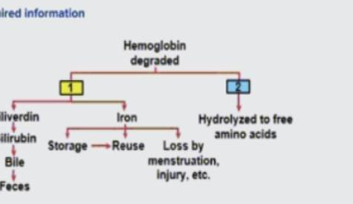
This figure shows the stages of hemoglobin breakdown and disposal. What should go in the yellow box labeled 1?
Heme
Globin
Erythropoietin
The Correct Answer is A
A. Heme: When hemoglobin from old red blood cells is broken down, it first separates into heme and globin. The yellow box leads to the pathway that forms biliverdin, then bilirubin, which is excreted in bile and leaves the body in feces. This sequence occurs only from the heme portion of hemoglobin. During heme breakdown, iron is removed for storage or reuse, and the remaining heme ring is converted to biliverdin and then bilirubin. Therefore, the structure in box 1 must be heme.
B. Globin is incorrect because globin is the protein portion of hemoglobin. It does not form bilirubin. Instead, globin is broken down into amino acids, which are reused by the body to make new proteins. This pathway does not involve bile pigments or fecal excretion.
C. Erythropoietin is incorrect because erythropoietin is a hormone produced by the kidneys that stimulates red blood cell production in the bone marrow. It is not a component of hemoglobin and does not play any role in hemoglobin breakdown or bilirubin formation.
Nursing Test Bank
Naxlex Comprehensive Predictor Exams
Related Questions
Correct Answer is E
Explanation
A. Hormone at E - Growth Hormone (GH): The diagram indicates that hormone E is released from the anterior pituitary and targets the liver and skeletal muscles. In the liver, it stimulates the production of insulin-like growth factors (IGFs) to promote systemic growth. Its action on skeletal muscle facilitates protein synthesis and tissue hypertrophy.
B. Hormone A - Prolactin (PRL): The diagram depicts hormone A traveling from the adenohypophysis to the mammary glands. This protein hormone is essential for initiating and maintaining milk production following parturition. Its secretion is regulated by hypothalamic dopamine, which serves as a primary prolactin-inhibiting factor.
C. Hormone B - Thyroid-stimulating Hormone (TSH): The pathway labeled B shows a tropic hormone targeting the thyroid gland. TSH stimulates the follicular cells of the thyroid to synthesize and release thyroxine and triiodothyronine. This hormone is a critical regulator of systemic basal metabolic rate and cellular heat production.
D. Hormone C - Gonadotropins (FSH and LH): Label C represents the gonadotropins, specifically follicle-stimulating hormone and luteinizing hormone, which target the testes and ovaries. These hormones regulate gametogenesis and the secretion of sex steroids like testosterone and estrogen. They are essential for the maintenance of reproductive cycles and secondary sexual characteristics.
E. Hormone at D - Adrenocorticotropic Hormone (ACTH): The diagram shows hormone D being secreted from the anterior pituitary and traveling specifically to the adrenal gland. More specifically, it targets the adrenal cortex to regulate the production of steroid hormones. It is a critical component of the hypothalamic-pituitary-adrenal (HPA) axis.
Correct Answer is C
Explanation
A. Lungs: The lungs are the primary site for the activity of Angiotensin-Converting Enzyme, which transforms angiotensin I into angiotensin II. While they are central to the RAAS pathway, they do not synthesize the precursor protein angiotensinogen. Their role is enzymatic conversion rather than substrate production.
B. Kidneys: The juxtaglomerular cells of the kidneys secrete the enzyme renin in response to low blood pressure. While the kidneys initiate the cascade, they are the source of the enzyme, not the protein substrate angiotensinogen. The kidneys react to the substrate produced by a different organ.
C. Liver: This organ constitutively synthesizes and releases the alpha-2 globulin known as angiotensinogen into the systemic circulation. This protein serves as the essential substrate upon which renin acts to produce angiotensin I. It is the primary biosynthetic source of this precursor molecule.
D. Heart: The heart produces atrial natriuretic peptide in response to atrial stretch, which generally opposes the effects of the RAAS pathway. It does not produce the angiotensinogen required for the initiation of angiotensin I formation. Cardiac tissue is a target rather than a source for this substrate.
E. spleen: The spleen serves primarily as a lymphoid organ and a site for erythrocyte recycling. It does not possess the secretory capacity or the metabolic machinery to produce systemic hormonal precursors like angiotensinogen. It is not a component of the renin-angiotensin-aldosterone system.
Whether you are a student looking to ace your exams or a practicing nurse seeking to enhance your expertise , our nursing education contents will empower you with the confidence and competence to make a difference in the lives of patients and become a respected leader in the healthcare field.
Visit Naxlex, invest in your future and unlock endless possibilities with our unparalleled nursing education contents today