
Use the diagram above to answer the following questions.
Which letter indicates Wernicke's area, which is important for understanding spoken words?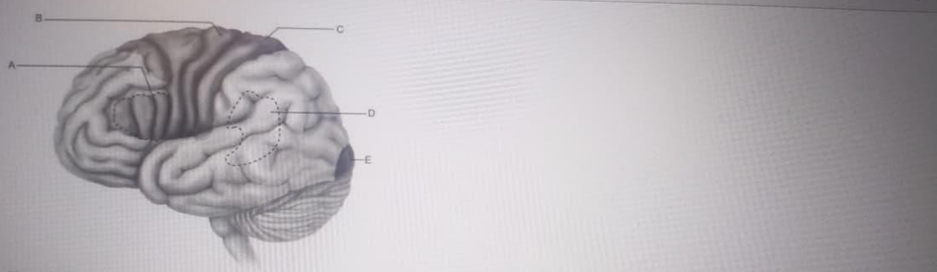
A
B
C
D
E
The Correct Answer is D
A. Broca’s Area: This region is primarily responsible for the motor production of speech. Damage to this area results in expressive aphasia, where a patient understands language but struggles to physically produce words or form grammatically complex sentences. It is distinct from the sensory processing required for understanding spoken language.
B. Precentral Gyrus: This anatomical landmark represents the primary motor cortex (Brodmann area 4), which controls voluntary muscle movements on the contralateral side of the body. While it is essential for the mechanical execution of speech via the cranial nerves, a lesion here would manifest as hemiparesis or dysarthria.
C. Postcentral Gyrus: This region houses the primary somatosensory cortex, where the brain processes tactile sensations such as touch, pressure, and proprioception. It follows a somatotopic arrangement known as the sensory homunculus, mapping various body parts to specific cortical locations. Its function is strictly sensory.
D. Wernicke’s Area: This area is the neurological hub for language comprehension and processing. It allows the brain to interpret auditory code and attach meaning to spoken words; consequently, damage here leads to receptive aphasia (Wernicke's aphasia). In this clinical state, patients can produce fluid, melodic speech, but the content is often nonsensical or "word salad" because they cannot monitor their own language or understand others.
E. Primary visual cortex: Brodmann area 17 is dedicated to receiving and processing visual stimuli from the retinas. While the occipital lobe is involved in reading (visual word recognition) through connections to the angular gyrus, it is not the site where spoken words are interpreted. Dysfunction in this area would lead to visual field defects or cortical blindness.
Nursing Test Bank
Naxlex Comprehensive Predictor Exams
Related Questions
Correct Answer is B
Explanation
A. Right and left Hepatic Ducts: These are the right and left ducts that exit the liver, carrying bile produced by hepatocytes into the common hepatic duct.
B. Cystic Duct: This is the short duct that connects the gallbladder to the common hepatic duct. It facilitates the bidirectional flow of bile—allowing it to enter the gallbladder for storage and concentration, and later signaling its release into the digestive tract.
C. Common Bile Duct: Formed by the junction of the cystic duct and the common hepatic duct, this vessel carries bile down to the duodenum to aid in the emulsification of fats.
D. Hepatopancreatic Ampulla: This is the distal location where the common bile duct and the pancreatic duct join to empty their contents into the second part of the duodenum.
E. Pancreatic Duct: This duct runs through the length of the pancreas, transporting digestive enzymes (pancreatic juice) to be secreted into the small intestine.
Correct Answer is A
Explanation
A. protons: The number of protons in the nucleus determines the atomic number, which uniquely identifies an element on the periodic table. Changing the proton count alters the nuclear charge and results in a completely different element with distinct physical and chemical properties.
B. neutrons: Neutrons contribute to the atomic mass and nuclear stability but do not define the type of element. Atoms of the same element may have different numbers of neutrons, forming isotopes without changing elemental identity.
C. mesotrons: Mesotrons, also known as mesons, are particles involved in nuclear force interactions and are not structural components of atoms. They play no role in determining elemental classification.
D. electrons: Electrons determine how an atom interacts chemically and forms bonds, but gaining or losing electrons creates ions rather than new elements. The elemental identity remains unchanged as long as the proton number is constant.
Whether you are a student looking to ace your exams or a practicing nurse seeking to enhance your expertise , our nursing education contents will empower you with the confidence and competence to make a difference in the lives of patients and become a respected leader in the healthcare field.
Visit Naxlex, invest in your future and unlock endless possibilities with our unparalleled nursing education contents today