
What nursing intervention is particularly indicated for the second stage of labor?
Providing pain medication to increase the client's tolerance of labor pains
Assessing the fetal heart rate and pattern for signs of fetal distress
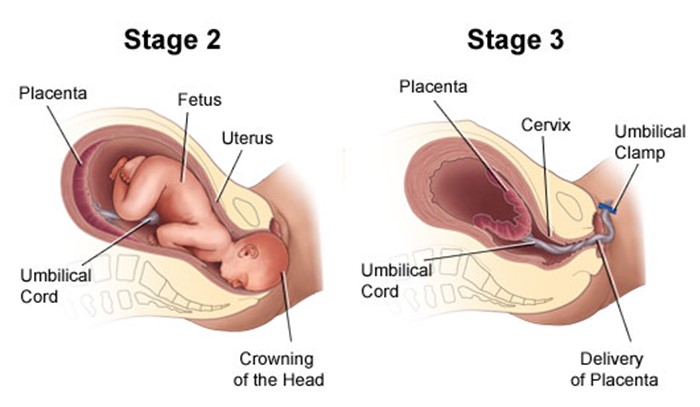
Assisting the client to push effectively so that expulsion of the fetus can be achieved
Monitoring effects of oxytocin administration to help achieve cervical dilation
The Correct Answer is C
Choice A reason: Providing pain medication to increase the client's tolerance of labor pains is not a specific intervention for the second stage of labor. Pain medication is a drug that relieves pain by blocking pain signals or reducing inflammation. Pain medication can be given during any stage of labor, depending on the client's preference and condition. However, pain medication may have side effects such as sedation, nausea, or respiratory depression, and may affect the fetal heart rate or the progress of labor.
Choice B reason: Assessing the fetal heart rate and pattern for signs of fetal distress is not a particular intervention for the second stage of labor. Fetal heart rate and pattern are indicators of fetal well-being and oxygenation. Fetal heart rate and pattern should be monitored throughout labor, especially during contractions, to detect any abnormalities or complications such as bradycardia, tachycardia, or decelerations.
Choice D reason: Monitoring effects of oxytocin administration to help achieve cervical dilation is not a relevant intervention for the second stage of labor. Oxytocin is a hormone that stimulates uterine contractions and cervical dilation. Oxytocin can be administered during labor to augment or induce labor, especially if there is prolonged or dysfunctional labor. However, oxytocin is not needed in the second stage of labor, when the cervix is already fully dilated and the focus is on pushing and delivering the baby.
Nursing Test Bank
Naxlex Comprehensive Predictor Exams
Related Questions
Correct Answer is ["A","C","D"]
Explanation
Choice A reason: This is a correct answer because continuing to monitor the client for signs of an infection is important to detect any recurrence or complication of MRSA infection. MRSA is a type of bacteria that is resistant to many antibiotics and can cause serious skin, soft tissue, bone, joint, or bloodstream infections. The nurse should assess the client's vital signs, wound appearance, pain level, and laboratory results.
Choice B reason: This is not a correct answer because calling the healthcare provider for a prescription for linezolid is not necessary unless the client has an active MRSA infection that requires treatment. Linezolid is an antibiotic that can be used to treat MRSA infections, but it has potential side effects and interactions that need to be considered. The nurse should not prescribe or administer antibiotics without a valid order.
Choice C reason: This is a correct answer because collecting multiple sets of blood cultures for MRSA screening is important to identify any asymptomatic bacteremia or sepsis that could result from MRSA infection. MRSA can enter the bloodstream through wounds, catheters, or surgical sites and cause life-threatening complications such as endocarditis, osteomyelitis, or pneumonia. The nurse should obtain blood samples from different sites and times and send them to the laboratory for analysis.
Choice D reason: This is a correct answer because placing the client on contact transmission precautions is important to prevent the spread of MRSA to other clients, staff, or visitors. Contact transmission precautions include wearing gloves and gowns when entering the client's room, using dedicated or disposable equipment, and performing hand hygiene before and after contact with the client or their environment.
Choice E reason: This is not a correct answer because obtaining a sputum specimen for culture and sensitivity is not relevant to the client's history of MRSA wound infection. Sputum culture and sensitivity is a test that can be used to diagnose respiratory infections caused by bacteria, fungi, or viruses. The nurse should only obtain a sputum specimen if the client has signs or symptoms of a respiratory infection, such as cough, fever, chest pain, or dyspnea.
Correct Answer is C
Explanation
Choice A: Yellow-tinged sputum is not a critical finding for the nurse to report, as this is a common sign of pneumonia and does not indicate an adverse reaction to meropenem. This is a distractor choice.
Choice B: Nausea and headache are not urgent findings for the nurse to report, as these are mild side effects of meropenem and can be managed with supportive measures. This is another distractor choice.
Choice C: Watery diarrhea is an important finding for the nurse to report, as this can indicate a serious complication of meropenem, such as Clostridioides difficile infection, which can cause severe dehydration, electrolyte imbalance, and sepsis. Therefore, this is the correct choice.
Choice D: Increased fatigue is not a significant finding for the nurse to report, as this can be related to the client's underlying condition and does not suggest a problem with meropenem. This is another distractor choice.

Whether you are a student looking to ace your exams or a practicing nurse seeking to enhance your expertise , our nursing education contents will empower you with the confidence and competence to make a difference in the lives of patients and become a respected leader in the healthcare field.
Visit Naxlex, invest in your future and unlock endless possibilities with our unparalleled nursing education contents today