
What structure is indicated by the highlighting and leader line(s)?
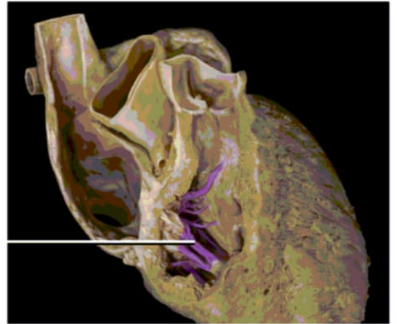
The Correct Answer is ["Chordae tendineae."]
The chordae tendineae are thin, strong, fibrous cords that connect the papillary muscles to the atrioventricular (AV) valves-in this case, the tricuspid valve on the right side of the heart. They prevent the valve leaflets from inverting into the atrium during ventricular contraction, ensuring one-way blood flow from the atria to the ventricles.
Nursing Test Bank
Naxlex Comprehensive Predictor Exams
Related Questions
Correct Answer is E
Explanation
A. Liver:The liver is involved in metabolism, detoxification, and some immune functions like Kupffer cell activity, but it is not a site for T cell maturation or development of immunocompetence.
B. Spleen:The spleen is a secondary lymphoid organ where mature T cells encounter antigens, but it does not confer immunocompetence. It primarily filters blood and supports immune responses.
C. Bloodstream:T cells circulate in the bloodstream after becoming immunocompetent. The blood serves as a transport medium but is not a site for T cell maturation or education.
D. Bone marrow:While T cells originate from hematopoietic stem cells in the bone marrow, they do not achieve immunocompetence there. Bone marrow is the site for B cell maturation, not T cell education.
E. Thymus:The thymus is the primary lymphoid organ where T cells undergo differentiation, selection, and maturation. It provides the necessary environment for developing functional T cell receptors and self-tolerance, making it the site of T cell immunocompetence.
Correct Answer is C
Explanation
A. Their secretions may be released onto the body surface:This describes exocrine glands, such as sweat or sebaceous glands, which secrete substances through ducts onto epithelial surfaces. Endocrine glands do not release secretions onto body surfaces.
B. They secrete substances that do not alter the metabolism of their target cells, but have extracellular effects:Endocrine glands secrete hormones that specifically act on target cells to alter their metabolism or function. Substances with only extracellular effects without influencing metabolism are not characteristic of endocrine function.
C. They release their secretions into the blood:Endocrine glands secrete hormones directly into the bloodstream. This allows the hormones to travel throughout the body and act on distant target cells, which is the defining feature of endocrine glands.
D. They secrete their products by way of ducts:Secretion via ducts is a hallmark of exocrine glands, not endocrine glands. Endocrine glands are ductless and rely on the circulatory system to transport their secretions.
E. They have an unusually low density of blood capillaries:Endocrine glands are highly vascularized to facilitate rapid hormone transport into the blood. A low density of capillaries would impede hormone distribution, which is contrary to endocrine physiology.
Whether you are a student looking to ace your exams or a practicing nurse seeking to enhance your expertise , our nursing education contents will empower you with the confidence and competence to make a difference in the lives of patients and become a respected leader in the healthcare field.
Visit Naxlex, invest in your future and unlock endless possibilities with our unparalleled nursing education contents today