
When preparing medication from a vial for a subcutaneous injection for a client, which of the following actions should the nurse take?
Hold the syringe so that bubbles collect at the level of the plunger.
Hold the vial with the top facing upward while injecting air into the vial.
Inject air into the vial with the eye of the needle immersed in the fluid.
Hold the syringe at a 45° angle to verify dosage.
The Correct Answer is B
When preparing medication from a vial for subcutaneous injection for a client, the nurse should hold the vial with the top facing upward while injecting air into the vial.
This is because injecting air into the vial equalizes the pressure inside and makes it easier to withdraw the medication 1.
Choice A is wrong because holding the syringe so that bubbles collect at the level of the plunger is not necessary when preparing medication from a vial.
Choice C is wrong because injecting air into the vial with the eye of the needle immersed in the fluid can contaminate the medication.
Choice D is wrong because holding the syringe at a 45° angle is not necessary when verifying dosage.
Nursing Test Bank
Naxlex Comprehensive Predictor Exams
Related Questions
Correct Answer is D
Explanation
In general, parental (or legal guardian) consent is required for any diagnostic or surgical procedure performed on a child under the age of 181.
Choice A is wrong because the mother’s 21-year-old sibling is not a parent or legal guardian of the infant.
Choice B is wrong because the infant’s provider cannot sign the consent form on behalf of the infant.
Choice C is wrong because the infant’s grandparent cannot sign the consent form unless they are a legal guardian of the infant.
Correct Answer is B
Explanation
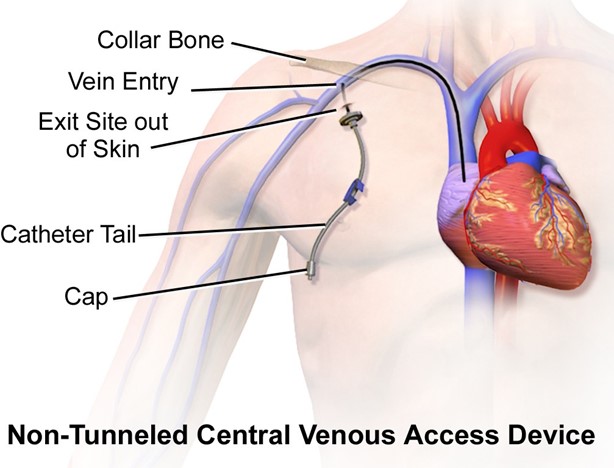
Prepare the client for a central venous line.
Parenteral nutrition (PN) with 20% dextrose and fat emulsions is a hypertonic solution that requires infusion through a central venous line to prevent damage to peripheral veins.
Choice A is wrong because the PN infusion bag should be changed every 24 hours, not every 48 hours.
Choice Cis wrong because blood glucose should be monitored more frequently than once daily when initiating PN therapy.
Choice Dis wrong because PN and fat emulsions can be administered together in a total nutrient admixture (TNA)1.
Whether you are a student looking to ace your exams or a practicing nurse seeking to enhance your expertise , our nursing education contents will empower you with the confidence and competence to make a difference in the lives of patients and become a respected leader in the healthcare field.
Visit Naxlex, invest in your future and unlock endless possibilities with our unparalleled nursing education contents today