
Which auscultation site is best located at the fifth intercostal space along the left midclavicular line?
Aortic valve
Mitral valve
Pulmonic valve
Erb's Point
The Correct Answer is B
Choice A reason: The aortic valve is auscultated at the second intercostal space along the right sternal border. This location is anatomically optimized to capture sounds generated by blood flow exiting the left ventricle through the aortic valve into the systemic circulation, rather than the mitral valve site.
Choice B reason: The mitral valve is anatomically located at the cardiac apex. Auscultation at the fifth intercostal space along the left midclavicular line allows the stethoscope to be placed directly over this point of maximal impulse, where the mitral valve's S1 closure is most distinctively heard during the cardiac cycle.
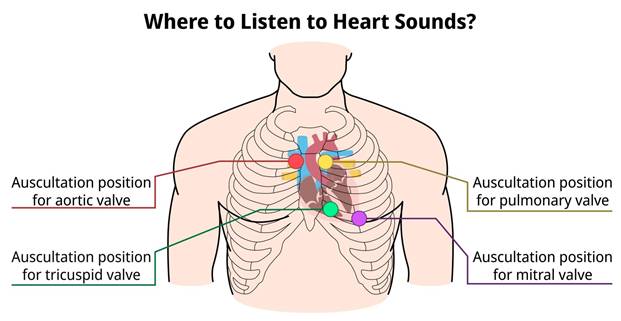
Choice C reason: The pulmonic valve is auscultated at the second intercostal space along the left sternal border. This position is specific to monitoring the closure of the semilunar pulmonic valve and is distinct from the apical position used for the mitral valve.
Choice D reason: Erb's Point is situated at the third intercostal space along the left sternal border. This is a common location where sounds from both the aortic and pulmonic valves are heard with relatively equal intensity, facilitating the detection of murmurs, but it is not the anatomical site for the mitral valve.
Nursing Test Bank
Naxlex Comprehensive Predictor Exams
Related Questions
Correct Answer is D
Explanation
Choice A reason: Rales, also known as crackles, are adventitious (abnormal) lung sounds that indicate fluid in the small airways, such as in pneumonia or congestive heart failure. They are characterized by discontinuous, popping sounds rather than the soft, low-pitched, rustling sound of normal healthy lung ventilation.
Choice B reason: Tracheal breath sounds are very loud, high-pitched, and harsh, heard directly over the trachea. They are distinctly different from the soft, low-pitched sounds of normal peripheral lung tissue. These sounds are not indicative of normal peripheral respiratory gas exchange but reflect air moving through the main airway.
Choice C reason: Bronchial breath sounds are loud, high-pitched, and hollow, heard over the large airways such as the manubrium. They have a distinct pause between inspiration and expiration and are much more intense than the gentle, soft sounds heard throughout the majority of the peripheral lung fields.
Choice D reason: Vesicular breath sounds are the normal, soft, low-pitched sounds heard over most of the peripheral lung fields. The sound is often described as a soft, gentle rustling, similar to wind blowing through trees, produced by air moving into the smaller bronchioles and alveoli during inhalation.
Correct Answer is A
Explanation
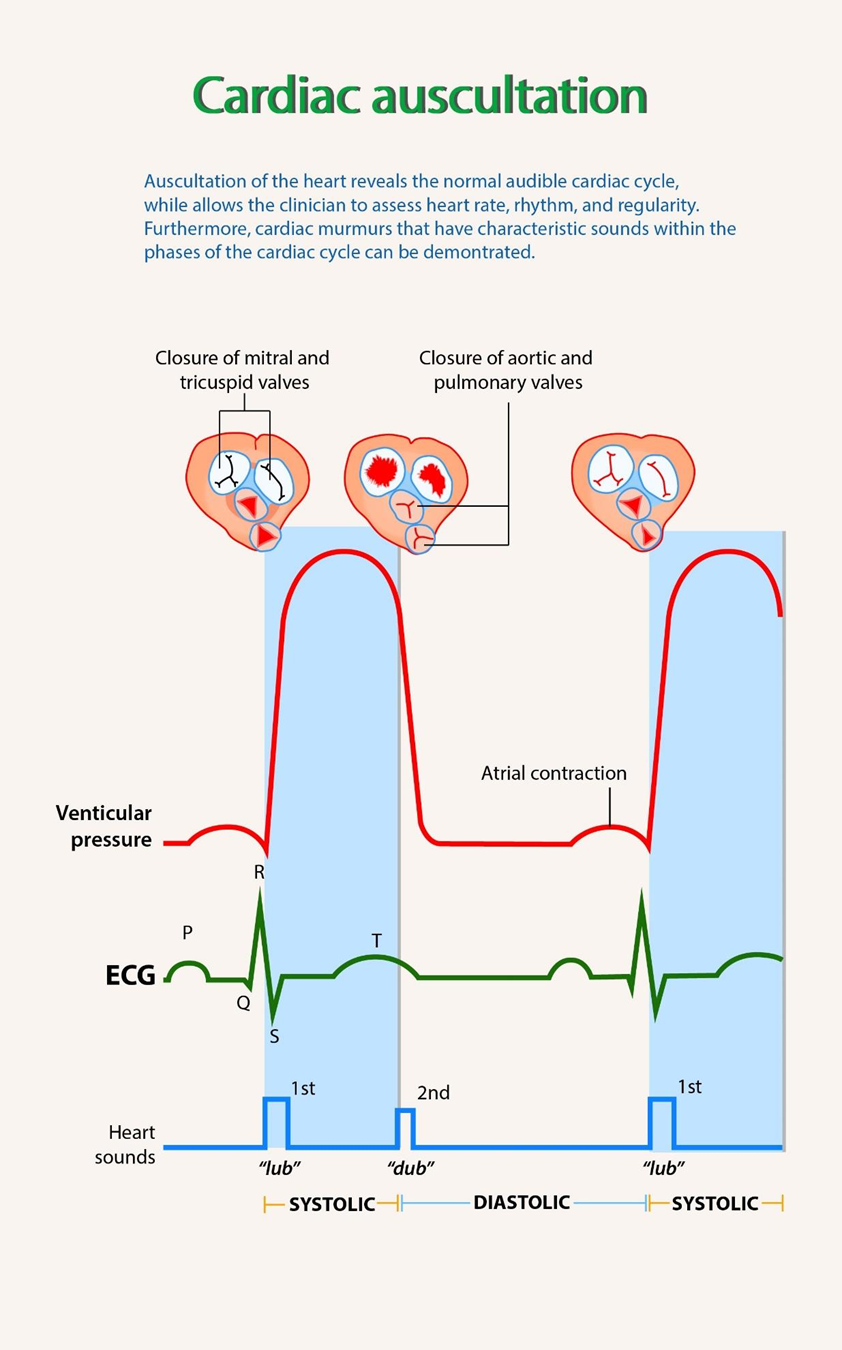
Choice A reason: The S1 heart sound represents the closure of the atrioventricular valves, and S2 represents the closure of the semilunar valves. The interval between S1 and S2 corresponds to ventricular systole. Any audible turbulence or vibration detected during this specific cardiac phase is classified as a systolic murmur, often resulting from increased blood flow or valvular pathology.
Choice B reason: While S1 and S2 are considered expected heart sounds, turbulence audible during the systolic phase is considered an adventitious sound. An expected or normal heart examination typically involves clear, crisp valvular closures without audible swishing or blowing sounds, which indicate abnormal blood flow patterns.
Choice C reason: The third heart sound is a low-frequency sound occurring during the rapid filling phase of early diastole, immediately following S2. It is produced by the vibration of the ventricular walls as blood rushes into the ventricles. It is not associated with the systolic interval between S1 and S2.
Choice D reason: The fourth heart sound is a low-pitched sound heard in late diastole, just before S1. It is generated by the atrial contraction forcing blood into a stiff, non-compliant ventricle. Like the S3, this sound occurs during diastole and is not related to the turbulence occurring during the systolic interval.
Whether you are a student looking to ace your exams or a practicing nurse seeking to enhance your expertise , our nursing education contents will empower you with the confidence and competence to make a difference in the lives of patients and become a respected leader in the healthcare field.
Visit Naxlex, invest in your future and unlock endless possibilities with our unparalleled nursing education contents today