
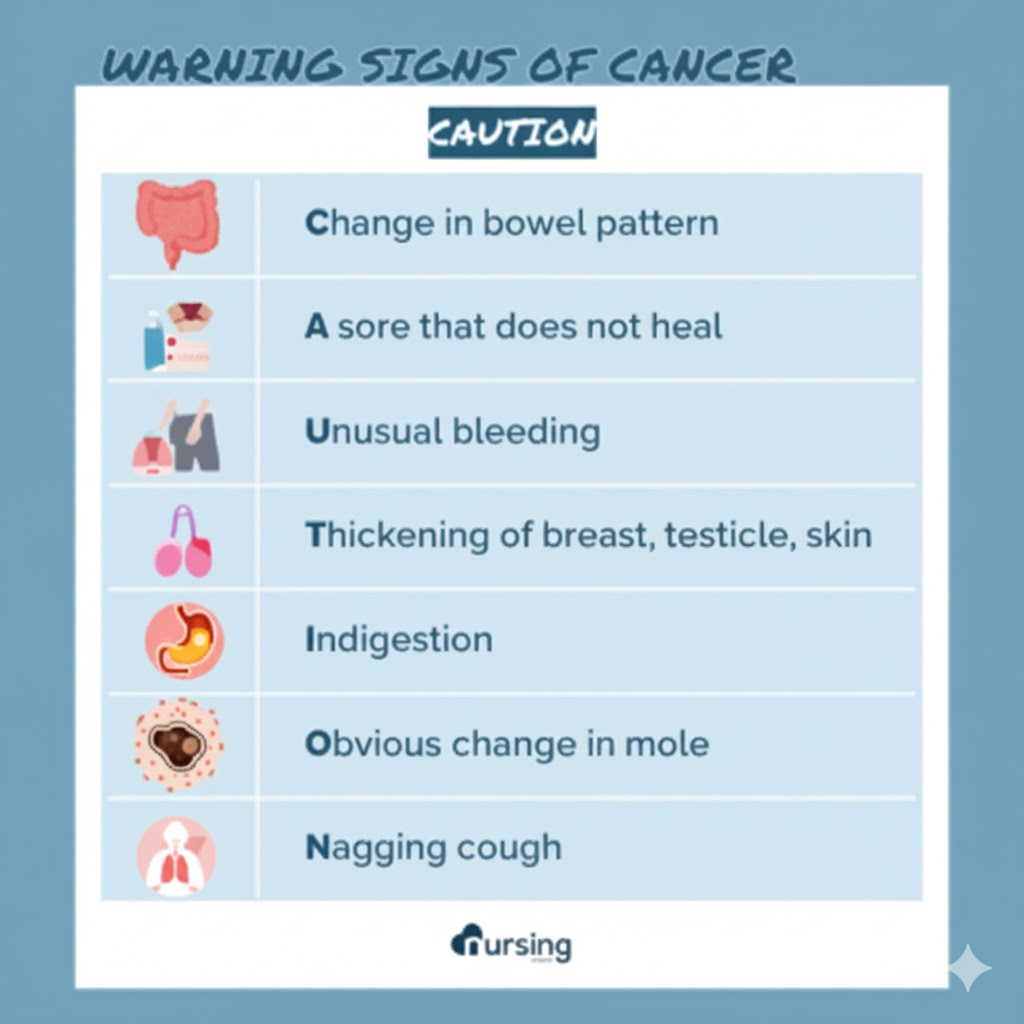
Which findings in a routine health assessment would the nurse recognize as part of the CAUTION acronym? (Select All that Apply.)
A sore that does not heal
Unusual bleeding or discharge
Frequent headaches
Thickening or lump in breast or elsewhere
Persistent cough or hoarseness
Difficulty swallowing
Change in bowel or bladder habits
Sudden weight gain
Fatigue
Correct Answer : A,B,D,E,F,G
Rationale:
A. A sore that does not heal: This corresponds to the "S" in CAUTION (“Sore that does not heal”), which can be an early warning sign of cancer.
B. Unusual bleeding or discharge: Matches the "U" in CAUTION (“Unusual bleeding or discharge”), indicating potential malignancy.
C. Frequent headaches: While concerning, headaches are not included in the CAUTION acronym and are not a general cancer warning sign.
D. Thickening or lump in breast or elsewhere: Represents the "T" in CAUTION (“Thickening or lump”), a common early sign of tumors.
E. Persistent cough or hoarseness: Corresponds to the "O" in CAUTION (“Obvious change in voice or persistent cough”), which may indicate cancers of the respiratory tract or larynx.
F. Difficulty swallowing: Matches the "O" in CAUTION (“Obvious change in swallowing” or persistent difficulty), which can be a warning sign for esophageal or throat cancer.
G. Change in bowel or bladder habits: Represents the "C" in CAUTION (“Change in bowel or bladder habits”), which may indicate colorectal, bladder, or prostate cancer.
H. Sudden weight gain: Not part of the CAUTION acronym; unintentional weight loss is sometimes a concern, but gain is not included.
I. Fatigue: Fatigue is a general symptom but is not specifically part of the CAUTION warning signs.
Nursing Test Bank
Naxlex Comprehensive Predictor Exams
Related Questions
Correct Answer is B
Explanation
Rationale:
A. Encouraging the patient to eat solid foods may be appropriate once vomiting has subsided, but during active gastroenteritis with persistent vomiting and diarrhea, oral intake is often insufficient to prevent dehydration. Relying on food alone does not address acute fluid loss.
B. Initiating intravenous (IV) fluid therapy is the priority intervention. Persistent vomiting and diarrhea can lead to rapid fluid and electrolyte loss, resulting in hypovolemia, hypotension, tachycardia, and potential shock. IV fluids provide immediate restoration of circulating volume, correct electrolyte imbalances, and prevent life-threatening complications.
C. Administering antiemetics can help reduce nausea and vomiting, but it does not correct the underlying fluid deficit. While controlling vomiting supports oral intake, IV fluid replacement is more urgent to stabilize the patient.
D. Monitoring daily weight is useful for tracking fluid balance, but it is a secondary assessment tool. It does not intervene in acute hypovolemia and cannot replace prompt fluid resuscitation.
Correct Answer is D
Explanation
Rationale:
A. Fasting before an MRI is generally not required unless contrast dye is planned. While fasting may prevent nausea, it does not address the critical safety concern related to the Linx device.
B. Administering antacids may help control GERD symptoms but does not impact MRI safety. The primary risk involves the magnetic properties of the Linx device, not reflux.
C. Requesting a CT scan instead of an MRI is not necessary if the Linx device is confirmed to be MRI-compatible. Substituting imaging modalities without verifying safety may delay needed diagnostic evaluation.
D. Informing the radiologist about the Linx device and confirming MRI compatibility is the most appropriate action. The Linx device, which is a magnetic ring placed around the lower esophageal sphincter, contains metal and magnets, which can interact with MRI machines. Some newer Linx devices are conditional for MRI under specific parameters, so verification with the radiology team ensures patient safety, prevents device displacement, and avoids injury or malfunction during imaging.
Whether you are a student looking to ace your exams or a practicing nurse seeking to enhance your expertise , our nursing education contents will empower you with the confidence and competence to make a difference in the lives of patients and become a respected leader in the healthcare field.
Visit Naxlex, invest in your future and unlock endless possibilities with our unparalleled nursing education contents today