
Which is not part of your appendicular skeleton?
Ulna.
Ethmoid bone.
Ilium.
Patella.
The Correct Answer is B
The ethmoid bone is a part of the axial skeleton, not the appendicular skeleton.
The axial skeleton consists of the bones of the skull, vertebral column, ribs, and sternum.
Choice A is incorrect because the ulna is a part of the upper limb, which is supported by the pectoral girdle.
Choice C is incorrect because the ilium is a part of the hip bone, which forms the pelvic girdle.
Choice D is incorrect because the patella is a part of the lower limb, which is supported by the pelvic girdle.
Nursing Test Bank
Naxlex Comprehensive Predictor Exams
Related Questions
Correct Answer is D
Explanation
The transverse foramina are openings in the transverse processes of the cervical vertebrae that allow the passage of the vertebral arteries and veins.
They are not found on any other vertebrae.
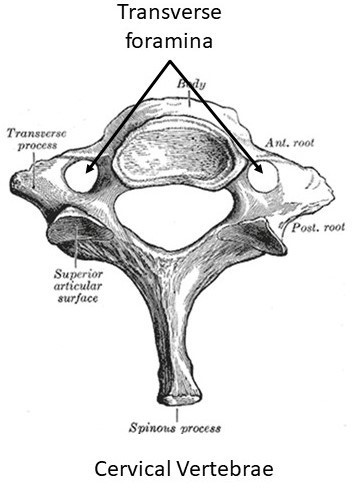
Choice A is incorrect because spinous processes are bony projections on the posterior aspect of all vertebrae that serve as attachment sites for muscles and ligaments.
Choice B is incorrect because transverse processes are lateral projections on all vertebrae that serve as attachment sites for muscles and ribs.
Choice C is incorrect because costal facets are articular surfaces on the thoracic vertebrae that articulate with the heads of the ribs.
They are found on all thoracic vertebrae except T11 and T123.
Correct Answer is ["Clavicular notch"]
Explanation
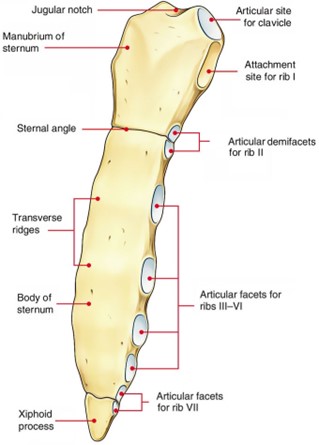
The clavicular notch, also known as the sternal notch, is a shallow, V-shaped depression located at the superior aspect of the sternum, which is the long, flat bone in the center of the chest.
The clavicular notch serves as the articulation site for the medial end of the clavicle bone, forming the sternoclavicular joint.
This joint allows for movements of the clavicle and shoulder girdle, including elevation and depression of the shoulder and rotation of the scapula
 .
.
Whether you are a student looking to ace your exams or a practicing nurse seeking to enhance your expertise , our nursing education contents will empower you with the confidence and competence to make a difference in the lives of patients and become a respected leader in the healthcare field.
Visit Naxlex, invest in your future and unlock endless possibilities with our unparalleled nursing education contents today