
naxlex image logo

Naxlex

  • Nursing School Content
  • TEAS Content
  • HESI Content
  • Register
  • Sign Up
How it Works
Naxlex
  • Medical Surgical
  • Blood and Cardiovascular Disorders
  • Cardiac Arrest Recognition and Response
Try Naxlex NCLEX-RN (14-day Free-Trial)

Cardiac Arrest Recognition and Response

- Cardiac arrest is when the heart stops beating or beats too ineffectively to circulate blood to the brain and other vital organs.

- Cardiac arrest can be caused by many factors, such as heart attack, drowning, electrocution, drug overdose, choking, trauma, or infection.

- Cardiac arrest can happen to anyone, at any age, at any time.

- Cardiac arrest is a life-threatening emergency that requires immediate action.

- The signs of cardiac arrest are :

  - Sudden collapse or loss of consciousness

  - No breathing or gasping breaths

  - No pulse or movement

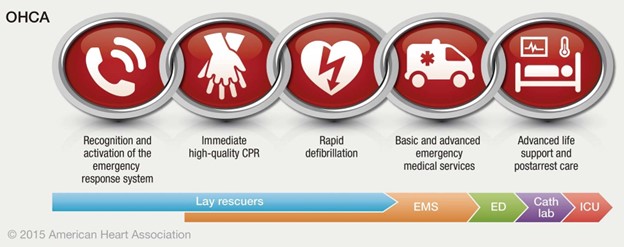
- The steps to respond to cardiac arrest are :

  - Check for safety and responsiveness

  - Call 9-1-1 or the local emergency number and get an AED if available

  - Start chest compressions (and rescue breaths if trained)

  - Use an AED as soon as possible

  - Continue CPR until help arrives or the person shows signs of life
Nursing Test Bank

Test Bank #1: RN Pharmacology Exams Test Bank #2: RN Medical-Surgical Exams Test Bank #3: RN Fundamentals Exams Test Bank #4: RN Maternal-Newborn Exams Test Bank #5: RN Anatomy and Physiology Exams Test Bank #6: RN Obstetrics and Pediatrics Exams Test Bank #7: RN Fluid and Electrolytes Exams Test Bank #9: RN Adult Health Test Bank #10: RN Dosage Calculation Test Bank #11: RN Community Health Exams Test Bank #12: RN Psychology Exams Test Bank #13: RN Nursing Care Of Children Test Bank #14: RN Foundations of Nursing Exams

Naxlex Comprehensive Predictor Exams

Exam #1: RN Comprehensive predictor 2023 proctored exam Exam #2: Ati rn vati comprehensive predictor proctored exam Exam #3: Ati Rn Comprehensive Predictor Proctored Exam 2023 Exam #4: Rn Comprehensive Predictor 2023 Proctored Exam - St. Joseph Exam #5: RN Comprehensive Predictor Proctored Exam (National U CA San Diego) Exam #6: Ati rn comprehensive predictor 2023 retake proctored exam Exam #7: RN Hesi Exit Proctored Exam Exam #8: Hesi RN Exit proctored exam Exam #9: Hesi rn exit proctored exam Exam #10: Hesi Rn compass exit B proctored exam

Questions on Cardiac Arrest Recognition and Response

Correct Answer is A

Explanation

Incorrect. Time is critical during a cardiac arrest, and the nurse should not wait for additional healthcare providers before initiating CPR and activating the emergency response system.

Correct Answer is A

Explanation

Incorrect. Performing a quick physical examination is not the first step when using an AED. The immediate priority is to check for responsiveness and turn on the AED.

Correct Answer is C

Explanation

Incorrect. For severe allergic reactions, the primary intervention is to administer epinephrine and seek emergency medical assistance. Hands-Only CPR is not indicated for anaphylactic reactions.

Correct Answer is A

Explanation

Incorrect. Immediate initiation of advanced cardiac life support (ACLS) is part of the overall resuscitation effort, but it is not the specific third link in the Chain of Survival. Prompt arrival of EMS takes precedence.

Correct Answer is B

Explanation

Incorrect. Closed-loop communication involves active engagement and acknowledgment between the team leader and team members. In this example, the team leader expects acknowledgment or response from team members.Questions

Correct Answer is B

Explanation

Incorrect. Compressing the chest to a depth of 4 inches (10 cm) is much deeper than the recommended depth for adult CPR. Excessive depth can lead to rib fractures and other injuries.

Correct Answer is B

Explanation

Incorrect. 60 compressions per minute is lower than the recommended rate for BLS chest compressions. The correct rate, as mentioned in option B, is 100-120 compressions per minute.

Correct Answer is A

Explanation

Incorrect. Administration of intravenous medications is part of advanced life support, which comes later in the Chain of Survival. The second link is focused on bystander CPR.

Correct Answer is A

Explanation

Incorrect. While medications play a role in advanced cardiac life support, they are not part of the initial links in the Chain of Survival. The first link focuses on early recognition and activation of the emergency response system.

Correct Answer is D

Explanation

Correct. High-quality CPR is critical because it improves the likelihood of restoring blood circulation and oxygenation to vital organs during resuscitation efforts. Effective chest compressions maintain blood flow, while rescue breaths provide oxygen to the lungs, enhancing the chances of a successful resuscitation outcome.Questions

Correct Answer is B

Explanation

Incorrect. Compressing the chest to a depth of 4 inches (10 cm) is much deeper than the recommended depth for adult CPR. Excessive depth can lead to rib fractures and other injuries.

Correct Answer is C

Explanation

Incorrect. While formal training in advanced life support is ideal, bystanders without formal training can still perform hands-only CPR, which involves chest compressions, until professional help arrives.

Correct Answer is B

Explanation

Incorrect. The compression-to-ventilation ratio of 10:1 is not the current guideline for adult CPR. The correct ratio involves more frequent compressions and periodic rescue breaths, as mentioned in option B.

Correct Answer is C

Explanation

Incorrect. While maintaining a calm demeanor is important, the team leader should involve other team members in decision-making and communication. Effective team dynamics rely on collaborative efforts.

Correct Answer is B

Explanation

Incorrect. Placing the pads on the lower abdomen is not the correct position for defibrillation. The pads should be positioned on the chest to deliver the electric shock to the heart.

Correct Answer is B

Explanation

Incorrect. While electronic devices can be used for communication, they may not be practical or necessary during CPR. Verbal and written communication are the primary modes of communication in such situations.

Correct Answer is D

Explanation

Correct. Early defibrillation is crucial because it helps to reset the heart's electrical activity, allowing the heart to resume an effective rhythm. The sooner defibrillation is performed, the better the chances of restoring a normal heart rhythm and improving the chances of survival.Questions

Correct Answer is C

Explanation

Incorrect. Long-term cardiac rehabilitation may be beneficial after a cardiac event, but it is not the fifth and final link in the Chain of Survival. The focus of the Chain of Survival is on the immediate response and resuscitation efforts.Questions

Incorrect. While an AED may have basic monitoring capabilities, its primary purpose is not to monitor vital signs during resuscitation efforts. The AED is used for defibrillation to treat cardiac arrest.

Incorrect. Administering an opioid antagonist is not part of the BLS guidelines. The focus of BLS is on providing immediate chest compressions and rescue breaths to support circulation and oxygenation.

Incorrect. This client's statement reflects an understanding of the significance of early recognition in improving survival rates during cardiac arrest.

Incorrect. Reporting resuscitation outcomes to the hospital administration is not the primary purpose of closed-loop communication during CPR. Its focus is on effective communication within the resuscitation team.

Incorrect. The compression-to-ventilation ratio in adult CPR is not based on the individual's weight but follows the standard 30:2 guideline.

Incorrect. For severe allergic reactions, the primary intervention is to administer epinephrine and seek emergency medical assistance. Hands-Only CPR is not indicated for anaphylactic reactions.

Incorrect. Sudden loss of consciousness can occur due to various reasons, including seizures or fainting, and is not solely indicative of cardiac arrest.

Incorrect. The compression-to-ventilation ratio of 10:1 is not the current guideline for adult CPR. The correct ratio involves more frequent compressions and periodic rescue breaths.

Incorrect. The AED is specifically designed for use during cardiac arrest when the victim is unresponsive and not conscious. Using the AED is not appropriate for conscious individuals who can follow instructions.Questions

Incorrect. Defibrillation is appropriate for specific cardiac rhythms, especially ventricular fibrillation and pulseless ventricular tachycardia. In these cases, early defibrillation is vital. Delaying defibrillation can significantly decrease the chances of successful resuscitation.

Correct. The correct hand placement for adult CPR chest compressions is to center the hands on the sternum, between the nipples. Proper hand placement ensures effective compression depth and allows for adequate blood flow during CPR.

Correct. The correct hand placement for adult CPR chest compressions is to center the hands on the sternum, between the nipples. Proper hand placement ensures effective compression depth and allows for adequate blood flow during CPR.

Incorrect. In cardiac arrest situations, time is of the essence. Waiting for emergency medical services to arrive without initiating CPR can significantly reduce the chances of survival for the individual experiencing cardiac arrest.

Incorrect. Determining the client's blood pressure reading is not the first step in recognizing cardiac arrest. Assessing responsiveness is the initial priority.

Correct. High-quality CPR is critical because it improves the likelihood of restoring blood circulation and oxygenation to vital organs during resuscitation efforts. Effective chest compressions maintain blood flow, while rescue breaths provide oxygen to the lungs, enhancing the chances of a success

Incorrect. Transfer to a specialized cardiac care facility may be necessary for further management, but it is not the fourth link in the Chain of Survival. The fourth link pertains to the use of therapeutic hypothermia after resuscitation.

Correct. The primary goal of early recognition and response in cardiac arrest situations is to start immediate chest compressions and deliver rescue breaths to support circulation and oxygenation. These interventions are essential to maintaining blood flow and oxygen delivery to vital organs until a

Incorrect. While CPR is crucial in the immediate response to cardiac arrest, it is not a substitute for professional medical care. Timely activation of emergency medical services is essential to ensure the best possible outcome.
Try Naxlex NCLEX-RN
(14 Day Free-Trial)

Search Here

More on Nursing

  • Medico-Surgical Procedures
  • Immunological System
  • Genito-Urinary System Disorders
  • Digestive System Disorders
  • Perioperative Nursing
  • Endocrine Systems
  • Communicable Diseases
  • Introduction
  • Musculoskeletal System

Free Nursing Study Materials

Access to all study guides and practice questions for nursing for free.

  • Free Nursing Study Trials
  • Free Nursing Video tutorials
  • Free Nursing Practice Tests
  • Free Exam and Study Modes
  • Free Nursing Revision Quizlets
Join Us Today
naxlex-logo-footer

Designed to assess a student's preparedness for entering the health science fields.

Email Address: [email protected]

Phone No: +18175082244

Company

  • Contact us
  • How it Works
  • Blog

Resources

  • Privacy Policy
  • Terms of use
  • Help Center

© 2026 Naxlex.com