
Clinical Presentation of MDD
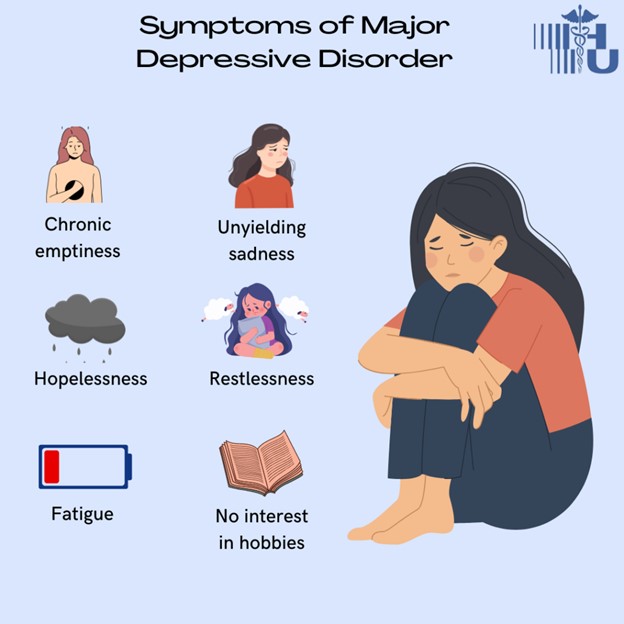
- The signs and symptoms of MDD vary from person to person but generally include:
- Depressed mood most of the day, nearly every day
- Markedly diminished interest or pleasure in all or almost all activities most of the day
- Significant weight loss or weight gain (more than 5% of body weight in a month) or appetite changes
- Insomnia or hypersomnia (excessive sleeping)
- Psychomotor agitation or retardation (observable by others)
- Fatigue or loss of energy
- Feelings of worthlessness or excessive or inappropriate guilt
- Diminished ability to think or concentrate or indecisiveness
- Recurrent thoughts of death or suicide or suicide attempts
- The diagnostic criteria for MDD according to DSM-5 are
- Five or more of the above symptoms must be present during the same 2-week period and represent a change from previous functioning
- At least one of the symptoms must be either depressed mood or loss of interest or pleasure
- The symptoms cause clinically significant distress or impairment in social, occupational, or other important areas of functioning
- The symptoms are not due to the direct effects of a substance or a medical condition
- The symptoms are not better explained by another mental disorder
- There has never been a manic episode or a hypomanic episode
- The assessment and screening tools for MDD include
- Patient Health Questionnaire (PHQ-9): a 9-item self-report questionnaire that measures the severity of depression based on the DSM-5 criteria. A score of 10 or higher indicates moderate to severe depression.
- Hamilton Depression Rating Scale (HAM-D): a 17-item clinician-administered scale that evaluates various aspects of depression such as mood, anxiety, insomnia, somatic symptoms, etc. A score of 20 or higher indicates severe depression.
- Beck Depression Inventory (BDI): a 21-item self-report inventory that assesses cognitive, affective, behavioral, and somatic symptoms of depression. A score of 30 or higher indicates severe depression.
- The differential diagnosis for MDD includes:
- Bipolar disorder: characterized by episodes of mania (elevated mood) or hypomania (mild mania) alternating with episodes of depression. A history of manic or hypomanic episodes rules out MDD.
- Dysthymia: a chronic form of depression that lasts for at least 2 years but is less severe than MDD. Dysthymia can coexist with MDD as a double depression.
- Adjustment disorder: a reaction to a stressful life event that causes emotional distress and impairment in functioning. Adjustment disorder usually resolves within 6 months after the stressor is removed or adapted to.
- Bereavement: a normal and expected response to the loss of a loved one that involves grief and sadness. Bereavement can be complicated by MDD if the symptoms are persistent, severe, or interfere with daily functioning.
- Substance-induced mood disorder: a mood disturbance that is caused by the use or withdrawal of a substance such as alcohol, drugs, or medications. The mood symptoms usually remit when the substance is discontinued or detoxified.
- Mood disorder due to a general medical condition: a mood disturbance that is caused by a physical illness or injury that affects the brain or other organs. The mood symptoms usually improve when the medical condition is treated.
Nursing Test Bank
Test Bank #1: RN Pharmacology Exams
Test Bank #2: RN Medical-Surgical Exams
Test Bank #3: RN Fundamentals Exams
Test Bank #4: RN Maternal-Newborn Exams
Test Bank #5: RN Anatomy and Physiology Exams
Test Bank #6: RN Obstetrics and Pediatrics Exams
Test Bank #7: RN Fluid and Electrolytes Exams
Test Bank #9: RN Adult Health
Test Bank #10: RN Dosage Calculation
Test Bank #11: RN Community Health Exams
Test Bank #12: RN Psychology Exams
Test Bank #13: RN Nursing Care Of Children
Test Bank #14: RN Foundations of Nursing Exams
Naxlex Comprehensive Predictor Exams
Exam #1: RN Comprehensive predictor 2023 proctored exam
Exam #2: Ati rn vati comprehensive predictor proctored exam
Exam #3: Ati Rn Comprehensive Predictor Proctored Exam 2023
Exam #4: Rn Comprehensive Predictor 2023 Proctored Exam - St. Joseph
Exam #5: RN Comprehensive Predictor Proctored Exam (National U CA San Diego)
Exam #6: Ati rn comprehensive predictor 2023 retake proctored exam
Exam #7: RN Hesi Exit Proctored Exam
Exam #8: Hesi RN Exit proctored exam
Exam #9: Hesi rn exit proctored exam
Exam #10: Hesi Rn compass exit B proctored exam
Questions on Clinical Presentation of MDD
Correct Answer is ["B","C","D"]
Explanation
Neurotransmitter imbalances are not psychosocial factors. They are more related to the biological underpinnings of depression rather than the social and psychological influences explored in psychosocial factors.
Correct Answer is ["A","C","E"]
Explanation
Interpersonal relationships are affected by depression and can also contribute to its development. The question does not focus on the effects of depression on relationships, but rather on the factors that can influence or be influenced by depression.
Correct Answer is C
Explanation
Endorphins and oxytocin are important neurotransmitters, but they are not as directly related to the regulation of mood, motivation, reward, cognition, and stress response as the neurotransmitters mentioned in choice C. Endorphins are known for their role in pain modulation and feelings of pleasure, while oxytocin is often referred to as the "bonding hormone" and is associated with social connections and childbirth.
Correct Answer is C
Explanation
Environmental theory suggests that external factors, such as life events and stressors, contribute to the development of depression. While environment can indeed influence depression, it does not specifically address the neurotransmitter imbalances that are central to this question.
Correct Answer is C
Explanation
Adjustment disorder is a condition characterized by emotional or behavioral symptoms that develop in response to a specific stressor. The client's statement is more indicative of a pervasive and ongoing lack of enjoyment, which aligns with the concept of anhedonia in MDD rather than the time-limited nature of adjustment disorder.
Correct Answer is ["C","D"]
Explanation
Elevated mood and increased energy are actually more indicative of conditions like bipolar disorder or manic episodes, where there are distinct periods of abnormally elevated mood, known as mania or hypomania.
Correct Answer is D
Explanation
Criteria for diagnosing MDD according to DSM-5. The client's symptoms of extreme fatigue, difficulty concentrating, and thoughts of worthlessness align with the criteria for Major Depressive Disorder (MDD) as defined in the Diagnostic and Statistical Manual of Mental Disorders, Fifth Edition (DSM-5). These criteria include the presence of specific symptoms for a specified duration, causing significant impairment in functioning. The symptoms should not be better explained by other conditions or substances. In this case, the client's presentation closely matches the criteria for diagnosing MDD.
Correct Answer is C
Explanation
A normal response to stress usually involves transient feelings of sadness or anxiety in response to a stressor. However, the client's symptoms of persistent feelings of sadness, guilt, worthlessness, weight loss, and insomnia are indicative of a more serious and prolonged condition like major depressive disorder (MDD).
Correct Answer is B
Explanation
Cognitive-behavioral therapy (CBT) is a specific type of psychotherapeutic intervention that focuses on changing thought patterns and behaviors. While CBT can lead to changes in brain activity and neuroplasticity, it does not involve direct brain stimulation through electrical or magnetic means like ECT or rTMS.
Correct Answer is A
Explanation
<p> MDD cannot be diagnosed if only one symptom is present. The diagnosis requires the presence of multiple symptoms, including depressed mood or anhedonia, for at least two weeks.</p>