
Treatment Options
Treatment Options for Aneurysms:
- Monitoring: Small, stable aneurysms may be monitored regularly through imaging tests to track their growth and determine if intervention is necessary.
- Medications: Certain medications, such as beta-blockers or calcium channel blockers, may be prescribed to manage blood pressure and reduce the risk of aneurysm rupture.
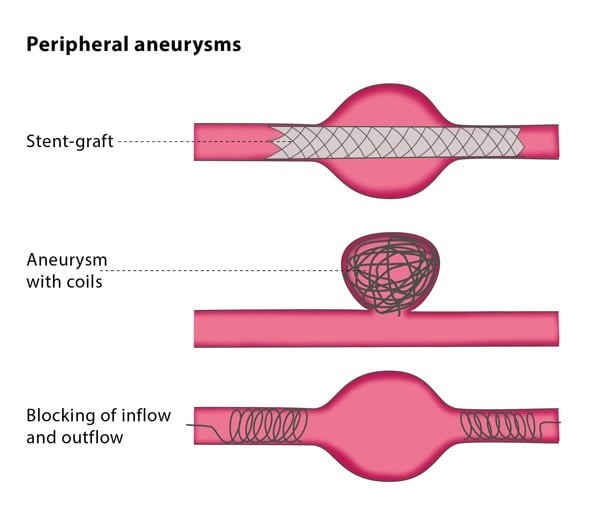
- Endovascular Repair: For certain types of aneurysms, endovascular repair may be an option. This minimally invasive procedure involves the insertion of a stent or a graft through the blood vessels to reinforce the weakened area and divert blood flow away from the aneurysm.
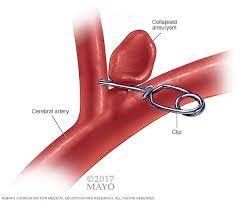
- Open Surgical Repair: In cases where the aneurysm is large or has a high risk of rupture, open surgical repair may be performed. During this procedure, the weakened portion of the blood vessel is replaced with a synthetic graft.
- Coil Embolization: For certain types of cerebral aneurysms, a technique called coil embolization may be used. Soft platinum coils are inserted into the aneurysm to promote clotting and reduce the risk of rupture.
- Blood Pressure Management: Maintaining optimal blood pressure through lifestyle modifications or medications is essential to prevent further weakening of arterial walls.
Treatment Options for Peripheral Vascular Disorders:
- Lifestyle Modifications: Lifestyle changes, including regular exercise, smoking cessation, a balanced diet, and weight management, can help improve blood flow and manage peripheral vascular disorders.
- Medications: Various medications may be prescribed to manage peripheral vascular disorders, such as antiplatelet agents (e.g., aspirin), statins to control cholesterol levels, and medications to manage blood pressure and blood sugar in diabetes.
- Angioplasty and Stent Placement: In cases of peripheral artery disease (PAD) with arterial blockages, angioplasty may be performed. During this procedure, a balloon is inflated to widen the narrowed artery, and a stent may be placed to keep the artery open.
- Bypass Surgery: In severe cases of peripheral artery disease (PAD), bypass surgery may be performed. During this procedure, a graft is used to bypass the blocked or narrowed artery, allowing blood to flow freely to the affected area.
- Endarterectomy: Endarterectomy is a surgical procedure to remove plaque buildup from the inner lining of an artery, improving blood flow.
- Compression Therapy: Compression stockings or bandages may be used to improve blood flow and reduce swelling in individuals with peripheral vascular disorders.
Nursing Test Bank
Test Bank #1: RN Pharmacology Exams
Test Bank #2: RN Medical-Surgical Exams
Test Bank #3: RN Fundamentals Exams
Test Bank #4: RN Maternal-Newborn Exams
Test Bank #5: RN Anatomy and Physiology Exams
Test Bank #6: RN Obstetrics and Pediatrics Exams
Test Bank #7: RN Fluid and Electrolytes Exams
Test Bank #9: RN Adult Health
Test Bank #10: RN Dosage Calculation
Test Bank #11: RN Community Health Exams
Test Bank #12: RN Psychology Exams
Test Bank #13: RN Nursing Care Of Children
Test Bank #14: RN Foundations of Nursing Exams
Naxlex Comprehensive Predictor Exams
Exam #1: RN Comprehensive predictor 2023 proctored exam
Exam #2: Ati rn vati comprehensive predictor proctored exam
Exam #3: Ati Rn Comprehensive Predictor Proctored Exam 2023
Exam #4: Rn Comprehensive Predictor 2023 Proctored Exam - St. Joseph
Exam #5: RN Comprehensive Predictor Proctored Exam (National U CA San Diego)
Exam #6: Ati rn comprehensive predictor 2023 retake proctored exam
Exam #7: RN Hesi Exit Proctored Exam
Exam #8: Hesi RN Exit proctored exam
Exam #9: Hesi rn exit proctored exam
Exam #10: Hesi Rn compass exit B proctored exam
Questions on Treatment Options
Correct Answer is C
Explanation
Incorrect - A sedentary lifestyle is a behavioral risk factor for aneurysms, not a genetic one. Lack of physical activity can contribute to hypertension and other risk factors.
Correct Answer is C
Explanation
No explanation
Correct Answer is A
Explanation
Incorrect - Encouraging coughing and deep breathing is a standard postoperative nursing intervention, but it is not the priority in this situation. The focus should be on monitoring for stroke symptoms.
Correct Answer is C
Explanation
<p>Incorrect - Conservative management with lifestyle changes may be recommended in certain cases, but it is not the definitive therapy for popliteal artery aneurysms, especially when the aneurysm poses a significant risk of rupture.</p>
Correct Answer is A
Explanation
Incorrect - Bending the knees during a venous Doppler ultrasound does not interfere with the procedure. The client can usually lie in a comfortable position during the test.
Correct Answer is A
Explanation
Incorrect - Beginning a rigorous exercise routine immediately after the procedure is not recommended. Clients should gradually resume physical activity as guided by their healthcare provider to avoid complications and promote proper healing.
Correct Answer is B
Explanation
<p>Incorrect - Endovascular repair may be an option for some AAAs, but it is not the best treatment for all cases, especially small, asymptomatic ones. The appropriate treatment plan will depend on the client's specific circumstances.</p>
Correct Answer is A
Explanation
No explanation
Correct Answer is D
Explanation
No explanation
Correct Answer is B
Explanation
Incorrect - Waiting until fully recovered before engaging in any physical activity is unnecessary and may delay the client's recovery process. Controlled and gradual activity resumption is usually preferred.
Correct Answer is B
Explanation
No explanation
Correct Answer is C
Explanation
Incorrect - While family history can be important in assessing an individual's overall risk for various diseases, it is not a direct risk factor for PAD. Diabetes itself is a risk factor for PAD, not its family history.
Correct Answer is C
Explanation
Incorrect - Over-the-counter painkillers may provide temporary relief but do not address the underlying cause of intermittent claudication. Relying solely on painkillers may lead to delayed diagnosis and treatment of PVD.
Correct Answer is C
Explanation
Incorrect - While elevated blood pressure can be a concern after some procedures, it is not a specific complication of femoral artery catheterization. The primary focus after the procedure is on monitoring the insertion site.
Correct Answer is B
Explanation
Incorrect - Capillary refill of the fingers is important but is not the priority assessment in the immediate post-procedure period following femoral artery cannulation.
Correct Answer is B
Explanation
Incorrect - Taking hot baths is not recommended after peripheral artery bypass surgery. Heat may dilate blood vessels and increase blood flow, potentially causing complications at the surgical site.
Correct Answer is A
Explanation
Incorrect - Reducing physical activity is not recommended as a way to reduce the risk of peripheral vascular disorders. Regular physical exercise is essential for maintaining cardiovascular health and reducing the risk of many vascular conditions.