
A math teacher obtained the following scores from a class of 45 students. Which of the following is the best way to display the frequency of each day of the week?
|
Test score |
50-59 |
60-69 |
70-79 |
80-89 |
90-99 |
|
Number of students |
10 |
4 |
9 |
20 |
2 |
Scatterplot
Pie graph
Line graph
Histogram
Correct Answer : D
In order for the teacher to better visualize the test performance for his class, he needs to present the mark distribution in chart form. A better chart visualizer is the histogram, which will show the frequency of marks against range of test scores. A bar graph will not be used because the rectangles need to touch one another.
In a bar graph, the rectangles do not touch each other. Therefore, it will not be a good chart visualizer.
TEAS 7 Exam Quiz Bank
HESI A2 Exam Quiz Bank
Find More Questions 📚
Teas 7 Questions: We got the latest updated TEAS 7 questions
100% Money Refund: 100% money back guarantee if you take our full
assessment pass with 80% and fail the actual exam.
Live Tutoring: Fully customized live tutoring lessons.
Guaranteed A Grade: All students who use our services pass with 90%
guarantee.
Related Questions
Correct Answer is B
Explanation
To solve this problem, we need to have all options in fraction form.
74  95 =
95 = 
7/8 = 3/8
0.72 = 72/100
74% = 74/100
Now, find the least common denominator of 95, 8, and 100. The least common denominator is 3800, which we multiply by each fraction as follows:
74/95*3800=2960
7/8*3800=3325
72/100*3800=2736
74/100*3800=2812
We can see that the fraction 7/8 is the greatest among the given options.
Correct Answer is D
Explanation
We two conversions when asked to convert between kg and lb

And

We need kg equivalent of 220 lb, therefore we use option 1 and carry out the conversions as follows:
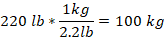
Thus, 100kg is equal to 220lb.
Correct Answer is C
Explanation
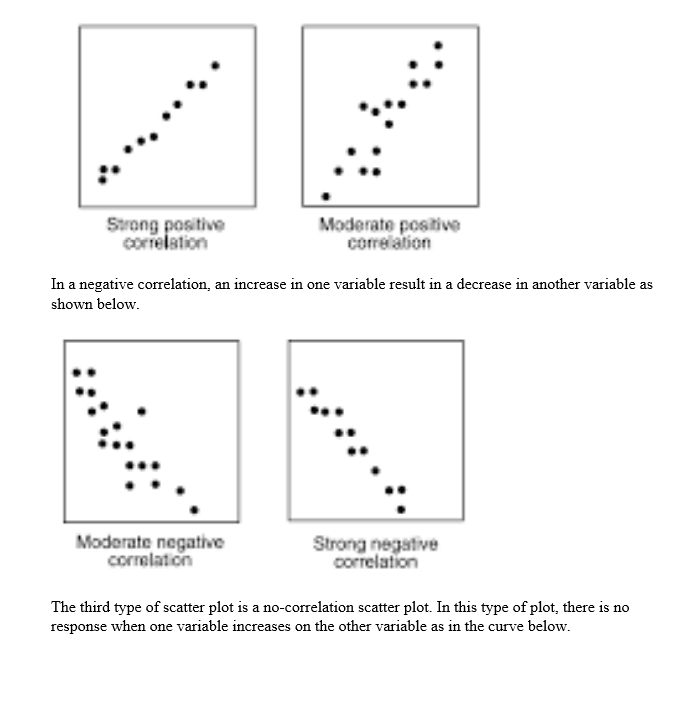
Correlation of two variables falls into:
Positive correlation: an increase in one variable causes another variable to increase
Negative correlation: an increase in one variable causes another one to decrease
No correlation: a change in one variable does not cause any response in another variable.
From the given choices
Option a is no correlation
Option b is a no correlation
Option c is a negative correlation
Option d is a positive correlation
Correct Answer is B
Explanation
To change between L and mL, the following two options are used.
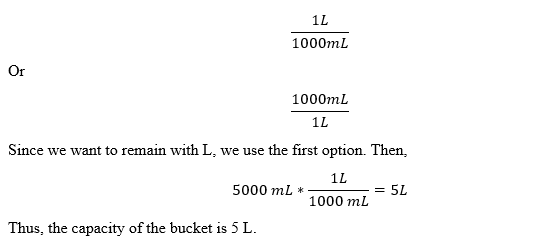
Correct Answer is B
Explanation
The median of a data set is found in two ways:
For an odd data set, the median fall in the (N+1)/2 th position.
For an even data set, the median is the average of the element in the (N/2)th and (N+1)/2 th positions.
To find the median of the given data set, we need to arrange the elements from the smallest to the largest as follows:
12, 12, 16, 18, 19, 22, 23, 24, 26, 35, 35
There are 11 elements in the data set. 11 is an odd number and the median fall in the (N+1)/2 th position.
Median =(11+1)/2=12/2=6 th position.
From the organized data, the element in the 6th position is 22, which is the required median for the data set.
Correct Answer is A
Explanation
An independent variable is a change that when modified brings a change in other variables. In this case, the person increases his climbing rate, calories burned, distance traveled and energy used increases. Therefore, the walking speed is the independent variable while other variables are dependent.
Correct Answer is D
Explanation
Scatter plots can depict three correlations: positive, negative and no correlation. A positive correlation scatter plot reveals that as one variable increases, the other variable also increases as shown below
Correct Answer is D
Explanation
Based rainfall falling for the first 5 months, a bar graph will give a great display for the farmer to decide when start planting. The horizontal scale will represent months of the year and vertical scale will present the amount of rainfall falling.
Correct Answer is C
Explanation
We use given information to find how much ammonia is need to make the specified solution.
We are told, one gallon of cleaning solution requires 10oz of ammonia. Expressing this mathematically yields two options:
\(\frac{10\ oz\ of\ ammonia}{1\ gallon\ of\ solution}\)or\(\frac{1\ gallon\ of\ solution}{10\ oz\ of\ ammonia}\)
Now we find how much ammonia is needed using option two.
\(51\ gallon\ of\ solution\ *\frac{10\ oz\ of\ ammonia}{1\ gallon\ of\ solution}\ =\ 510\ oz\ of\ ammonia\)
From the above equation, gallon of solution will cancel, and oz of ammonia is left.
Therefore, the solution will require 510 oz of ammonia.
Correct Answer is D
Explanation
Here we need to find the actual values of the additions and see the trend the student will use to estimate the given problem. The exact sum is as follows
35+192 227
227
258+350=608
947+1032=1979
From the above calculations, it is evident that the student rounds up or down the ones place values. So, in the problem we need to approximate 694+7618.
694+7618=8312
We can approximate 8312 based on the provided choices is 8310.
This question was extracted from the actual TEAS Exam. Ace your TEAS exam with the actual TEAS 7 questions, Start your journey with us today
Visit Naxlex, the Most Trusted TEAS TEST Platform With Guaranteed Pass of 90%.
Money back guarantee if you use our service and fail the actual exam. Option of personalised live tutor on your area of weakness.