
A myocardial infarction affects which of the following blood vessels of the heart?
Pulmonary
Aorta
Vena cava
Coronary
Correct Answer : D
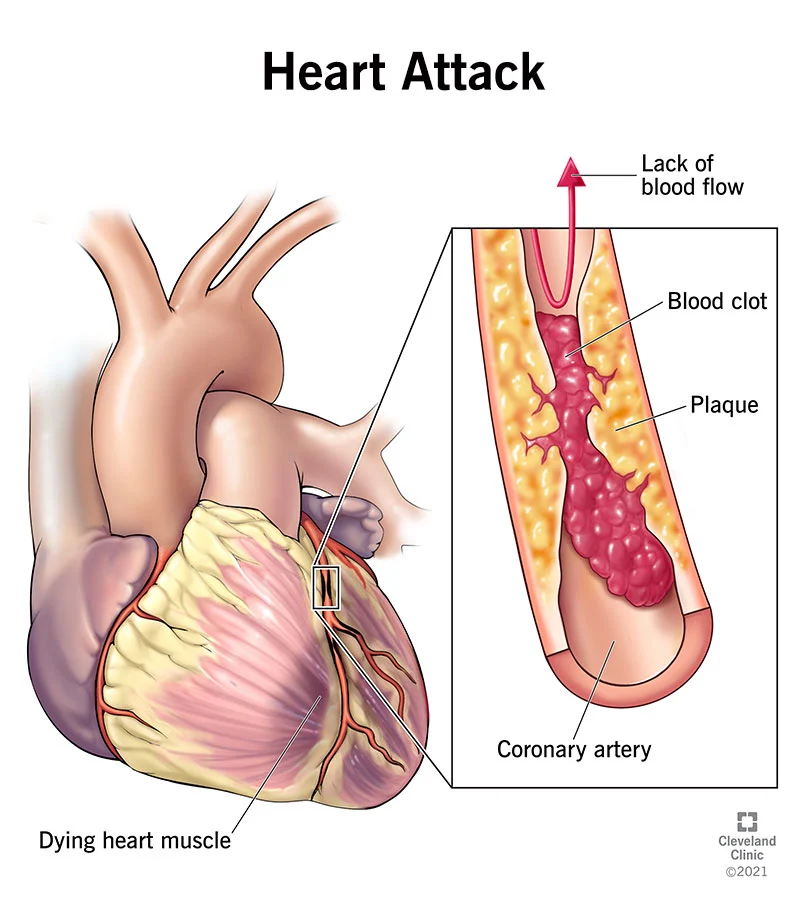
A myocardial infarction (MI), commonly known as a heart attack, occurs when the flow of blood to the heart is blocked. The blockage is usually due to a buildup of fat, cholesterol and other substances in the heart (coronary) arteries. The fatty, cholesterol-containing deposits are called plaques. The process of plaque buildup is called atherosclerosis. Sometimes, a plaque can rupture and form a clot that blocks blood flow. A lack of blood flow can damage or destroy part of the heart muscle.
TEAS 7 Exam Quiz Bank
HESI A2 Exam Quiz Bank
Find More Questions 📚
Teas 7 Questions: We got the latest updated TEAS 7 questions
100% Money Refund: 100% money back guarantee if you take our full
assessment pass with 80% and fail the actual exam.
Live Tutoring: Fully customized live tutoring lessons.
Guaranteed A Grade: All students who use our services pass with 90%
guarantee.
Related Questions
Correct Answer is D
Explanation
The dependent variable is the variable that is measured or observed in an experiment. It is the variable that changes as a result of the independent variable, which is the variable that is manipulated or controlled by the experimenter. In this case, the dependent variable is the bag mass change, because it depends on the sucrose concentrations in the bag and outside the bag. The other variables, such as duration, temperature, and sucrose concentrations, are independent variables that are set by the experimenter.
Correct Answer is D
Explanation
Terminal velocity is the maximum speed achieved by an object freely falling through a gas or liquid. At terminal velocity, the forces acting on the object are balanced so it is no longer accelerating. Terminal velocity is achieved when the force of gravity is equal to air resistance. From the data table you provided, we can see that as the mass of the coffee filters increases, so does the terminal velocity. This means that heavier objects fall faster than lighter objects. Therefore, conclusion D is supported by the data in the table.
Correct Answer is A
Explanation
Among the four types of microorganisms listed, only viruses lack their own metabolic pathways and can only reproduce inside of a host cell. Viruses are considered to be obligate intracellular parasites, meaning that they depend on another living cell for their survival and replication. Bacteria, helminths, and protozoa, on the other hand, are able to metabolize nutrients and energy from their surroundings and can reproduce independently of a host cell.
Correct Answer is C
Explanation
Cytokines are small proteins that act as chemical messengers between different types of immune cells. They can stimulate or inhibit the activation, proliferation, differentiation, and migration of immune cells. For example, interleukins are a type of cytokine that is produced by one type of white blood cell and can affect the behavior of another type of white blood cell. Lysozymes, perforin, and granzymes are all molecules that are involved in killing pathogens or infected cells, but they do not directly activate other immune cells.
Correct Answer is C
Explanation
The atomic number of an atom is defined as the number of protons in its nucleus. Protons are positively charged particles that make up part of the atomic mass, along with neutrons, which have no charge. The number of neutrons can vary for atoms of the same element, resulting in different isotopes. However, the number of protons is always constant for a given element. Therefore, to find the atomic number of an atom that has 12 protons and 12 neutrons, we only need to look at the number of protons.
Correct Answer is D
Explanation
The answer lies in the environmental conditions of the Alps. The body was quickly frozen by the low temperature and covered by snow and ice, which prevented exposure to air, moisture, and microorganisms. The freezing also slowed down the chemical reactions that would normally break down the body's cells and tissues. Thus, the body was preserved in a natural mummy state until it was discovered by modern humans.
Correct Answer is D
Explanation
A myocardial infarction (MI), commonly known as a heart attack, occurs when the flow of blood to the heart is blocked. The blockage is usually due to a buildup of fat, cholesterol and other substances in the heart (coronary) arteries. The fatty, cholesterol-containing deposits are called plaques. The process of plaque buildup is called atherosclerosis. Sometimes, a plaque can rupture and form a clot that blocks blood flow. A lack of blood flow can damage or destroy part of the heart muscle.
Correct Answer is D
Explanation
One of the essential aspects of scientific inquiry is the communication of results to peers and the public. Publishing new scientific findings allows other scientists to review, replicate, or challenge the methods and conclusions of a study. This way, science can advance by building on previous knowledge and correcting any errors or inconsistencies.
Correct Answer is B
Explanation
Osteoporosis is a condition that affects the bones, making them weak and brittle. It occurs when the balance between bone formation and bone resorption is disrupted. Bone formation is carried out by cells called osteoblasts, while bone resorption is done by cells called osteoclasts. Osteocytes are mature bone cells that maintain the bone matrix. Osteoporosis results from a decline in osteoblast activity while osteoclast activity continues at expected levels, leading to more bone loss than bone gain. This reduces the bone density and increases the risk of fractures.
Correct Answer is C
Explanation
The glomerulus is a microscopic structure located within the nephron of the kidney and is essential for the filtration of blood. The glomerulus is a network of capillaries (tiny blood vessels) that filters blood to remove waste products, excess substances, and fluid, which are then passed on to the renal tubules for further processing into urine.
- Microscopic function: Blood enters the glomerulus through the afferent arteriole, where the blood pressure forces water, ions, small molecules, and waste products out of the blood and into a structure called Bowman’s capsule (the next component of the nephron). This process is the first step in urine formation.
- Anatomy: The glomerulus is a highly specialized structure designed for filtration, with tiny pores in the capillary walls that allow small molecules to pass while larger molecules (like proteins and blood cells) remain in the bloodstream.
Explanation of the other options
A. Loop of Henle
The Loop of Henle is part of the nephron in the kidneys. It is located between the proximal and distal convoluted tubules and plays a crucial role in the process of urine concentration. The loop has both a descending and an ascending limb and is responsible for creating a concentration gradient in the renal medulla, which is essential for the kidneys to concentrate urine.
While it is part of the nephron and operates on a microscopic scale, it is not the primary microscopic component involved in filtration. Rather, it functions in reabsorption and the regulation of water and salt balance.
B. Ureter
The ureter is a macroscopic organ that connects the kidneys to the bladder. It is a muscular tube through which urine travels after being produced in the kidneys. The ureter is not considered a microscopic structure because it can be seen with the naked eye. It plays a major role in the transport of urine, but it is not involved in the filtration or microscopic processes within the kidneys.
D. Bowman’s Capsule
The Bowman’s capsule is a cup-shaped structure that surrounds the glomerulus. It is an important part of the nephron in the kidney. The role of Bowman’s capsule is to collect the filtrate (the fluid that has been filtered out of the blood in the glomerulus).
- Function: The Bowman’s capsule captures the filtrate (containing water, salts, glucose, urea, etc.) and channels it into the proximal convoluted tubule for further processing.
- Microscopic structure: While the Bowman’s capsule is part of the nephron and plays a key role in the filtration process, it is considered a structure that "contains" the glomerulus rather than being the structure that performs the filtration itself.
Thus, the glomerulus is the most accurate answer when identifying a microscopic component of the genitourinary system involved in filtration.
This question was extracted from the actual TEAS Exam. Ace your TEAS exam with the actual TEAS 7 questions, Start your journey with us today
Visit Naxlex, the Most Trusted TEAS TEST Platform With Guaranteed Pass of 90%.
Money back guarantee if you use our service and fail the actual exam. Option of personalised live tutor on your area of weakness.