
A recipe calls for 5.5 teaspoons of vanilla. 1 teaspoon equals approximately 4.93 mL. Which of the following is the correct amount of vanilla in mL?
10.2 mL
12 mL
7.43 mL
27 mL
Correct Answer : D
We need to find how many mL are in 5.5 teaspoons. We are told that 1 teaspoon is about 4.93 mL, which we interpret as follows:

Or

Since we are looking for mL, we use the second option.

Thus, 5.5 teaspoons can hold approximately 27 mL.
TEAS 7 Exam Quiz Bank
HESI A2 Exam Quiz Bank
Find More Questions 📚
Teas 7 Questions: We got the latest updated TEAS 7 questions
100% Money Refund: 100% money back guarantee if you take our full
assessment pass with 80% and fail the actual exam.
Live Tutoring: Fully customized live tutoring lessons.
Guaranteed A Grade: All students who use our services pass with 90%
guarantee.
Related Questions
Correct Answer is D
Explanation
to convert fraction to percent, multiply the fraction with 100%. Therefore, the percent equivalent of 3/4 is
3/4*100%=75%
Thus, 3/4is equal to 75%.
Correct Answer is D
Explanation
We need to find how many mL are in 5.5 teaspoons. We are told that 1 teaspoon is about 4.93 mL, which we interpret as follows:
Or
Since we are looking for mL, we use the second option.
Thus, 5.5 teaspoons can hold approximately 27 mL.
Correct Answer is A
Explanation
To form an equation from the word problem, first break the given statement into smaller statements.
First, we are given the width of the rectangle as x. We are told, the length is two times width. Mathematically, this means
Length=2*width=2*x=2x
Now, the length is 6 less than 2 times width of the rectangle. Thus, the length of rectangle in terms of width becomes:
Length =2x-6
Thus, the length of the rectangle is 2x-6.
Correct Answer is C
Explanation
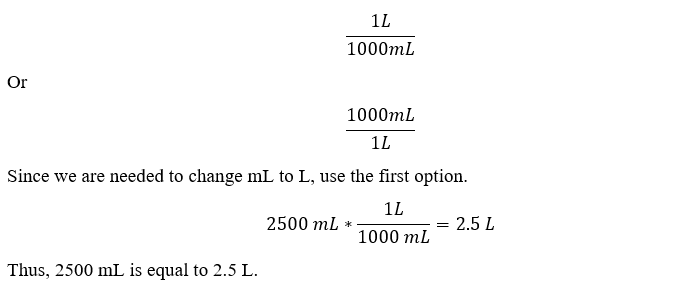
Explanation: We know that 1 L=1000 mL and to change between L and mL we use the following two options

Correct Answer is A
Explanation
: In order to solve for the value of x, we use the order of operations as follows:
The first step is to divide both sides by 3


Add 2 to both sides to eliminate it from the left-hand side of the equation
x-2+2=4+2
x = 6
Thus, the value of x is 6.
Correct Answer is D
Explanation
Before we compare the values of the options, we convert the decimals to fractions.
5.4 becomes 54/10
6.25 becomes 625/100
Thus, the set of fractions is 11/2, 54/10, 13/3, 625/100. The least common denominator for 2, 10, 3, and 100 is 300, which we use to compare each options given.
11/2*300=1650
54/10*300=1620
13/3*300=1300
625/100*300=1875
From the above, 1875 is the greatest value which corresponds to 6.25. Therefore, 6.25 is the greatest value of all the choices given.
Correct Answer is A
Explanation
: We need to find the total rainfall for the months of May, June, and July using the given graph.
In the month of May, rainfall is between 3 and 4, which is halfway. Therefore, rainfall in May is 3.5 inches
On June, rainfall was 3 inch and on July the rainfall was 2.5 inches. Thus,
Total rainfall=3.5 inches+3 inches+ 2.5 inches=9.0 inches
Correct Answer is A
Explanation
To solve the equation this equation, we use a calculator and find the product as:
3.45 * 0.53= 1.8285
Correct Answer is C
Explanation
The distribution of the weights of the newborn babies is symmetric meaning the mean, mode, and median are all equal. Thus, the bell-shape curve describes this kind of distribution of weights
Correct Answer is A
Explanation
we are asked to find the largest value from the options given. To solve this problem, we need to convert all the given values into fraction. Then find the least common denominator for all fractions, which we will use to multiply each fraction and make a comparison.
43÷ 55=43/55
5/7
0.729=729/1000
73%=73/100
Now, we need to find the least common denominator of 55, 7, 1000, and 100, which is 77000. We multiply each fraction by 77000 as follows:
43/55*77000=60200
5/7*77000=55000
729/1000*77000=56133
73/100*77000=56210
From the calculated values, it can be noted that 43/55 is the greatest value among the given options.
This question was extracted from the actual TEAS Exam. Ace your TEAS exam with the actual TEAS 7 questions, Start your journey with us today
Visit Naxlex, the Most Trusted TEAS TEST Platform With Guaranteed Pass of 90%.
Money back guarantee if you use our service and fail the actual exam. Option of personalised live tutor on your area of weakness.