
-2/9, -0.9, -1.7, -4/7
Of the number listed above, which number is the greatest?
-0.9
-4/7
-1.7
-2/9
Correct Answer : D
The initial step is to convert the decimal options to fractions. Then, we find the LCM of the denominators of all fractions, which will be used to compare the values of the given options.
-0. becomes -9/10
-1.7 becomes -17/10
Then, the resulting denominators are 9, 10, and 63. Their LCM of 630 is used to multiply each fraction.
-2/9*630=-140
-9/10*630=-567
-17/10*630=-1071
-4/7*630=-360
From the calculations above, -140 is the greatest value of all the values. Thus, -2/9 is the greatest number.
TEAS 7 Exam Quiz Bank
HESI A2 Exam Quiz Bank
Find More Questions 📚
Teas 7 Questions: We got the latest updated TEAS 7 questions
100% Money Refund: 100% money back guarantee if you take our full
assessment pass with 80% and fail the actual exam.
Live Tutoring: Fully customized live tutoring lessons.
Guaranteed A Grade: All students who use our services pass with 90%
guarantee.
Related Questions
Correct Answer is A
Explanation
To find the minimum length requires, we need to understand what slope in the question represents. The slope represents the ratio between the height to the length. Let x be the minimum length of the ramp. Then,
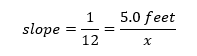
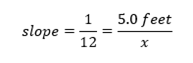
Now, we find the value of x by cross-products as follows
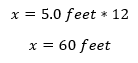
Thus, the minimum length required to provide access is 60 feet.
Correct Answer is D
Explanation
Given the equation F(z)=9z+28
To find the value of F(z), we need to vary the value of z. In this case, z is the independent variable while F(z) is what we measure, which is the dependent variable.
Correct Answer is D
Explanation
To find the cheapest option, we find the expenditure on each given option.:
2 two-24 packs of Orange and 1 pack of Cream Soda=2($15)+$3=$33
3 one 24-pack of Orange=3($9)=$27
2 packs of Root Beer and 1 pack of Cream Soda=2($14)+$3=$31
5 packs of cream Soda=5($3)=$15
Spending 5 packs of cream soda is the cost-effective option.
Correct Answer is C
Explanation
The weight of the knife could be appropriately expressed in grams. Since a knife is a small object, we do not expect to measure its weight in kilograms. Liter and milliliter are units of measuring the volume of objects.
Correct Answer is A
Explanation
The perimeter of a shape is the sum of the lengths of all its sides.
Given Trapezoid:
- Top side: 10 cm
- Bottom side: 16 cm
- Left slant side: 5 cm
- Right slant side: 5 cm
Calculate the Perimeter:
10+16+5+5=36cm
Correct Answer is C
Explanation
Step 1: Calculate the Discounted Price per Unit
The original price of each unit of bedding is $160. Since there is a 10% discount, the discounted price per unit is:
DiscountedPrice =160−(0.1×160) =160×0.9
Step 2: Determine the Total Cost
If X units are purchased, the cost for all units is:
T = (0.9)160X
Since there is a fixed shipping cost of $25 per order, the total cost equation becomes:
T = (0.9)160X+25
Step 3: Identify the Correct Answer
The equation that matches this is:
C. T=(0.9)160X+25
Correct Answer is A
Explanation
we find the value of x by applying the absolute conditions to the given equation.
First, add 2 to both sides of equation

Add 10 to both sides of the equation

Next, we apply the absolute rule:
If u=a , a>0, then u=a or u=-a
In this case a=5, which is greater 0.
The first condition becomes

Solving for x
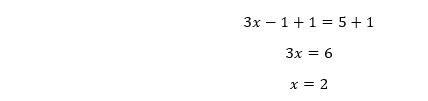
The second condition becomes

Solving for x


Then, the value of x is -4/3 or 2.
Correct Answer is A
Explanation
To find the area of the room, we form an equation of find an equation relating the length and width of the rectangle. If we let the width of the room to be w, then
Width of the rectangle= w
Length of rectangle=(w+8)
Area of the rectangle, A= Length*width=(w+8)*w
A=w(w+8)
Thus, the area of the rectangular room is w(w+8).
Correct Answer is D
Explanation
The circumference of a circle is given by the formula:
C=πd
where:
- d=16 inches
- π=3.14
Calculate the Circumference:
C=3.14×16 =50.24inches
Correct Answer is D
Explanation
To find the greatest number from the given options, convert the decimal numbers into fractions.
6.25 becomes 625/100
7.4 becomes 74/10
The LCM for the denominators of 8, 100, 7, and 10 is 2800. Now we can multiply each fraction with the LCM.
3/8*2800=1050
625/100*2800=17500
10/7*2800=4000
74/10*2800=20720
The fraction 7.4is the greatest of all.
This question was extracted from the actual TEAS Exam. Ace your TEAS exam with the actual TEAS 7 questions, Start your journey with us today
Visit Naxlex, the Most Trusted TEAS TEST Platform With Guaranteed Pass of 90%.
Money back guarantee if you use our service and fail the actual exam. Option of personalised live tutor on your area of weakness.