
One gallon of cleaning solution requires 6 oz of ammonia. If the maintenance department needs 230 gallons of solution to clean all of the floors, how much ammonia is needed?
1380 gallons
6900 gallons
1380 oz
1400 oz
Correct Answer : C
from the given data, one gallon of cleaning solution requires 6 oz of ammonia. The mathematical expression of this statement can be expressed in two ways:
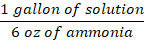
Or
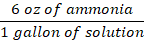
The question requires we find the amount of ammonia needed to make 230 gallons of the solution. So, we use the second option and proceed as follows:

From the above equation, gallon of solution will cancel, and oz of ammonia is left.
Therefore, the solution will require 1380 oz of ammonia.
TEAS 7 Exam Quiz Bank
HESI A2 Exam Quiz Bank
Find More Questions 📚
Teas 7 Questions: We got the latest updated TEAS 7 questions
100% Money Refund: 100% money back guarantee if you take our full
assessment pass with 80% and fail the actual exam.
Live Tutoring: Fully customized live tutoring lessons.
Guaranteed A Grade: All students who use our services pass with 90%
guarantee.
Related Questions
Correct Answer is C
Explanation
We usea calculator to find the product of
1.6*0.93=1.488
Correct Answer is A
Explanation
: In order to solve for the value of x, we use the order of operations as follows:
The first step is to divide both sides by 3


Add 2 to both sides to eliminate it from the left-hand side of the equation
x-2+2=4+2
x = 6
Thus, the value of x is 6.
Correct Answer is D
Explanation
to convert fraction to percent, multiply the fraction with 100%. Therefore, the percent equivalent of 3/4 is
3/4*100%=75%
Thus, 3/4is equal to 75%.
Correct Answer is B
Explanation
Histograms are used to present frequency of data of one variable over the other. On the other hand, a bar graph is used to compare the two variables with the rectangles not touching one another as in histograms. Scatter plots are used to show the correlations between two variables. In this case, the teacher will be able to use scatter plot to establish the correlation between test scores and the subjects.
Correct Answer is B
Explanation
: a ratio can be thought of a fraction of the form a/b, where b is not equal to zero. In ratio form, to means per.
Now, the class has 26 girls and 22 boys. Thus, the ratio of girls to boys becomes:

The fraction above reduces into
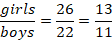
In ratio form, girls: boys=13:11
Thus, the ratio of girls to boys in a class of 48 students is 13 to 11.
Correct Answer is C
Explanation
Explanation: We know that 1 L=1000 mL and to change between L and mL we use the following two options
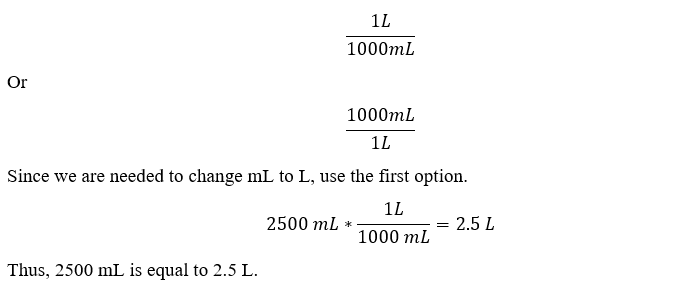

Correct Answer is B
Explanation
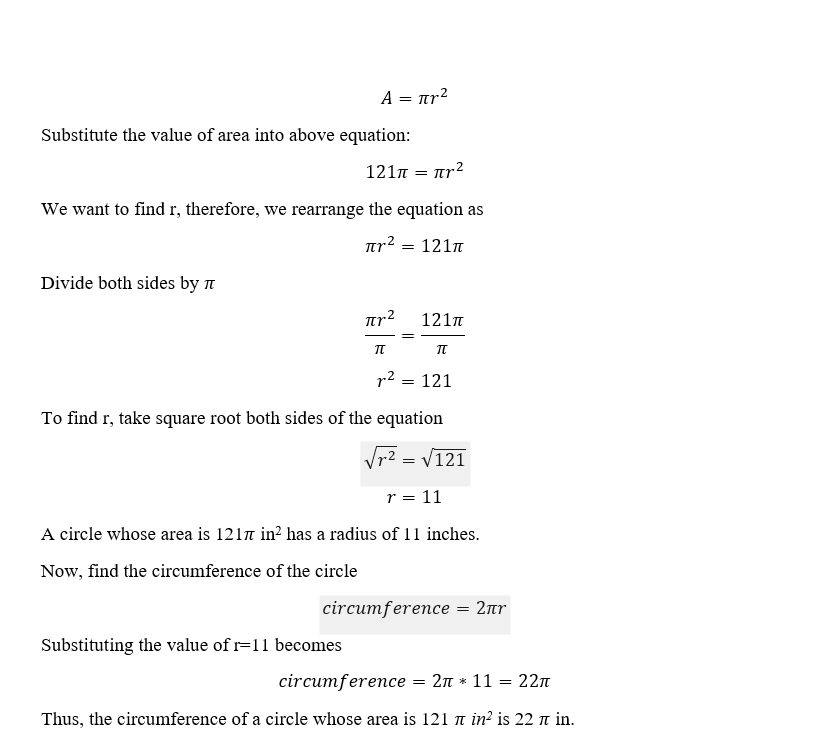
To solve this problem, first find the radius of the circle.
Correct Answer is D
Explanation
: the question requires we find the cost of four syringes.
If we let x be the cost of four syringes, then we set up a proportion equation with cost as numerator and number of syringes as denominator. The proportion equation becomes

Cross-multiply to solve for x


Rearranging the above

Divide both sides of the equation by 55


Thus, the cost of 4 syringes is $48.
Correct Answer is A
Explanation
Correlation of two variables falls into:
Positive correlation: an increase in one variable causes another variable to increase
Negative correlation: an increase in one variable causes another one to decrease
No correlation: a change in one variable does not cause any response in another variable.
From the given choices
Option a is no correlation
Option b is a negative correlation
Option c is a negative correlation
Option d is a positive correlation
Thus, the correct statement is a.
Correct Answer is A
Explanation
The length of the unknown side of the rectangle can be found by using the Pythagoras theorem. Letting the unknown side to be x, the labelled rectangle becomes: The unknown length of the triangle is about 16.7 feet.
The length of the unknown side of the rectangle can be found by using the Pythagoras theorem. Letting the unknown side to be x, the labelled rectangle becomes: 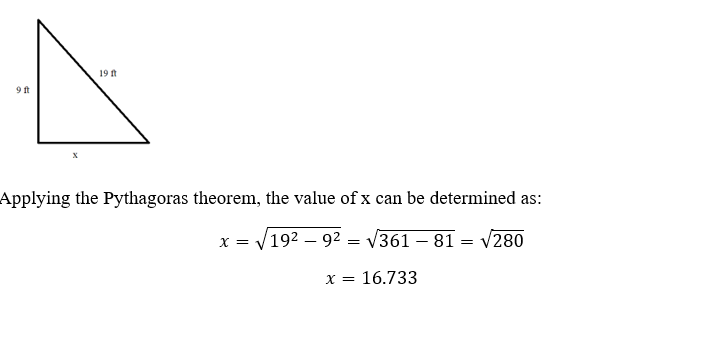
The unknown length of the triangle is about 16.7 feet.
This question was extracted from the actual TEAS Exam. Ace your TEAS exam with the actual TEAS 7 questions, Start your journey with us today
Visit Naxlex, the Most Trusted TEAS TEST Platform With Guaranteed Pass of 90%.
Money back guarantee if you use our service and fail the actual exam. Option of personalised live tutor on your area of weakness.