
The table below shows the miles driven as a function of gallons of gas used, what does the ordered pair (6,144) represent?

The driver can go 24 miles in 1 hour
The driver can go 144 miles with 6 gallons of gas
The driver can go 6 miles with 144 gallons of gas
The driver can go 144 miles in 6 hours
Correct Answer : B
from the provided table, the first option represents the amount of gas in gallons while the second column shows the distance in miles. Thus, (6, 144) will denote that the car can 144 miles by consuming 6 gallons of a gas.
TEAS 7 Exam Quiz Bank
HESI A2 Exam Quiz Bank
Find More Questions 📚
Teas 7 Questions: We got the latest updated TEAS 7 questions
100% Money Refund: 100% money back guarantee if you take our full
assessment pass with 80% and fail the actual exam.
Live Tutoring: Fully customized live tutoring lessons.
Guaranteed A Grade: All students who use our services pass with 90%
guarantee.
Related Questions
Correct Answer is D
Explanation
We solve the problem by first finding the amount of gallons needed for the whole trip then find the cost of the gallon.
The car uses 1 gallon to cover 25 miles, which is same as:

Now, in 3000 miles, the car will use how many gallons of gasoline?

A trip of 3000 miles will need 120 gallons. And to find the cost of 120 gallons, we proceed as follows:

The family will spend $199.20 to drive for 3000 miles.
Correct Answer is B
Explanation
total muffin is equal to the sum of the different muffins sold.
Total muffins=41+27+20=88 muffins
Thus, the bakery sold about 90 muffins.
Correct Answer is A
Explanation
A whole pizza is equivalent to 1. Then
One friend eats half of the pizza=1/2 of 1=1/2*1=1/2
Remaining amount of pizza to be shared=1-1/2=2/2-1/2=1/2
Now, three friends share ½ equally and each friend will get,
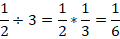
Thus, the three friends each share 1/6.
Correct Answer is B
Explanation
The median temperature can be found by organizing the temperature values from the smallest to the largest value as follows:
98.6, 98.7, 99.0, 99.0,99.2, 99.3, 99.7, 100.0
(for an even set of numbers, Median = frac{(frac{n}{2})th observation + (frac{n}{2} + 1) th observation}{2})
From the data set above, there are 8temperature values. The median is the temperature value in the middle position, which falls between the(frac{n}{2} th)and((frac{n}{2} + 1) th) position. Here N=8and median is found as:
(frac{(frac{n}{2})th + (frac{n}{2} + 1) th}{2} = )(frac{(frac{8}{2})th + (frac{8}{2} + 1) th }{2} = 4.5th position)
The element in the 4.5th position is the average of the 4th and 5th element.
(frac{99.0 + 99.2}{2} = 99.1)
Thus 99.1 is the median temperature.
Correct Answer is D
Explanation
We use the properties of exponent with the same base to solve for above expression.
Multiplication of exponents with same base, we add the exponents

Division of exponents with same base, we subtract the exponents

Using these two properties, we can solve the expression:
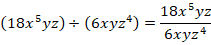

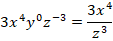
Now we use the following properties:
y0 =1, and , thus
Correct Answer is A
Explanation
We need to find the length of the rectangle from the given area and width of the rectangle. Let L be length if the rectangle. Then,
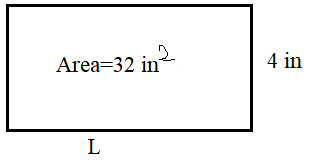
Area of rectangle=Length*width
Substituting area=32 in2 and w=4 inches
32=L*4
32=4L
Divide both sides by 4
32/4=4L/4
8=L
The length of the rectangle is 8 inches.
Correct Answer is D
Explanation
Percentages always add up to 100%. If we let x be the percent of graduates working for jobs unrelated to law, then
74%+3%+2%+x=100%
79%+x=100%
Subtract 79% from both sides of the equation
79%-79%+x=100%
x=100%-79%
x=21%
So, the number of graduates working for jobs unrelated to law is 21%.
Correct Answer is A
Explanation
all products represent 100%. Then, the portion of defect products is:
0.0025 of 100%
‘of’ means multiply
0.0025 *100%=0.25%
Correct Answer is D
Explanation
Looking at the given trend, it is observed that the price increases with years. From 2008 to 2012, the price is fairly constant but we expect it to be more than $130,000 in the year 2016. The expected price in 2016 is $140,000.
Correct Answer is B
Explanation
From the given scenario:
Initial charge is $40
Additional charge per circular cloth=$5c
Additional charge per rectangular cloth=$3.50r
Total cost = additional charge per circular rectangular cloths + Initial charge
Total cost, T = 5c + 3.5r + 40
This question was extracted from the actual TEAS Exam. Ace your TEAS exam with the actual TEAS 7 questions, Start your journey with us today
Visit Naxlex, the Most Trusted TEAS TEST Platform With Guaranteed Pass of 90%.
Money back guarantee if you use our service and fail the actual exam. Option of personalised live tutor on your area of weakness.