
Which of the following is the decimal equivalent of 15/27? (Round your answer to 2 decimal places).
0.56
5.56
3.86
0.36
Correct Answer : A
Using a calculator to evaluate 15÷27 results in 0.5555555556. To two decimal places, the answer becomes 0.56.
Thus, 0.56 is the decimal equivalent of 15/27.
TEAS 7 Exam Quiz Bank
HESI A2 Exam Quiz Bank
Find More Questions 📚
Teas 7 Questions: We got the latest updated TEAS 7 questions
100% Money Refund: 100% money back guarantee if you take our full
assessment pass with 80% and fail the actual exam.
Live Tutoring: Fully customized live tutoring lessons.
Guaranteed A Grade: All students who use our services pass with 90%
guarantee.
Related Questions
Correct Answer is D
Explanation
Given:
- 2 teaspoons of baking powder for every ½ cup of flour.
- We are using 5 cups of flour.
Step 1: Determine how many teaspoons are needed per cup of flour.
Since the recipe calls for 2 teaspoons for every ½ cup of flour, the number of teaspoons required for 1 full cup of flour would be:
2 teaspoons×2=4 teaspoonspercup.
Step 2: Calculate how many teaspoons are needed for 5 cups of flour.
Now, multiply the number of teaspoons needed for 1 cup of flour by 5:
4 teaspoonspercup×5 cups=20 teaspoons.
Thus, the number of teaspoons of baking powder needed for 5 cups of flour is 20 teaspoons.
Therefore, the correct answer is D. 20 tsp.
Correct Answer is B
Explanation
The number of cups of milk to make a bigger batch, we proceed as follows:
First convert the mixed number 1 2/5 as
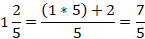
Then, we let the unknown number of cups of milk to be x and we set a proportion equation with number cups of floor as numerator and cups of milk as denominator
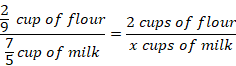
Find the value of x by cross-products


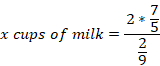
2 as a fraction is 2/1 which is then used to find the product of the numerator as follows.
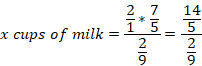
Per means division. The above equation becomes
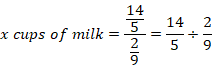
When dividing fractions, we multiply the first fraction with the reciprocal of the second. The reciprocal of 2/9 is 9/2. Thus

The numbers of cups of milk required is 63/5, which when converted to mixed fraction becomes 12 3/5.
Correct Answer is C
Explanation
The polling organization has an average ratio of 2 answered calls for every 15 attempted calls. To find the expected number of answered calls for 150 attempted calls, we can set up a proportion based on this ratio.
Step 1: Set up the proportion
The ratio of answered calls to attempted calls is:
 =
= 
Where x is the number of expected answered calls for 150 attempted calls.
Step 2: Solve for x
Cross-multiply to solve for x:
2×150=15×x
300=15x
X = 
x = 20
Conclusion:
The expected number of answered calls for 150 attempted calls is 20 calls.
The correct answer is C. 20 calls.
Correct Answer is A
Explanation
To find the cheapest option, we find the amount the consume will spend for each option given.:
- 2 packs of Orange and 1 pack of Cream Soda will cost $16+$5= $21
- 3 Packs of Orange will cost $16+$12=$28
- 2 packs of Root Beer and 1 pack of Cream Soda will cost 2($15)+$7=$37
- 5 packs of cream Soda will cost 5($7)=$35
From the above evaluation, the cheapest option will cost the consumer $21. Thus, buying 2 packs of Orange and 1 pack of Cream Soda will be cheaper to purchase compared to other options.
Correct Answer is A
Explanation
Using a calculator to evaluate 15÷27 results in 0.5555555556. To two decimal places, the answer becomes 0.56.
Thus, 0.56 is the decimal equivalent of 15/27.
Correct Answer is B
Explanation
we find the value of x by applying the absolute conditions to the given equation.
First, add 2 to both sides of equation



The absolute conditions are:
If  , a>0, then u=a or u=-a
In this case a=10, which is greater 0.
The first condition becomes

Add 2 to both sides of the equation


Divide both sides by 4


The second condition becomes

Add 2 to both sides of the equation


Divide both sides by 4


Then, the value of x is 3 or -2.
Correct Answer is A
Explanation
A. A=w(2w+1)
Explanation
The area of a rectangle is given by the formula:
A=length×width
Given that the length is one more than twice the width, we can express it as:
Length=2w+1
The width is simply w.
Now, substituting these into the area formula:
A=w(2w+1)
Thus, the correct answer is:
A=w(2w+1)
Correct Answer is C
Explanation
The mean of a data set is the sum of all scores divided by the number of tests.
Total test scores = 83+86+76+88+97 = 430
Number of tests = 5
Mean test score = 430/5 = 86
The mean test score is 86.
Correct Answer is B
Explanation
A histogram is used to visualize the frequency of a one variable over the other while a line graph is used to compare two variables.
A scatter plot used to show the correlation between two variables.
A pie chart is used to show the proportion of the given information in circle, with each section of a circle representing a given fraction of a whole.
From the given information, a pie chart is an appropriate tool show the frequency of the students choosing their favorite color.
Correct Answer is C
Explanation
To convert millilitres (mL) to litres (L), we use the fact that:
1 L=1000 mL
So, to convert 2,500 mL to litres:
 =2.5 L
Thus, the patient needs 2.5 litres of saline.
The correct answer is C. 2.5 L.
This question was extracted from the actual TEAS Exam. Ace your TEAS exam with the actual TEAS 7 questions, Start your journey with us today
Visit Naxlex, the Most Trusted TEAS TEST Platform With Guaranteed Pass of 90%.
Money back guarantee if you use our service and fail the actual exam. Option of personalised live tutor on your area of weakness.