
A client presents to labor and delivery for evaluation. Upon placing her on the monitor you find the fetal heart rate to be consistently 170 to 180 bpm. What should the nurse do first?
Apply a fetal scalp electrode.
Apply oxygen at 10 liters per minute by face mask.
Prepare for cesarean delivery.
Take the mother's temperature.
The Correct Answer is D
A. Apply a fetal scalp electrode: This invasive internal monitor is used for precise heart rate assessment when external tracings are non-reassuring or difficult to obtain. It does not address the underlying etiology of the current fetal tachycardia. Diagnosing the cause of the high heart rate takes priority.
B. Apply oxygen at 10 liters per minute by face mask: Oxygen therapy is an intrauterine resuscitation measure for fetal distress or late decelerations. Tachycardia between 170 to 180 beats per minute is often a compensatory response rather than acute hypoxia. Identifying the maternal trigger for the tachycardia is the first step.
C. Prepare for cesarean delivery: Fetal tachycardia is not an immediate indication for surgical intervention without evidence of a non-reassuring tracing or fetal compromise. Many causes of tachycardia are reversible or treatable through maternal interventions. Unnecessary surgery should be avoided until a full assessment is completed.
D. Take the mother's temperature: Maternal pyrexia is the most common cause of fetal tachycardia as heat is transferred across the placenta. Fever increases the fetal metabolic rate and heart rate to maintain homeostasis. Assessing for infection or dehydration allows for appropriate maternal treatment and stabilization.
Nursing Test Bank
Naxlex Comprehensive Predictor Exams
Related Questions
Correct Answer is C
Explanation
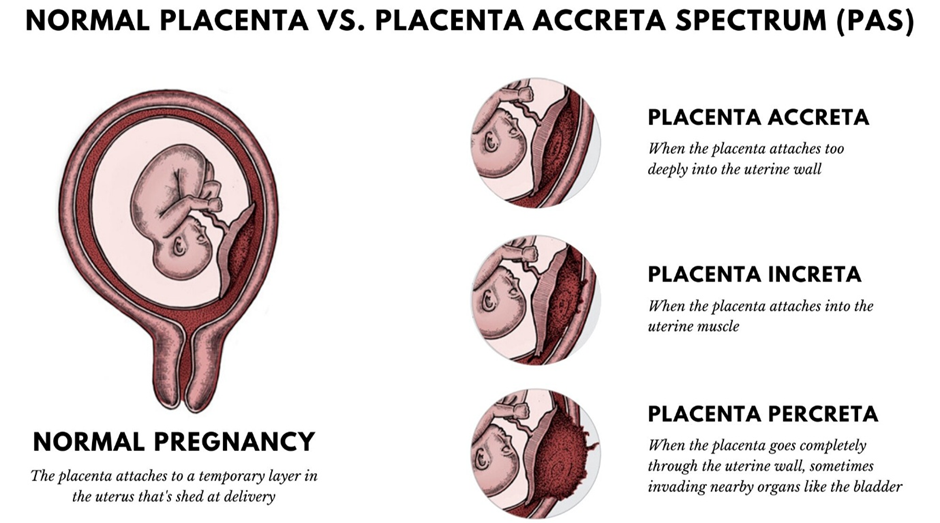
A. Accreta: This refers to the simplest form of morbidly adherent placenta where the chorionic villi attach directly to the myometrium. The placenta does not penetrate the muscle layer but lacks an intervening decidua basalis. It is the most common but least invasive of the three types.
B. Plancreta: This term is not a recognized medical diagnosis in obstetrics or pathology for placental attachment disorders. The standard nomenclature for invasive placentation includes accreta, increta, and percreta based on depth. Using incorrect jargon can lead to clinical errors in surgical planning.
C. percreta: This represents the most severe form of abnormal placentation where villi penetrate through the entire thickness of the myometrium and serosa. The placental tissue can invade adjacent pelvic structures, most commonly the urinary bladder. It carries the highest risk for massive obstetric hemorrhage.
D. increta: In this condition, the placental villi invade deeply into the myometrium but do not breach the outer uterine serosa. While more invasive than accreta, it does not involve the penetration of extrauterine organs like the bladder. It still requires significant surgical management, often a hysterectomy.
Correct Answer is C
Explanation
A. achieving attitude: Attitude describes the degree of flexion or extension of the fetal head. Station refers specifically to the descent of the presenting part along the pelvic axis. These are distinct clinical assessments during a vaginal examination of a laboring patient.
B. reaching ballottement: This term describes a floating fetal part that rebounds when pushed during an examination. A head at +2 station is firmly engaged in the mid-pelvis and is no longer ballotable. It signifies advanced descent rather than a floating or unengaged fetus.
C. below the ischial spines: The ischial spines serve as the zero-point landmark for fetal station. Positive numbers indicate the number of centimeters the presenting part has descended past this point toward the pelvic outlet. A +2 station confirms the head is below the spines.
D. floating above "0" station: Negative numbers are used to indicate that the fetus is still high in the pelvis or floating. A +2 reading is a positive value, meaning the head has passed the midpoint of the pelvis. This confirms the fetus is descending.
Whether you are a student looking to ace your exams or a practicing nurse seeking to enhance your expertise , our nursing education contents will empower you with the confidence and competence to make a difference in the lives of patients and become a respected leader in the healthcare field.
Visit Naxlex, invest in your future and unlock endless possibilities with our unparalleled nursing education contents today