
A client who is NPO has an order for 1000 mL of D5W 0.45% NS with 40 mEq of potassium over 24 hours.
How many mL/h should the IV pump be programmed for?
Math instructions: IV calculations: (rate-mL/hr).
Although some IV pumps do allow calibration to the tenth or hundredth, for the purpose of exams, IV rate calculations will be rounded to the nearest whole number.
42 mL/h.
44 mL/h.
46 mL/h.
48 mL/h.
The Correct Answer is A
The correct answer is A. 42 mL/h.
Choice A: 42 mL/h
Reason: To calculate the IV rate, we use the formula: IV rate (mL/h) = Total volume (mL) ÷ Total time (hours). For this problem, the total volume is 1000 mL and the total time is 24 hours. Therefore, the calculation is 1000 mL ÷ 24 hours = 41.6667 mL/h. When rounded to the nearest whole number, the IV rate is 42 mL/h. This makes 42 mL/h the correct answer.
Choice B: 44 mL/h
Reason: This choice is incorrect because it does not match the calculated IV rate. The calculation of 1000 mL ÷ 24 hours results in 41.6667 mL/h, which rounds to 42 mL/h, not 44 mL/h. Therefore, 44 mL/h is not a valid option based on the given data.
Choice C: 46 mL/h
Reason: This choice is also incorrect. The calculated IV rate of 41.6667 mL/h, when rounded to the nearest whole number, is 42 mL/h. There is no mathematical basis for rounding up to 46 mL/h from 41.6667 mL/h, making this choice invalid.
Choice D: 48 mL/h
Reason: This choice is incorrect as well. The correct calculation yields 41.6667 mL/h, which rounds to 42 mL/h. There is no justification for rounding up to 48 mL/h. This choice does not align with the calculated and rounded IV rate.
Nursing Test Bank
Naxlex Comprehensive Predictor Exams
Related Questions
Correct Answer is A
Explanation
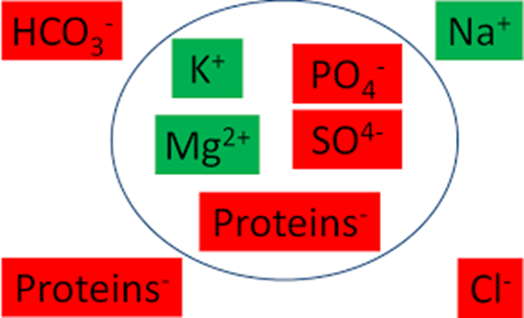
Sodium is the major extracellular electrolyte in the body.
It is responsible for maintaining the extracellular fluid volume, and also for regulation of the membrane potential of cells.
Sodium is exchanged along with potassium across cell membranes as part of active transport.
Choice B is wrong because potassium is mainly an intracellular ion.
It is important for nerve and muscle function, but it is not the predominant electrolyte in the extracellular fluid.
Choice C is wrong because calcium is not the major electrolyte in the extracellular fluid.
Calcium is mostly found in bones and teeth, where it forms a mineral reserve with phosphate.
Calcium also plays a role in muscle contraction, blood clotting, and enzyme activity.
Choice D is wrong because magnesium is not the major electrolyte in the extracellular fluid.
Magnesium is mostly found in bones, where it helps to stabilize the structure of ATP2.
Magnesium also participates in enzyme reactions, nerve and muscle function, and protein synthesis.
Correct Answer is B
Explanation
This is a priority nursing intervention for a client with acute kidney injury (AKI) because it helps to assess the renal function and fluid status of the client. Urine output is also an indicator of the response to treatment and the need for further interventions.
Choice A is wrong because pain medication is not a priority intervention for AKI unless the client has other conditions that cause pain.
Pain medication may also have adverse effects on the kidney function and should be used with caution.
Choice C is wrong because ambulation is not a priority intervention for AKI and may not be appropriate for a client who is fluid overloaded or hypotensive.
Ambulation may also increase the risk of falls and injury in a client who is confused or fatigued.
Choice D is wrong because assisting with meals is not a priority intervention for AKI and may not be necessary for a client who has adequate oral intake.
A client with AKI may also have dietary restrictions such as low protein, low potassium, low sodium, and low phosphorus, which should be considered when providing meals.
Whether you are a student looking to ace your exams or a practicing nurse seeking to enhance your expertise , our nursing education contents will empower you with the confidence and competence to make a difference in the lives of patients and become a respected leader in the healthcare field.
Visit Naxlex, invest in your future and unlock endless possibilities with our unparalleled nursing education contents today