
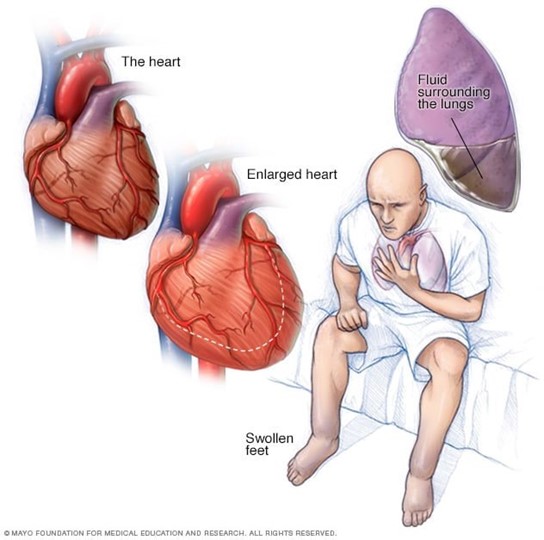
A nurse is providing discharge teaching to a client who has a new diagnosis of heart failure. Which of the following instructions should the nurse include in the teaching?
Exercise at least three times per week.
Notify the provider of a weight gain of 0.5 kg (1 lb) in a week.
Take diuretics early in the morning and before bedtime.
Take naproxen for generalized discomfort.
The Correct Answer is A
a. This is appropriate as regular, moderate exercise can help improve cardiovascular health and functional capacity in clients with heart failure. It is essential to discuss appropriate types and levels of exercise based on the individual’s condition.
b. This is incorrect because clients should be instructed to notify the provider if they gain 1 kg (2.2 lbs) in one day or 2 kg (4.4 lbs) in one week. A weight gain of 0.5 kg is not typically a threshold for concern.
c. Take diuretics early in the morning and before bedtime is wrong because it may disrupt the client's sleep patern and cause nocturia. The nurse should advise the client to take diuretics early in the morning and avoid taking them in the evening or at night, unless prescribed otherwise.
d. Take naproxen for generalized discomfort is wrong because naproxen is a nonsteroidal anti-inflammatory drug (NSAID) that can worsen heart failure by causing sodium and water retention, increasing blood pressure, and reducing the effectiveness of diuretics and other heart failure medications. The nurse should advise the client to avoid NSAIDs and use acetaminophen or other alternatives for pain relief, as prescribed by the provider.
Nursing Test Bank
Naxlex Comprehensive Predictor Exams
Related Questions
Correct Answer is D
Explanation
Hypokalemia is a low serum potassium level, usually below 3.5 mEq/L. It can be caused by diuretics that increase potassium excretion, such as thiazides or loop diuretics. Potassium is essential for normal muscle and nerve function, and hypokalemia can impair cardiac, skeletal, and smooth muscle activity. Symptoms of hypokalemia include fatigue, weakness, muscle cramps, arrhythmias, constipation, and hyporeflexia.
- Dyspnea is difficulty or labored breathing that can be caused by various respiratory or cardiac conditions, such as asthma, pneumonia, pulmonary edema, or heart failure. It is not a specific sign of hypokalemia, although severe hypokalemia can affect respiratory muscle function and cause respiratory failure.
- Oliguria is a reduced urine output, usually less than 400 mL per day or 30 mL per hour. It can be caused by various renal or fluid balance disorders, such as acute kidney injury, dehydration, or shock. It is not a specific sign of hypokalemia, although severe hypokalemia can impair renal function and cause renal failure.
- Pitting edema is a swelling of the tissues that leaves an indentation when pressed with a finger. It can be caused by various fluid retention disorders, such as heart failure, liver cirrhosis, or nephrotic syndrome. It is not a specific sign of hypokalemia, although severe hypokalemia can affect fluid and electrolyte balance and cause edema.
Correct Answer is D
Explanation
Taking one tablet at the first indication of chest pain is the correct way to use SL nitroglycerin tablets, as they are fast- acting and can relieve anginal symptoms within minutes. The client should place the tablet under the tongue and let it dissolve.
Taking one tablet at the first indication of chest pain is the correct way to use SL nitroglycerin tablets, as they are fast- acting and can relieve anginal symptoms within minutes. The client should place the tablet under the tongue and let it dissolve.
Taking this medication after each meal and at bedtime is not appropriate, as SL nitroglycerin tablets are not meant for routine or prophylactic use, but only for acute episodes of angina.
Taking one tablet every 15 min during an acute attack is not correct, as the client should not exceed three doses in 15 min. If the pain is not relieved after three doses, the client should seek emergency medical attention.
Taking this medication with 8 ounces of water is not necessary, as SL nitroglycerin tablets do not need to be swallowed or washed down with water. They should be dissolved under the tongue for optimal absorption.
Whether you are a student looking to ace your exams or a practicing nurse seeking to enhance your expertise , our nursing education contents will empower you with the confidence and competence to make a difference in the lives of patients and become a respected leader in the healthcare field.
Visit Naxlex, invest in your future and unlock endless possibilities with our unparalleled nursing education contents today