
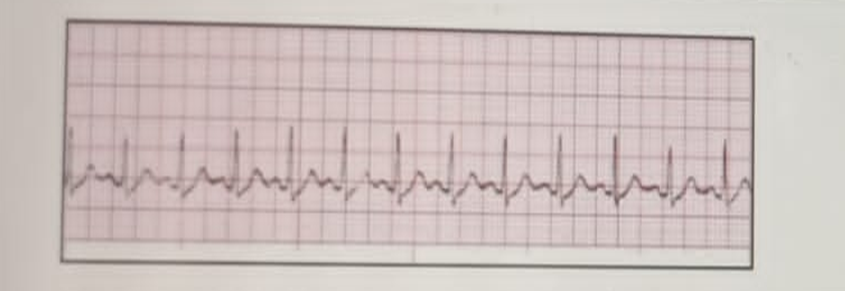
An older adult client comes to the emergency department stating, "My heart is beating out of my chest." Based on this electrocardiogram (ECG) rhythm strip, which intervention should the nurse implement?
Assess oxygenation status.
Administer IV atropine.
Prepare for a transcutaneous pacemaker.
Administer IV heparin infusion.
The Correct Answer is A
A. Assess oxygenation status: Palpitations and a rapid heart rate indicate tachycardia as evidenced by sinus tachycardia shown in the strip. The first nursing priority is to assess oxygenation, as hypoxia can trigger or worsen arrhythmias. Supplemental oxygen may be needed based on this assessment.
B. Administer IV atropine: Atropine is used to treat symptomatic bradycardia, not tachycardia. In this case, where the heart is racing, and ECG shows tachycardia, atropine would not be appropriate and could worsen the condition by increasing the heart rate further.
C. Prepare for a transcutaneous pacemaker: Transcutaneous pacing is indicated for unstable bradyarrhythmias, especially complete heart block or symptomatic sinus node dysfunction. It is not appropriate for a client who is experiencing tachycardia.
D. Administer IV heparin infusion: Heparin is an anticoagulant used to prevent or treat blood clots. It is not a primary intervention for managing sinus tachycardia. While some cardiac conditions might involve heparin, it's not the immediate and direct intervention for the rhythm shown or the patient's primary complaint of palpitations.
Nursing Test Bank
Naxlex Comprehensive Predictor Exams
Related Questions
Correct Answer is D
Explanation
A. Accelerated junctional rhythm: An accelerated junctional rhythm originates in the AV junction (40-100 bpm), typically has absent, inverted, or hidden P waves (before, during, or after QRS), and a regular rhythm. This strip has clear, upright P waves, an irregular rhythm, and a lengthening PR interval.
B. Premature atrial contractions (PAC): PACs are single ectopic beats that occur earlier than expected, originating in the atria. While they involve P waves, they don't show a pattern of progressively lengthening PR intervals or dropped beats in the characteristic Wenckebach pattern.
C. Atrial fibrillation (A-fib): Atrial fibrillation is characterized by irregularly irregular R-R intervals, chaotic atrial activity with no discernible P waves, and a variable ventricular rate. This strip clearly shows discernible P waves.
D. Wenckebach, Mobitz Type I atrioventricular (AV) block: This rhythm is defined by a progressive lengthening of the PR interval until a QRS complex is dropped. The cycle then repeats. This is what is observed in the ECG strip.
Correct Answer is A
Explanation
A. Obtain hemoglobin and hematocrit levels: A PTT of 152 seconds is significantly elevated, indicating a high risk of spontaneous bleeding. Monitoring hemoglobin and hematocrit helps detect internal or occult bleeding early.
B. Measure and record the client's IV fluid intake: While maintaining hydration is important, fluid intake does not directly address the risk associated with excessive anticoagulation. It is a routine measure, not a priority in this context.
C. Compare pedal pulse volume bilaterally: Assessing pedal pulses is important for evaluating perfusion, but it does not directly relate to the current risk of bleeding from excessive anticoagulation. It would be more relevant in the initial PE assessment.
D. Perform guaiac tests on the client’s next stools: Testing for occult blood is helpful in identifying gastrointestinal bleeding. However, waiting for the next bowel movement could delay detection. Hemoglobin and hematocrit offer more immediate insight into bleeding risk.
Whether you are a student looking to ace your exams or a practicing nurse seeking to enhance your expertise , our nursing education contents will empower you with the confidence and competence to make a difference in the lives of patients and become a respected leader in the healthcare field.
Visit Naxlex, invest in your future and unlock endless possibilities with our unparalleled nursing education contents today