
How do neurons communicate with each other?
Through electrical signals only
Through chemical signals only
Through electrical and chemical signals
Through mechanical signals only.
The Correct Answer is C
Neurons communicate with each other through both electrical and chemical signals.
The electrical signal, or action potential, runs from the cell body area to the axon terminals, through a thin fibre called axon.
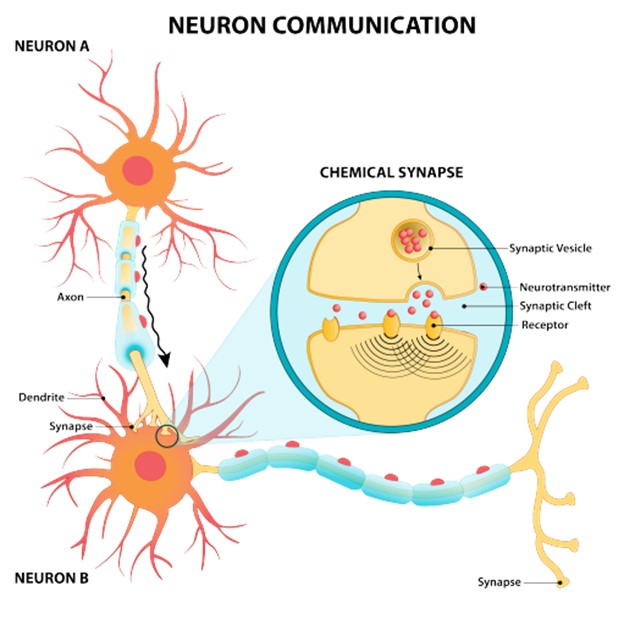
Neurons also communicate with one another at junctions called synapses. At a synapse, one neuron sends a message to a target neuron—another cell.
Most synapses are chemical; these synapses communicate using chemical messengers.
Choice A is incorrect because neurons communicate not only through electrical signals but also through chemical signals.
Choice B is incorrect because neurons communicate not only through chemical signals but also through electrical signals.
Choice D is incorrect because neurons do not communicate through mechanical signals.
Nursing Test Bank
Naxlex Comprehensive Predictor Exams
Related Questions
Correct Answer is A
Explanation
The Golgi apparatus is a membrane-bound organelle that is responsible for transporting, modifying, and packaging proteins and lipids into vesicles for delivery to targeted destinations.
Choice B is incorrect because mitochondria are responsible for energy production.
Choice C is incorrect because ribosomes are responsible for protein production.
Choice D is incorrect because the endoplasmic reticulum is responsible for lipid production and protein production, but not for modifying, sorting and packaging proteins and lipids.
Correct Answer is B
Explanation
Using a placebo group and a double-blind technique for giving the medications is the best way to ensure that the study is valid and reliable.
A placebo group helps control for the placebo effect, which can influence the results of a study.
A double-blind technique means that neither the patients nor the researchers know which medication is being given, reducing bias.
Choice A is not the best answer because while a large sample size and standardized procedure can increase reliability, they do not address validity.
Choice C is not the best answer because a matched-pairs design and crossover technique are useful for reducing variability but do not address validity.
Choice D is not the best answer because a convenience sample may not be representative and a pretest-posttest design does not control for extraneous variables.
Whether you are a student looking to ace your exams or a practicing nurse seeking to enhance your expertise , our nursing education contents will empower you with the confidence and competence to make a difference in the lives of patients and become a respected leader in the healthcare field.
Visit Naxlex, invest in your future and unlock endless possibilities with our unparalleled nursing education contents today